 EV Charger Scout
The United States has committed $5 billion to building a national EV charging backbone through the National Electric Vehicle Infrastructure program — NEVI for short. On paper, it's the most ambitious public charging investment in American history. In practice, 2026 has exposed just how difficult it is to spend that money. Buy America manufacturing requirements, state-level disputes, and a shifting political environment have slowed the buildout considerably compared to original projections. Here's a clear-eyed look at where NEVI stands, what the domestic content rules actually mean, and what it signals for anyone planning to own or charge an EV in the years ahead.
What NEVI Actually Is
NEVI was established by the Infrastructure Investment and Jobs Act (IIJA) signed into law in November 2021. The program allocates $5 billion over five years to states, which apply through the Federal Highway Administration (FHWA) to fund DC fast charging stations along designated Alternative Fuel Corridors — primarily major Interstate highways.
The core requirement is straightforward: NEVI-funded stations must be located within one mile of an Interstate interchange, spaced no more than 50 miles apart, capable of simultaneously charging at least four vehicles at 150 kW or higher per port, and open 24 hours. Every NEVI station must offer NACS and CCS connectors — the two dominant DC fast charging standards in North America — and must accept credit card payment without an app or membership.
All 50 states, the District of Columbia, and Puerto Rico have submitted and received approval for NEVI state plans. The theory was that by late 2025 or 2026, a reliable network of high-power chargers would line every major highway corridor in the country. That hasn't happened at the pace originally anticipated.
The Buy America Problem
The IIJA included federal Buy America requirements for infrastructure projects. For NEVI, this translates into a mandate that EV charging equipment funded by the program must be manufactured in the United States — specifically that all iron, steel, and manufactured products used in the construction of a charging station must be produced domestically.
When NEVI launched, no domestic EV charger manufacturing supply chain capable of meeting demand at scale existed. The major DC fast charger suppliers — ABB, BTC Power, Tritium, Signet, and others — relied heavily on components sourced from Asia, particularly power electronics and connector hardware from suppliers in China, South Korea, and Taiwan.
The FHWA issued a waiver allowing non-domestically-manufactured equipment temporarily, with a phased compliance schedule:
| Milestone | Requirement |
|---|---|
| Program launch (2022) | Broad waiver — any equipment permitted |
| July 2023 | At least one major component manufactured in the US |
| July 2024 | 55% domestic content requirement for manufactured products |
| Ongoing (2025–2026) | Full compliance expected; waiver extensions case-by-case |
The transition has been messier than the table suggests. Manufacturers scrambled to establish or expand US production. Tritium, an Australian company, opened a factory in Lebanon, Tennessee. BTC Power operates a facility in California. ABB accelerated assembly operations in South Carolina. However, many components — particularly the power semiconductor modules at the heart of a fast charger's electronics — remain difficult to source domestically at competitive cost and at the volumes NEVI demands.
States that deployed NEVI-funded chargers using equipment that later fails domestic content audits risk having to return federal funding or face project disqualification. This risk has made some state DOTs cautious about award decisions, contributing to slower-than-expected station deployments.
Home Charging Upgrade · EV Shop

Emporia Universal Dual EV Charger
Best Value Universal — UL + ETL Certified, NACS & J1772 Dual Connector
* Amazon affiliate link — EV Charger Scout may earn a small commission at no extra cost to you.
Why 2026 Is the Critical Year
The original NEVI projections had the program well into its buildout phase by 2026. The reality looks more like a program still working through its procurement and compliance machinery. Several factors converged in 2025 and 2026:
- →Administration change — The Trump administration took office in January 2025 with a different posture toward EV-specific mandates. Executive orders froze portions of IIJA and Inflation Reduction Act spending temporarily, including some NEVI disbursements. Courts partially blocked those freezes, and most NEVI funding ultimately remained committed, but the legal uncertainty delayed state award processes by months in several cases.
- →Domestic content audits — FHWA began conducting stricter reviews of Buy America compliance certifications from charger manufacturers. Several suppliers discovered that components they believed qualified as "domestically manufactured" did not meet the standard under closer examination. Requalification processes slowed the pipeline of approved equipment.
- →Bidding complexity — States procuring NEVI-funded stations have found the bid process significantly more complex than a standard construction contract. Bidders must document the domestic origin of components, maintain records for potential audits, and price projects accounting for Buy America compliance — which typically adds 15–30% to equipment costs compared to non-compliant alternatives.
- →Site acquisition — Identifying, securing, and permitting sites that meet NEVI's one-mile, 50-mile-spacing requirements has proven slower than anticipated. Private landowners along highway corridors can demand high lease rates once the program's requirements become known, and environmental and utility permitting timelines vary widely by state.
NEVI funding flows through state DOTs, not directly to charging companies. If you want to track which NEVI-funded stations have actually opened near you, FHWA maintains a public dashboard at the Alternative Fuels Station Locator — and EV Charger Scout's database pulls from NREL, which aggregates this data.
What's Actually Been Built
Progress has been uneven by state. As of early 2026, states that moved earliest through their procurement processes — Colorado, Ohio, Utah, and Michigan among them — have operational NEVI stations on multiple corridors. States that faced political hesitancy about EV mandates or ran into procurement challenges are significantly behind.
The overall station count across the country from NEVI funding remains well below the original 2026 projections. Some industry analysts who initially projected 4,000–5,000 NEVI-funded ports by end of 2026 have revised those estimates down to 1,500–2,500, with the majority of the $5 billion still in various stages of state procurement, contracting, or construction.
This doesn't mean public DC fast charging isn't expanding — Tesla Supercharger expansion continues independently, as do EVgo, Electrify America, ChargePoint, and the new Ionna network. NEVI is one major funding stream among several, not the whole picture.
How Charger Manufacturers Are Responding
The Buy America push has triggered meaningful domestic manufacturing investment, even if compliance timelines have slipped. Several developments are reshaping the US charger supply chain:
- →Tritium (Tritium Tennessee) — Tritium's Lebanon, TN facility became one of the first purpose-built US EV charger factories specifically designed for NEVI compliance. The plant produces RT175 and RT50 units. Production ramp has been slower than the company initially projected, but the facility is operational.
- →ABB E-mobility — ABB has expanded assembly and final-stage manufacturing in South Carolina, working toward compliance for its Terra series DC fast chargers. ABB's global component supply chain remains complex, but US assembly operations bring products closer to compliance thresholds.
- →Signet EV — US-based, with manufacturing in Houston, Texas. Signet has been positioned as a strong NEVI-compliant option and has secured multiple state contracts. Their pricing advantage disappears somewhat when factoring in compliance documentation overhead, but delivery lead times have been competitive.
- →BTC Power — California-based with manufacturing in Rancho Dominguez. Active in multiple NEVI state programs, particularly in Western states where proximity reduces logistics overhead.
- →New entrants — The NEVI opportunity has attracted interest from manufacturing companies outside the traditional EV charger space — defense contractors and industrial equipment manufacturers exploring the sector. Several have announced US-made charger programs, though most remain in pre-production stages as of 2026.
The International Comparison
The US isn't the only country wrestling with how to mandate domestic manufacturing in a global EV supply chain. The dynamics are different elsewhere, but the underlying tension is similar.
European Union — AFIR
The EU's Alternative Fuels Infrastructure Regulation (AFIR) mandates fast charging stations every 60 km on the Trans-European Transport Network (TEN-T) core network, with 150 kW minimum capability. The EU does not have a "Buy Europe" requirement equivalent to NEVI's Buy America rules — member states fund and procure through national programs, and most charger procurement is open to global suppliers. The result has been faster hardware deployment (Ionity, Fastned, and others have moved relatively quickly) but less leverage to develop a domestic European charger manufacturing sector.
Several European governments are now considering procurement preferences for EU-manufactured charging hardware as part of broader industrial policy goals, but as of 2026 these remain proposals rather than enforceable requirements.
United Kingdom
The UK's Electric Vehicle Infrastructure Strategy targets 300,000 public charge points by 2030. Rapid charging fund grants exist for high-power charger deployment at motorway service areas. The UK does not impose domestic content requirements on charging equipment post-Brexit, and most UK-deployed hardware is sourced from European and Asian manufacturers.
Australia
Australia's National EV Strategy includes funding through the Future Fuels Fund and state-level programs for public charging. No domestic content requirement exists — the market is primarily served by Tritium (Australian-headquartered, US-manufactured), Evie Networks, and Chargefox, with hardware sourced globally. Australia's geography makes corridor charging particularly challenging, and the government's funding focus has been on closing regional gaps rather than manufacturing origin.
DC Fast Charging Upgrade · EV Shop
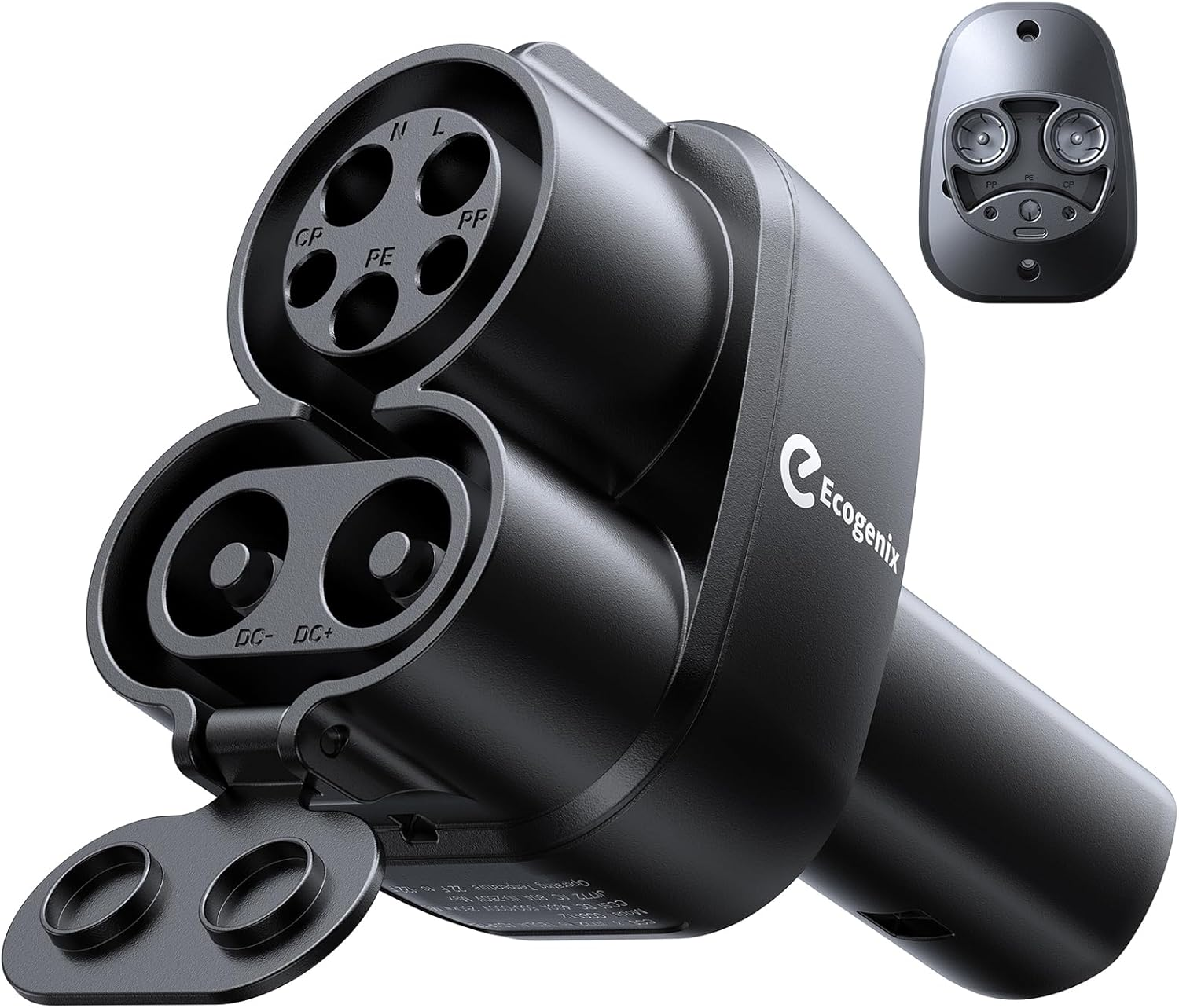
Ecogenix 2-in-1 CCS & J1772 to NACS Adapter
One Adapter, Two Standards — CCS DC Fast + J1772 Level 2
* Amazon affiliate link — EV Charger Scout may earn a small commission at no extra cost to you.
South Korea and Japan
Both countries have national fast charger programs through government-linked entities. South Korea's Ministry of Environment operates a national charging network alongside private operators. Japan's CHAdeMO-heavy infrastructure has been transitioning toward CCS2 for new deployments, driven by export market alignment pressure from automakers. Both countries have implicit preference for domestically manufactured hardware, driven by industrial policy rather than legal requirements.
What This Means for EV Drivers Right Now
If you're driving in the US today and planning a long-haul trip, NEVI-funded stations may or may not exist at the corridors you need. Using EV Charger Scout or PlugShare alongside your vehicle's navigation gives you the most current picture — new stations are opening regularly, but coverage is patchy enough that trip planning still matters.
The bigger practical implication of NEVI's slower-than-expected rollout is that the networks already operating — Tesla Supercharger, EVgo, Electrify America, Ionna, ChargePoint DCFC — remain the primary public charging infrastructure for the foreseeable future. Their expansion plans don't depend on NEVI timelines.
On any road trip corridor you're not familiar with, filter your route by DC Fast Charger and check station reviews and recent check-ins. NEVI stations, when operational, must meet strict uptime requirements — but non-NEVI stations have no such obligation, and reliability varies significantly by operator.
Home Charging as Your NEVI Hedge
The clearest takeaway from the NEVI situation is that public fast charging infrastructure build-out will continue to be slower and more uneven than the original roadmap suggested. For most EV owners, this reinforces the case for doing the majority of charging at home.
A Level 2 home charger (240V, 32–48A) can fully recharge most EVs overnight — adding 40–60 km/25–37 miles of range per hour. For day-to-day driving, public DC fast charging becomes optional rather than essential. You arrive home, plug in, and wake up to a full battery. Road trips still require public infrastructure, but your daily charging need is completely decoupled from the NEVI timeline.
If you haven't yet installed a Level 2 charger at home, it's one of the highest-return investments an EV owner can make. Installation typically costs $200–800 for labor (depending on panel proximity and permit requirements), plus the charger hardware. Many US states and utilities offer rebates that partially offset the cost. The federal Section 30C Alternative Fuel Vehicle Refueling Property Credit (claimed on Form 8911) still covers 30% of home charger installation costs up to $1,000 for residential installations in qualifying low-income or non-urban census tracts — but the One Big Beautiful Bill Act (OBBBA) accelerated the sunset of 30C, and the credit is no longer available for property placed in service after June 30, 2026 (originally 2032 under the IRA). Confirm your address against the IRS 30C eligibility map and your placed-in-service date before counting on it.
Looking for a home Level 2 charger that works with any EV — NACS or J1772? The EV Charger Scout shop has vetted options for every setup, including dual-connector chargers that work with all EV types without an adapter.
Will NEVI Recover?
The $5 billion is appropriated — it doesn't expire if unspent by a particular date, and the funding has largely survived legal challenges. States will continue working through their procurement processes. The Buy America requirements, while slowing deployment, are also creating real domestic manufacturing capacity that didn't exist in 2021. By 2027–2028, the domestic supply chain should be significantly more mature, and deployment pace should accelerate as procurement and compliance processes become routine rather than novel.
The most realistic scenario is a NEVI network that builds toward its original vision on a two-to-three year delay — meaningful coverage of major Interstate corridors by 2028 rather than 2026, with rural and secondary highway coverage extending into the early 2030s.
For the rest of the world, the NEVI experience is an object lesson in how industrial policy requirements interact with infrastructure deployment timelines. The EU, UK, and Australia are watching closely — and some are drawing the conclusion that procurement neutrality (no domestic content requirements) gets infrastructure built faster, while the US approach is a longer-term bet on building domestic manufacturing capacity simultaneously.
EV Charger Scout pulls live station data from NREL and OpenChargeMap so you can see which DC fast chargers — NEVI-funded or otherwise — are currently active near you. Filter by connector type to match your vehicle.
Frequently Asked Questions
What is the NEVI program?
NEVI — the National Electric Vehicle Infrastructure program — was created by the Infrastructure Investment and Jobs Act signed in November 2021. It allocates $5 billion over five years to states to fund DC fast charging stations along designated Alternative Fuel Corridors, mainly major Interstate highways. Funded stations must sit within one mile of an interchange, be spaced no more than 50 miles apart, charge at least four vehicles at 150 kW or higher, offer both NACS and CCS, and accept credit-card payment without an app.
What are the Buy America rules for NEVI chargers?
Buy America requires that EV charging equipment funded by NEVI be manufactured in the United States, with all iron, steel, and manufactured products produced domestically. Because no domestic charger supply chain existed at scale when NEVI launched, the FHWA issued a phased waiver — moving from a broad allowance in 2022, to one major US-made component in July 2023, to a 55% domestic content requirement in July 2024.
Why has NEVI been slower than expected?
Several factors converged: a 2025 administration change that temporarily froze some IIJA spending until courts intervened, stricter FHWA audits of Buy America compliance that forced suppliers to requalify components, bidding complexity that adds roughly 15–30% to equipment costs, and slow site acquisition and permitting. Some analysts cut their 2026 projections from 4,000–5,000 ports down to 1,500–2,500.
Which states have built the most NEVI stations?
States that moved earliest through procurement — including Colorado, Ohio, Utah, and Michigan — have operational NEVI stations on multiple corridors. States that faced political hesitancy about EV mandates or ran into procurement challenges are significantly behind. Overall, the national count remains well below the original 2026 projections.
Should I rely on NEVI stations for my charging needs?
Not exclusively. NEVI is one funding stream among several, and the networks already operating — Tesla Supercharger, EVgo, Electrify America, Ionna, and ChargePoint — remain the primary public infrastructure. For day-to-day driving, installing a Level 2 home charger (240V, 32–48A) that recharges most EVs overnight decouples your routine from the NEVI timeline.
More guides on Policy & Infrastructure
Explore the full Policy & Infrastructure topic hub — related guides that build on this one.