 EV Charger Scout
"Public EV charging stations near me" — that search has been typed hundreds of millions of times in the past year, and it's not slowing down. The number of EVs on the road has grown faster than most predictions, and the question drivers ask most isn't "should I go electric?" anymore. It's "where do I charge right now, and will the charger actually work when I get there?" This guide answers that question properly — with the tools, the data, and the real-world knowledge that closes the gap between a hopeful search and a successful charging session.
Whether you're a new EV owner figuring out your routine or a long-time driver who's tired of apps that show outdated information, this is a complete rundown of what's available in 2026, how to use it, and which tools are actually worth your time.
Why "Near Me" Searches Have Taken Over EV Conversations
The shift is simple: there are now more than 9 million public charging points worldwide. The US alone has crossed 200,000 public ports. Europe tops 700,000. Asia-Pacific adds hundreds of thousands more. On paper, the infrastructure is there. In practice, the challenge is no longer "does a charger exist?" — it's "which one is compatible with my car, available right now, and not a total gamble?"
That's why location-aware search has become the dominant behavior. Drivers don't browse charging maps for fun; they search when they need to act. The table below shows the most-searched EV charging phrases globally in 2026 — and what they reveal about what drivers actually need.
| Search Phrase | What the Driver Actually Needs |
|---|---|
| EV charging stations near me | A fast, location-aware list of what's close and working |
| EV chargers near me | Same intent — quick discovery before deciding on a route |
| Find EV charging stations near me | A tool that narrows results to compatible options |
| Electric vehicle charging stations near me | Broader search, often from newer EV owners |
| Real-time EV charging stations | Live port availability — not stale map data |
| Best EV charging apps 2026 | App comparison — which tool to trust and download |
| EV charger finder | Simple discovery tool, no account required |
| Public EV chargers near me | Specifically public — not workplace or home |
| Tesla charging stations near me | Supercharger locations, sometimes including Magic Dock access |
| Free EV charging stations near me | Budget-conscious drivers seeking zero-cost top-ups |
Every phrase on that list reflects a driver with a real need. The tools that serve them well are the ones that answer the question quickly, accurately, and with the right context for that driver's car. Most apps answer maybe half of that. A few answer all of it.
Real-Time EV Charging Tools: What's Available and How They Compare
There are dozens of apps and map tools for finding EV chargers. Here are the ones that actually matter in 2026, and what each one does best.
PlugShare
PlugShare is the crowd-sourced standard for EV charging maps. Drivers check in when they charge, leaving comments that tell you whether a station is actually working, whether the lot is accessible, and whether there's a payment issue. For verifying a specific station before you drive to it, the recent check-in stream is invaluable. The weakness is that PlugShare shows everything — compatible and incompatible — without any real-time live port status. You're relying on driver reports, not sensor data.
ChargePoint App
ChargePoint has one of the largest networks of Level 2 workplace and public chargers in North America and Europe. Their own app shows live availability for ChargePoint-managed stations with solid accuracy. The limitation is obvious: it only shows ChargePoint equipment, so you're blind to everything else.
Electrify America
Electrify America's app is the right tool for initiating a session at an Electrify America DC fast charger. It shows real-time stall availability at EA locations and handles payment and session monitoring. It covers EA stations only, and the app's station discovery features outside of that network are minimal.
Google Maps
Google Maps shows EV chargers as a layer on the map, pulling data from multiple sources. It's useful for a quick glance and works well when you're already navigating. But it doesn't filter by your vehicle's connector type, doesn't show live port-level availability in most markets, and doesn't tell you whether a station is actually working today. It's a starting point, not a complete solution.
EV Charger Scout — The Standout
EV Charger Scout at evchargerscout.com does something the others don't: it knows your car. Set up your vehicle once — it supports 600+ EV models from Tesla, Kia, Hyundai, Rivian, Ford, GM, BMW, Mercedes, Polestar, and virtually every other brand — and every station search automatically filters to show only the connectors your specific vehicle can use. No more arriving at a DC fast station that turns out to be CHAdeMO-only when your car needs CCS. The app knows, before you drive there.
It draws from 500,000+ stations across 60+ countries, updated continuously, and overlays real-time live port status (available vs. in-use vs. out of service) from TomTom sensor data at participating stations. It's free — no subscription, no account required. Available on the web, iOS, and Android, and it runs natively in the Tesla in-car browser without any workarounds.
Inside EV Charger Scout: A Feature-by-Feature Look
Rather than describing it in abstract terms, here's exactly what the app looks like in use.
The Station List: Filters That Actually Work
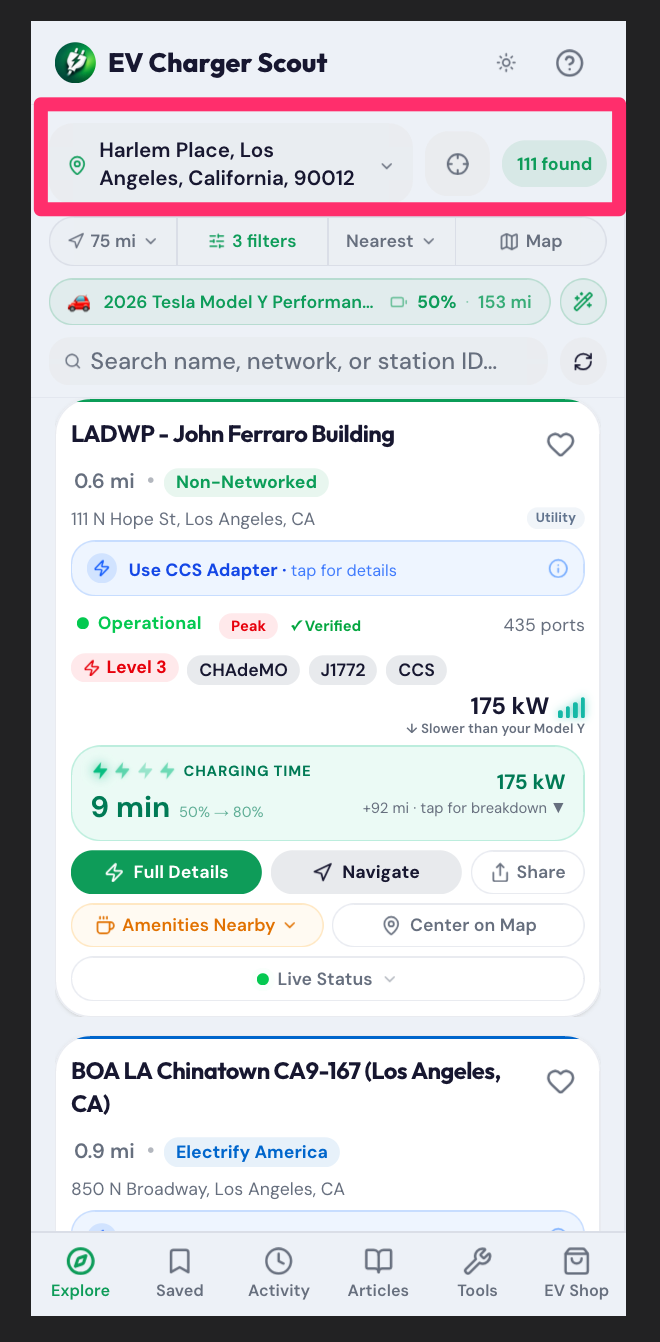
The main station list shows results near your location — in this case, 111 stations found in the Los Angeles area within 75 miles. The filter bar at the top gives you instant control over search radius, sort order, and the full filter panel. Each station card shows the distance, network name, address, connector types, charging speed in kW with a visual speed tier bar, estimated charging time for your vehicle, and quick-action buttons for directions, sharing, and amenities. Everything you need to decide whether to go — without opening a separate detail view.
Quick Setup Wizard — Getting Personalized in 60 Seconds
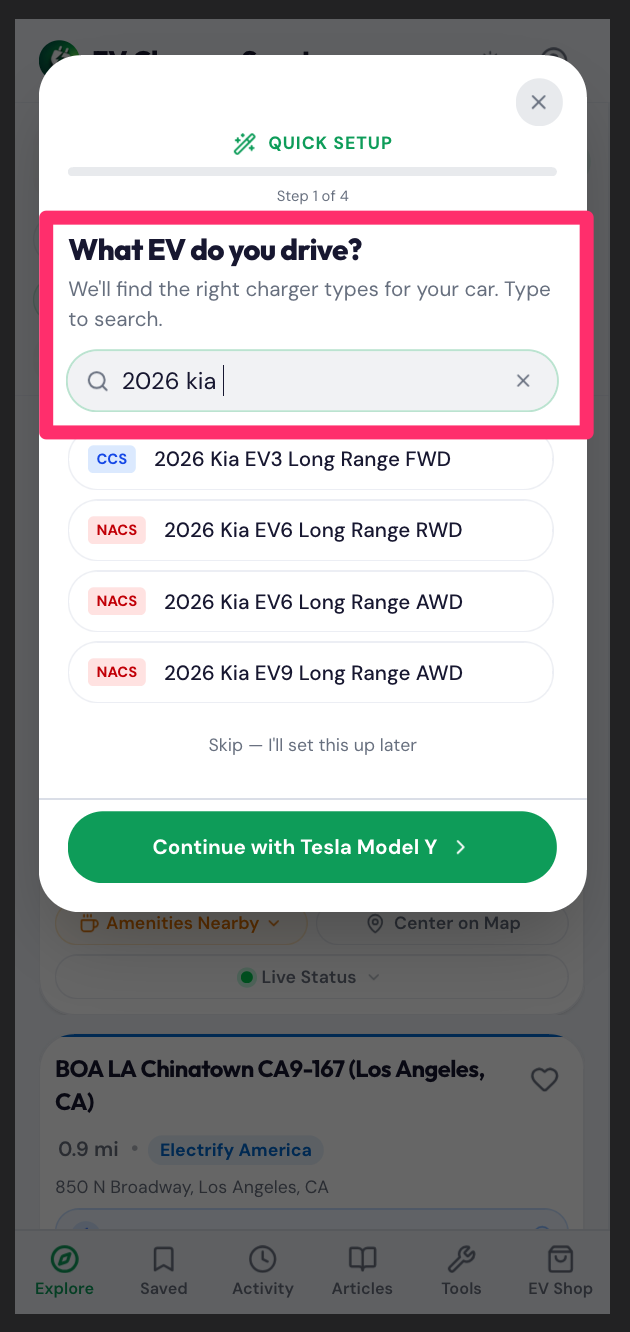
The first time you open EV Charger Scout, the Quick Setup Wizard walks you through four steps to personalize the experience. Step one: what EV do you drive? Type any part of the model name and it surfaces matching vehicles with their connector types labeled (NACS, CCS, CHAdeMO, GB/T). The wizard is why the app can immediately show connector-compatible stations — it's not a generic map that treats every EV the same.
Vehicle & Compatibility Filtering
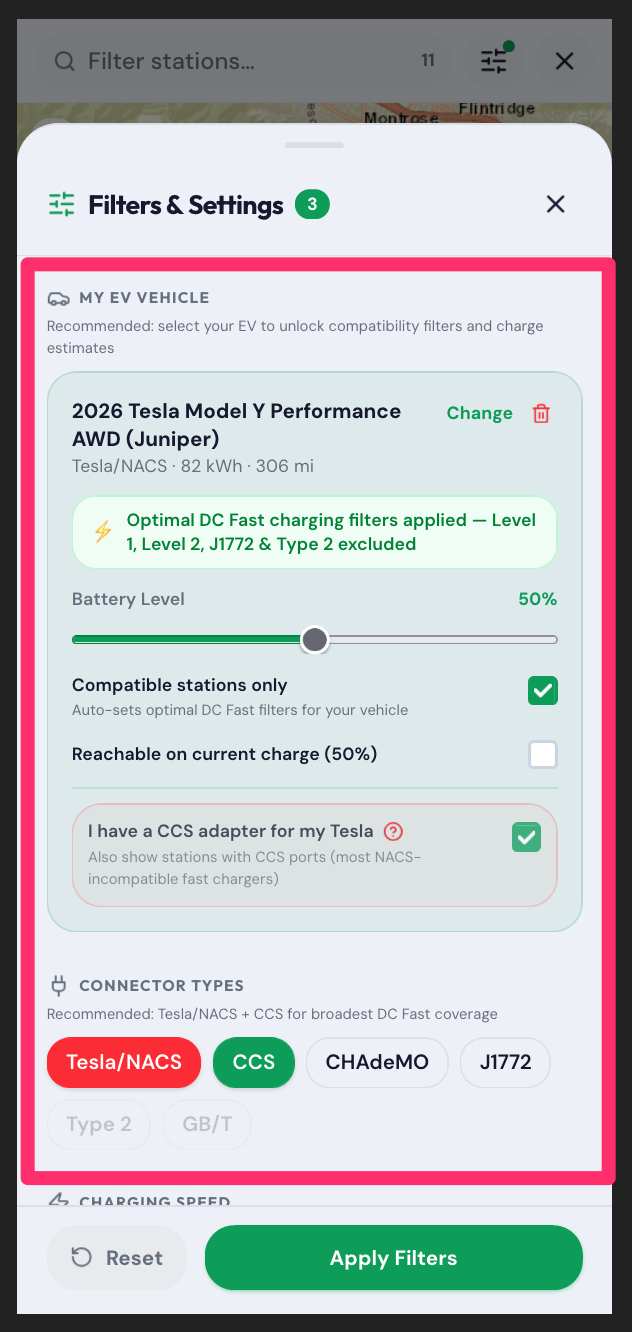
The Filters & Settings panel shows your selected EV and the filters it automatically applies. With a 2026 Tesla Model Y Performance selected, the app knows to filter for NACS and CCS-compatible DC fast stations, exclude J1772 and Type 2 (incompatible for DC fast charging on this vehicle), and flag the battery level slider so it can calculate whether a station is actually reachable on your current charge. There's even a toggle for "I have a CCS adapter for my Tesla" — which expands results to include CCS1 fast chargers, since an adapter makes them compatible.
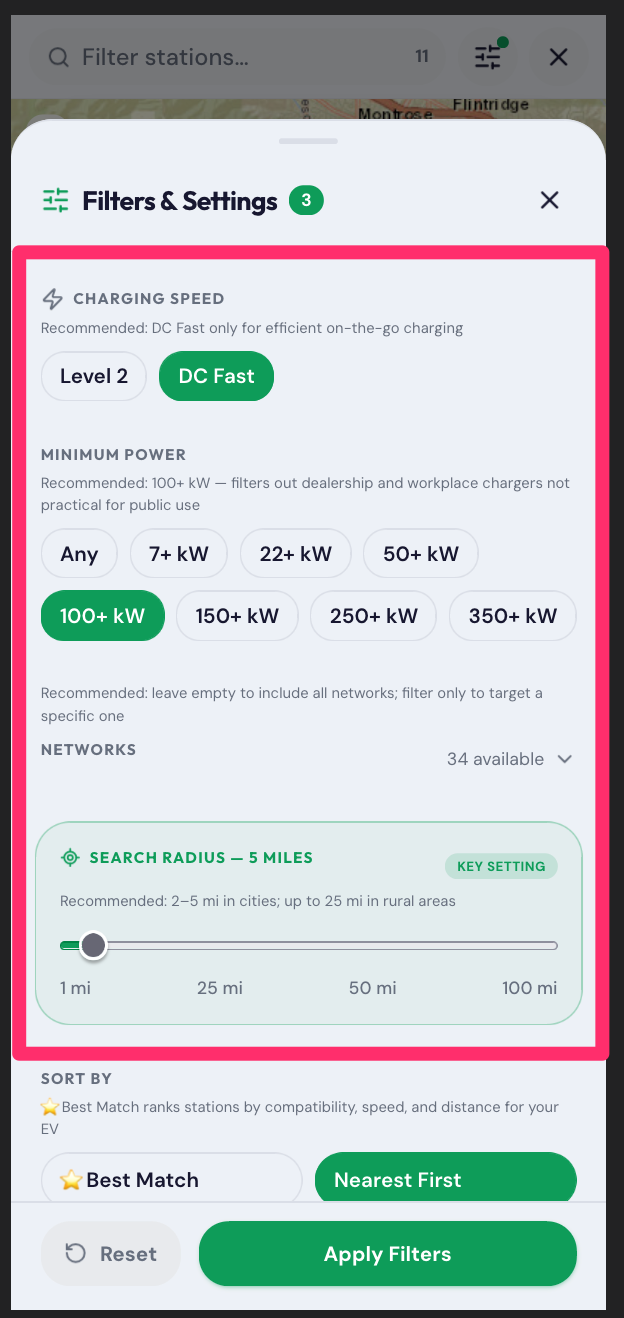
The charging speed filter lets you set a minimum power threshold — from Any all the way up to 350+ kW for ultra-fast stations only. The search radius slider goes from 1 to 100 miles (or kilometers, your choice). The Networks dropdown has 34 selectable networks so you can target or exclude specific ones. Sort options include Best Match (compatibility + speed + distance), Nearest First, Highest Power, Most Ports, Best Rated, and Price.
For day-to-day use, "Best Match" is the smartest sort order — it ranks stations by how well they suit your vehicle and current situation, not just raw distance. A 100 kW station 0.3 miles away beats a 350 kW station 0.8 miles away if your car caps out at 150 kW anyway.
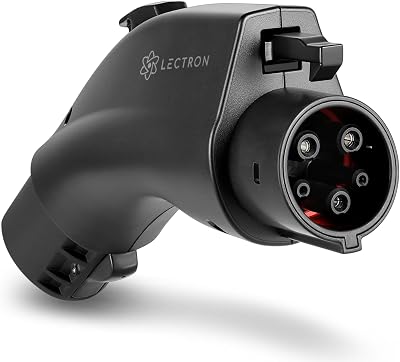
Lectron Vortex Plus NACS-to-CCS Adapter
The Gold Standard — UL 2252 Certified with Safety Interlock
* Amazon affiliate link — EV Charger Scout may earn a small commission at no extra cost to you.
Real-Time Live Port Status
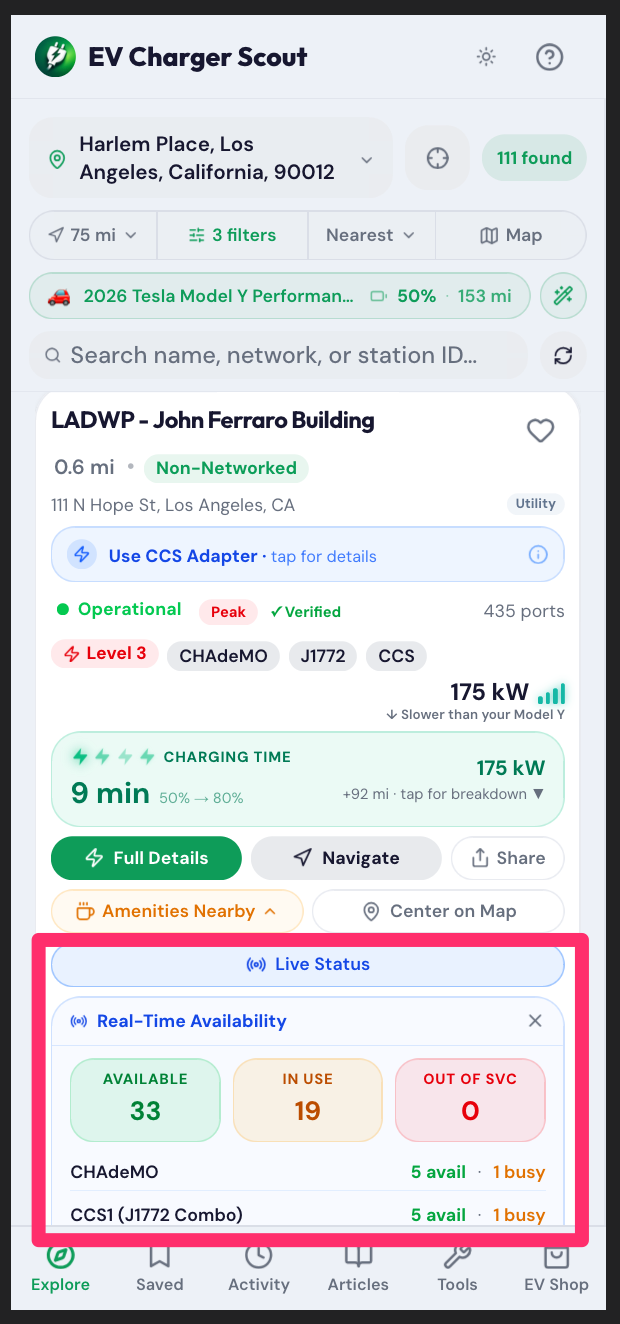
This is the feature that separates EV Charger Scout from static map tools. The Live Status panel pulls real-time sensor data from TomTom at participating stations and shows exactly how many ports are available, in use, and out of service — broken down by connector type. In this example: 33 ports available, 19 in use, 0 out of service at the LADWP John Ferraro Building in Los Angeles. CHAdeMO shows 5 available, 1 busy. CCS1 shows 5 available, 1 busy. That's actionable information you can use to decide whether to head there now or wait.
Charging Time Estimates — Personalized to Your Car
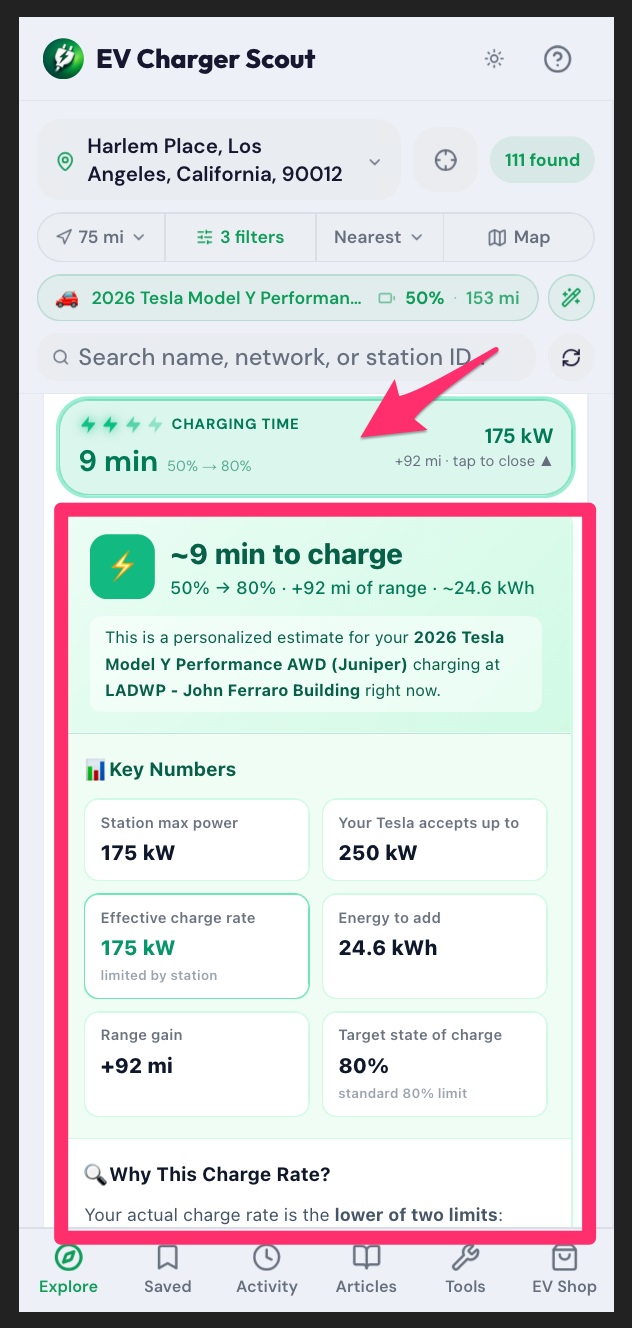
Tap the charging time display on any station card and you get a full breakdown: estimated time to charge from your current battery level to 80%, the effective charge rate (the lower of what the station delivers and what your car accepts), energy added in kWh, and range gained. This isn't a generic estimate — it's calculated for your specific EV at the specific station you're looking at, right now. In this example, a 2026 Tesla Model Y Performance at a 175 kW station charges from 50% to 80% in approximately 9 minutes, adding around 92 miles of range and 24.6 kWh. That's the kind of number you need to plan a stop.
Map View with Live Station Pins
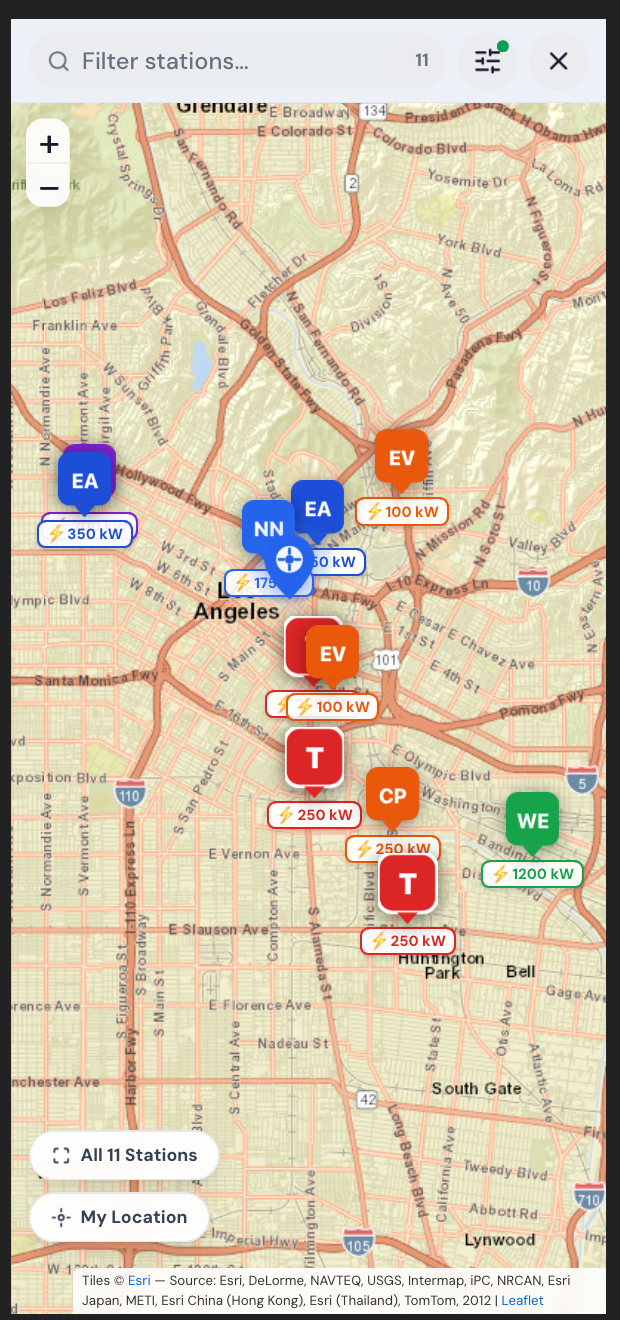
The map view plots all filtered stations on an interactive map. Each pin shows the network abbreviation (EA = Electrify America, T = Tesla Supercharger, CP = ChargePoint, WE = Webasto, NN = non-networked) and the maximum power output in kW. Tap any pin to see a station summary popup with real-time port counts, connector breakdown, address, distance, and quick-access buttons for directions, full details, and sharing. The map is fully zoomable and pans smoothly — and it works well in the Tesla in-car browser.
Amenities Nearby
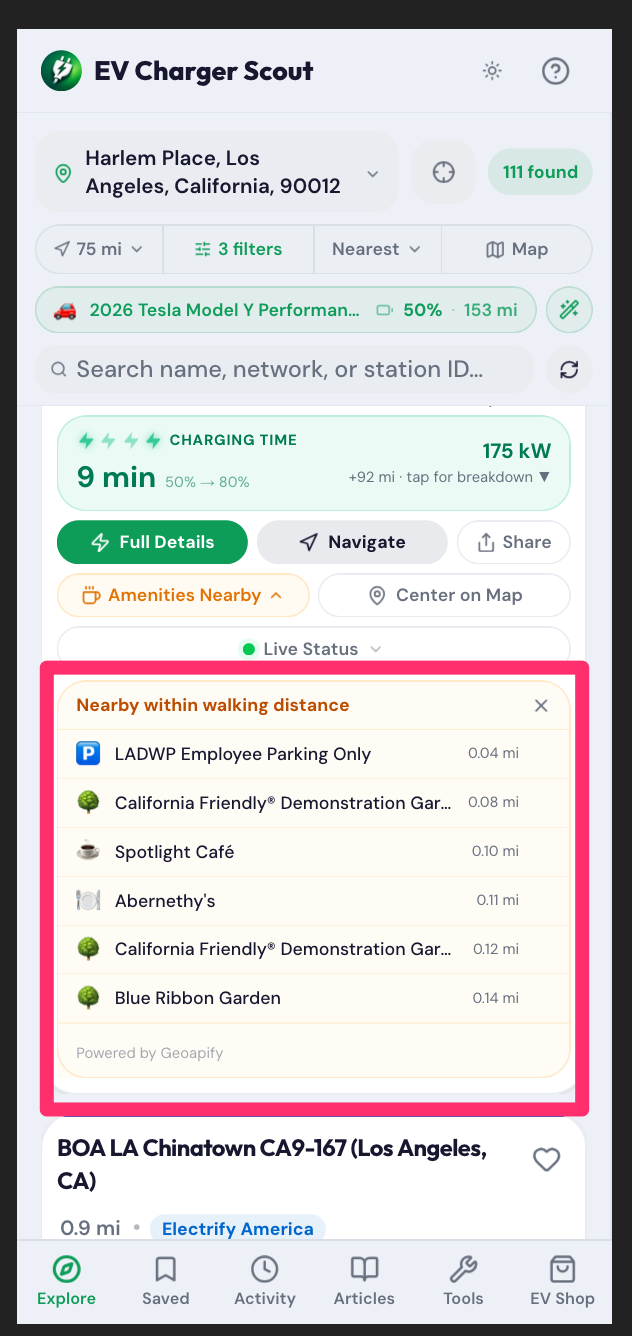
Charging takes time, so knowing what's walkable from the station matters. Tap "Amenities Nearby" on any station card and a panel loads showing places within walking distance — cafés, restaurants, parks, grocery stores — pulled from live map data with distances accurate to the meter. This is especially useful at DC fast stations where a 20–30 minute top-up is a perfect excuse to grab a coffee. No app-switching, no separate Google Maps search.
International Region Support
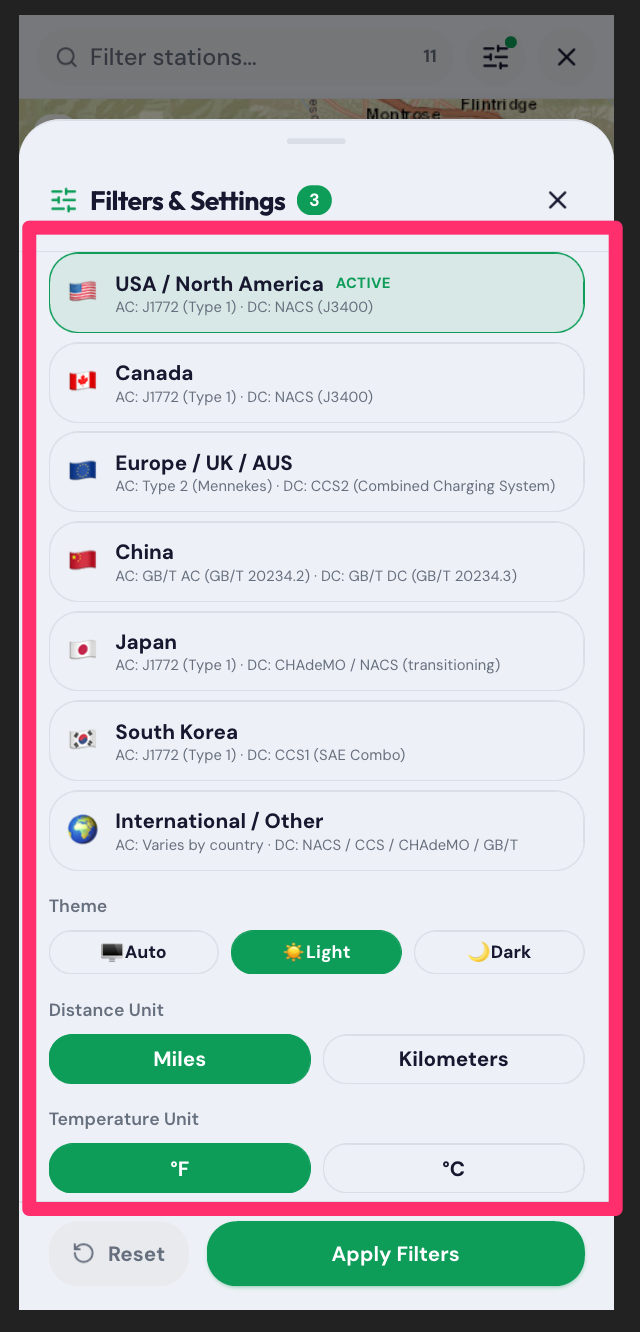
EV Charger Scout isn't a North American tool with some international data bolted on — it's built for global use from the ground up. The region selector in Filters & Settings covers USA/North America, Canada, Europe/UK/AUS, China, Japan, South Korea, and an International/Other setting for everywhere else. Each region automatically applies the correct connector standards: Type 2 / CCS2 for Europe, GB/T for China, CHAdeMO and NACS (transitioning) for Japan, CCS1 (SAE Combo) for Korea. Distance units switch between miles and kilometers. Temperatures between °F and °C. Set your region once and the filters match your local charging reality.
10 Free EV Tools — Built Right In
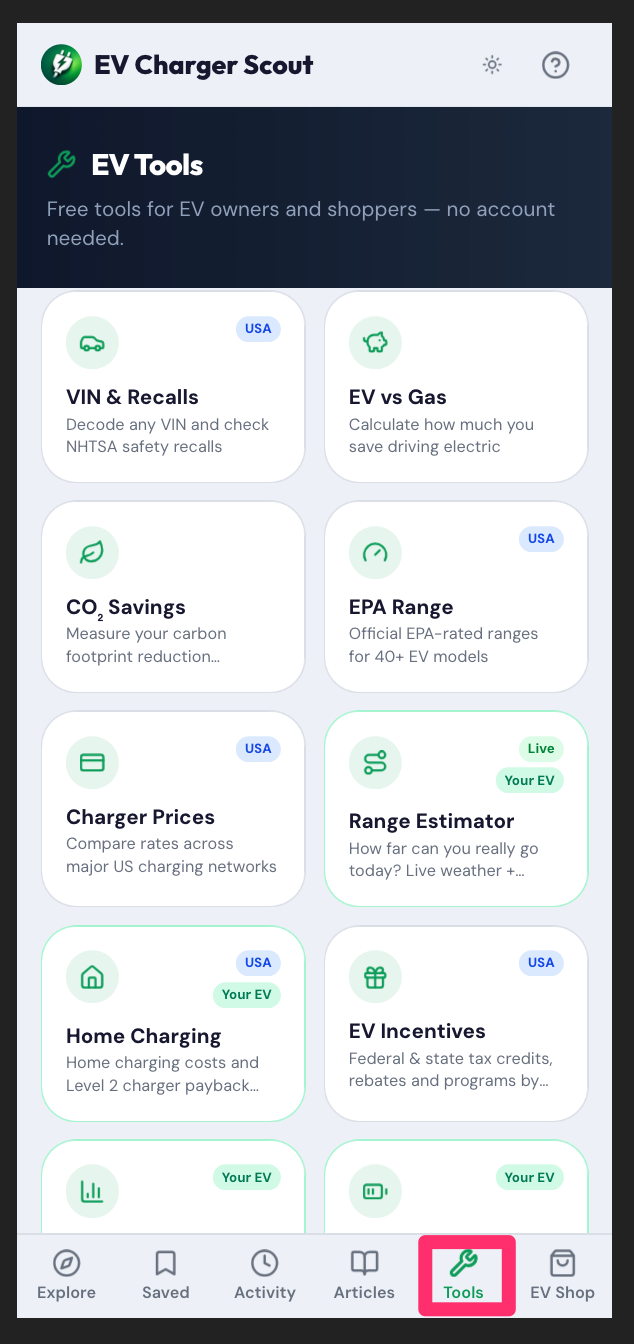
Beyond station finding, EV Charger Scout includes a full tools hub with 10 free utilities: VIN & Recall Lookup (decode any VIN and check NHTSA safety recalls), EV vs Gas Calculator (actual cost savings at current prices), CO₂ Savings Tracker, EPA Range Lookup for 40+ models, Charger Prices comparison across US networks, a live Range Estimator that factors in real weather at your location, Home Charging cost calculator, EV Incentives guide covering federal and state credits, and two more personalized tools. All free, no account needed.
Understanding Public EV Charging Costs and Speeds in 2026
Charging costs and speeds vary enormously depending on the charging level, network, country, and time of day. Here's a practical breakdown to help you evaluate any station you find.
| Charging Level | Typical Speed | Real-World Use | Typical Cost (2026) |
|---|---|---|---|
| Level 1 (AC) | 5–15 km / 3–10 mi per hour | Overnight at accommodation or trickle top-up | Often free at hotels; ~$0.10–$0.20/hr where metered |
| Level 2 (AC) | 25–100 km / 15–65 mi per hour | Shopping, work, hotel, errand stops | $0.20–$0.50/kWh; some free (retail, workplace) |
| DC Fast (50–150 kW) | 150–400 km / 90–250 mi per hour | Quick top-ups on the road | $0.30–$0.50/kWh; some per-minute pricing |
| Ultra-Fast DC (250+ kW) | 400–800+ km / 250–500+ mi per hour | Highway stops, long-distance travel | $0.35–$0.55/kWh; premium network pricing |
Pricing structures vary by network. Some charge per kilowatt-hour (kWh), which rewards faster-accepting vehicles. Others charge per minute, which can penalize slower-charging vehicles at high-power stations. A few use a combination. In Europe, per-kWh pricing is standard under AFIR regulations that took effect in 2024. In North America, per-minute pricing is still common at some networks but per-kWh is gaining ground. In China, per-kWh pricing is universal.
At some retailers (Whole Foods, Target, Ikea, Walmart), at many workplaces, and as promotional incentives from some automakers (certain Hyundai, Kia, and GM purchases included charging credits). Filter by "free" on PlugShare or use EV Charger Scout's network filter to target non-networked stations, which are often free or low-cost utility-operated chargers.

ChargePoint Home Flex
Best J1772 — Up to 50A, Energy Star Certified, Any Non-Tesla EV
* Amazon affiliate link — EV Charger Scout may earn a small commission at no extra cost to you.
Practical Tips for Successful Public Charging Every Time
- →Don't arrive below 10%. Arrive between 15–30% state of charge. It reduces stress, gives you flexibility if a charger is occupied, and most DC fast chargers deliver peak speed in the 20–80% range anyway — so there's no advantage to arriving nearly empty.
- →Charge to 80%, not 100%, at DC fast stations. Charging slows dramatically above 80% to protect the battery. Going from 80% to 100% at a public DC charger can take as long as 20% to 80%. Stop at 80% unless you genuinely need the extra range for your next leg.
- →Check live status before you leave. Use EV Charger Scout's Live Status feature or the network's own app to confirm ports are available before you drive across town. A 30-second check saves a potentially 20-minute wasted trip.
- →Have a backup station in mind. Especially at high-traffic routes and events, have a plan B. Know the next-closest compatible station before you arrive at your first choice.
- →Watch for idle fees. Most networks charge a fee per minute if you leave your car plugged in after charging completes. Electrify America charges $0.40/min after a grace period. Tesla Supercharger idle fees activate when the station is at capacity. Move your car promptly.
- →Carry the right adapter if your car needs one. In North America, CCS1 vehicles can now access Tesla Superchargers via Magic Dock at select stations, or with a NACS-to-CCS adapter at open NACS stalls. Teslas can access CCS fast chargers with an adapter. Knowing this before a trip is the difference between having 50 fast charging options and having 200.
- →In Europe and internationally: CCS2 (Type 2 combo) is the standard DC fast connector across Europe, UK, and Australia. CHAdeMO is still active in Japan and at some European stations but is declining. GB/T is the standard in mainland China — non-GB/T vehicles need an adapter. Multi-standard chargers are common at premium European highways (IONITY, Fastned, Shell Recharge).
Not all stations listed on any map are functional. Equipment faults, network outages, and payment terminal issues affect even the best-maintained networks. Always check recent driver reports (PlugShare check-ins) or live status (EV Charger Scout) before relying on a single station for a critical charge stop — especially in less urban areas where the next option may be 30+ miles away.
Finding the Right Station in Any Country
The "near me" problem looks different depending on where you are. Here's the regional reality of public EV charging in 2026:
| Region | Coverage | Primary Fast Connector | Key Networks |
|---|---|---|---|
| USA / Canada | 200,000+ public ports; excellent along major highways | NACS (Tesla), CCS1 | Tesla Supercharger, Electrify America, EVgo, ChargePoint, Ionna |
| Europe / UK | 700,000+ public points; strong motorway coverage | CCS2 (Type 2 Combo) | IONITY, Fastned, Shell Recharge, BP Pulse, Osprey, EnBW |
| Australia | Rapidly expanding; strong in major cities and east coast | CCS2 | Chargefox, NRMA, Evie Networks, Tesla Supercharger |
| China | World's largest network; dense in cities | GB/T DC | TGOOD, Star Charge, State Grid, NIO Power |
| Japan | Wide but transitioning; CHAdeMO declining | CHAdeMO → NACS | Nippon Charge Service, e-Mobility Power, Tesla Supercharger |
| South Korea | Dense in cities; growing highway network | CCS1 (SAE Combo) | Korea Charging Service, EV Infra, ChargeEV |
| India / Southeast Asia | Growing rapidly; urban-centric coverage | CCS2, GB/T, AC Type 2 | Tata Power EV, Ather Grid, various national operators |
EV Charger Scout covers all of the regions above under one interface. Switch your region setting and the app immediately adjusts connector filters, station data, and distance units to match where you are — whether that's California, the M1 in England, Tokyo's Ring Road, or the highways of South Korea.
Start Smarter: The Search That Actually Works
Searching "public EV charging stations near me" is the right instinct. The results you get depend entirely on which tool you're using to answer it. Generic maps give you dots on a screen. Network-specific apps give you one piece of the puzzle. EV Charger Scout gives you the full picture: 500,000+ stations worldwide, filtered to your car's connectors, with live availability, personalized charge time estimates, nearby amenities, and 10 free tools — all in one place, all for free.
Open it at evchargerscout.com on any device, set up your vehicle in under 60 seconds, and every station you see from that point forward is one that will actually work for your car. That's the difference between a map and a tool that understands what you're actually looking for.
Frequently Asked Questions
How do I find EV charging stations near me?
Use a real-time charging map that filters by your car's connector and shows live availability, charging speed, and pricing. EV Charger Scout aggregates hundreds of thousands of stations worldwide and lets you filter by connector type and power level so you only see stalls your car can actually use.
How much does public EV charging cost in 2026?
It varies by network, location, and speed. Level 2 public charging is relatively inexpensive per kWh, while DC fast charging costs more — often two to three times your home rate. Some networks also add session or idle fees, so check the price before you plug in.
How can I tell if a charging station is available before I drive there?
Look for tools that show real-time port status. Live availability tells you whether stalls are open, in use, or out of service, which saves you from arriving at a fully occupied or broken station. Availability data depends on the network reporting it, so treat it as a strong guide rather than a guarantee.
What should I check before starting a public charging session?
Confirm the connector matches your car, the charging speed is what you expect, the price is acceptable, and the stall is actually working. Having the network's app installed and payment set up in advance makes the session faster and less stressful.
Can I find charging stations when traveling in other countries?
Yes — a good global charging map covers stations across regions and different connector standards (NACS/J1772/CCS1 in North America, Type 2/CCS2 in Europe, GB/T in China). Filter by the connector and adapter you'll have with you so the results stay relevant abroad.
More guides on App Guides
Explore the full App Guides topic hub — related guides that build on this one.