 EV Charger Scout
Most CCS1-to-Supercharger adapters on the market are stub units — a compact block of metal and plastic that bridges your car's port to the NACS charger cable. They work well in ideal conditions, but real-world Supercharger stalls are not always ideal. Cables hang at angles that don't cooperate with where your port sits. The charger cable is tethered, short, and you're pulling it across a wheel arch or past a body panel to make the connection. That mechanical stress on a rigid stub adapter — repeated over dozens of sessions — is not great for the connector pins, the latch mechanism, or your car's port.
EVBASE's NACS-to-CCS1 Adapter with Extension Cable takes a different approach. Instead of a rigid stub, it includes a short but meaningful length of flexible cable between the NACS plug (which connects to the Supercharger cable) and the CCS1 connector end (which goes into your vehicle). That cable absorbs angle stress, gives you extra reach when you need it, and makes the whole charging process noticeably less awkward at stations with stiff or short tethered cables. This review covers the full picture: specs, real-world use, vehicle compatibility, safety features, and how it fits into the current Supercharger access landscape worldwide.
What This Adapter Actually Is
The EVBASE NACS-to-CCS1 Extension Adapter is designed specifically for CCS1-equipped EVs that want to charge at Tesla Supercharger stations — either through the built-in Magic Dock hardware (which Tesla began installing at select US stations in 2023) or at open Supercharger stalls equipped with NACS cables.
The connection path is straightforward: the NACS connector on the adapter plugs into the Supercharger cable coming out of the station pedestal. The CCS1 connector on the other end plugs into your vehicle's CCS1 charging port. The extension cable in between — the part that makes this product different from a stub — is a short, heavy-gauge flexible assembly that handles the electrical load while absorbing the mechanical angle differences between the charger cable and your port.
EVBASE is a California-based EV accessories company trusted by over 200,000 EV and Tesla owners worldwide, known for engineering-focused products including carbon fiber panels, spoilers, and now this adapter designed for CCS1 drivers who want Supercharger access.
Full Specifications
| Specification | Detail |
|---|---|
| Product type | NACS-to-CCS1 extension adapter cable |
| Input connector | NACS (SAE J3400) — plugs into Tesla Supercharger cable |
| Output connector | CCS1 (Combined Charging System Type 1) — plugs into your EV |
| Maximum current | 350A |
| Maximum voltage | 1,000V DC |
| Peak theoretical power | 350 kW |
| Thermal protection | Automatic shutoff at 185°F (85°C) |
| Cable design | Extension cable for flexible reach and angle absorption |
| Compatible networks | Tesla Supercharger (Magic Dock units and open NACS stalls) |
| Use case | CCS1 vehicles at Tesla Superchargers — DC fast charging only |
| Locking mechanism | Positive interlock on both connector ends |
| Warranty | 1 year |
The 350A / 1,000V rating gives this adapter a theoretical ceiling of 350 kW — comfortably above what any current CCS1 consumer EV accepts and above what any current Supercharger V3 stall delivers to a single vehicle (V3 peaks at 250 kW per stall). The headroom matters: an adapter running at its rated limit is a thermal risk. One running at 70–80% of its limit stays cool and lasts longer.
EVBASE NACS to CCS1 Adapter with Extension Cable
Max 350A/1000V with Extension Cable — Charge CCS1 EVs at Tesla Superchargers
* EVBASE affiliate link (via AWIN) — EV Charger Scout may earn a small commission at no extra cost to you.
The Extension Cable Advantage
If you've tried to charge a CCS1 vehicle at a Supercharger using a compact stub adapter, you may have noticed that some stalls require you to wrestle the tethered charger cable into position. Supercharger cables are engineered around Tesla's own vehicles and hang at angles suited to Tesla port locations — which are not always aligned with where a Ford, Rivian, Hyundai, or Nissan puts its CCS1 port.
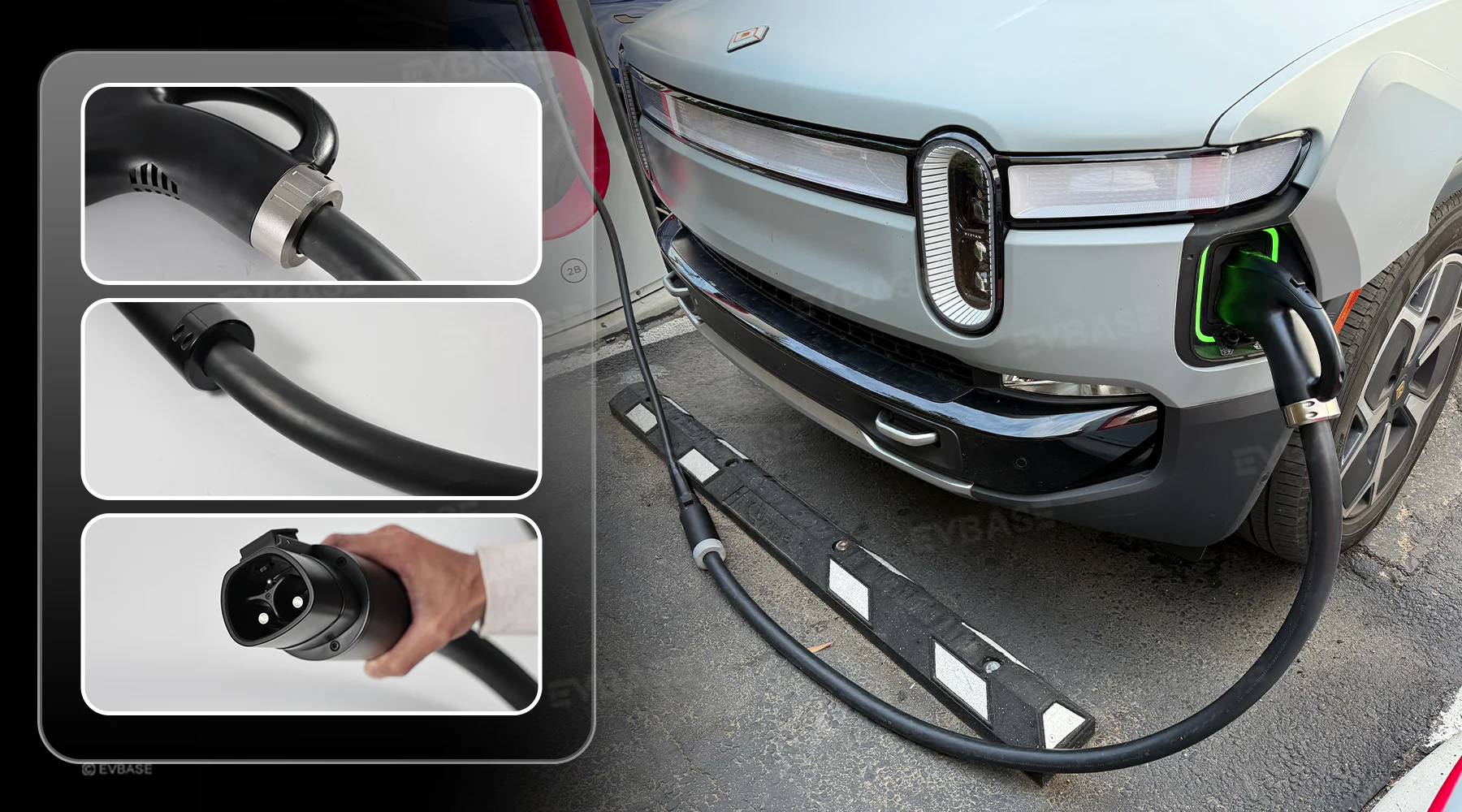
A rigid stub adapter transfers all of that angular mismatch directly to the two connector faces — the NACS joint and the CCS1 joint — as lateral mechanical load. Over repeated sessions, this stresses the latch mechanism and the contact pins at both ends. The extension cable in the EVBASE unit distributes that stress along the cable body instead, leaving both connector joints under far less strain. The cable also extends your reach by several inches, which matters at stations where the tethered cable is barely long enough to reach your port comfortably.
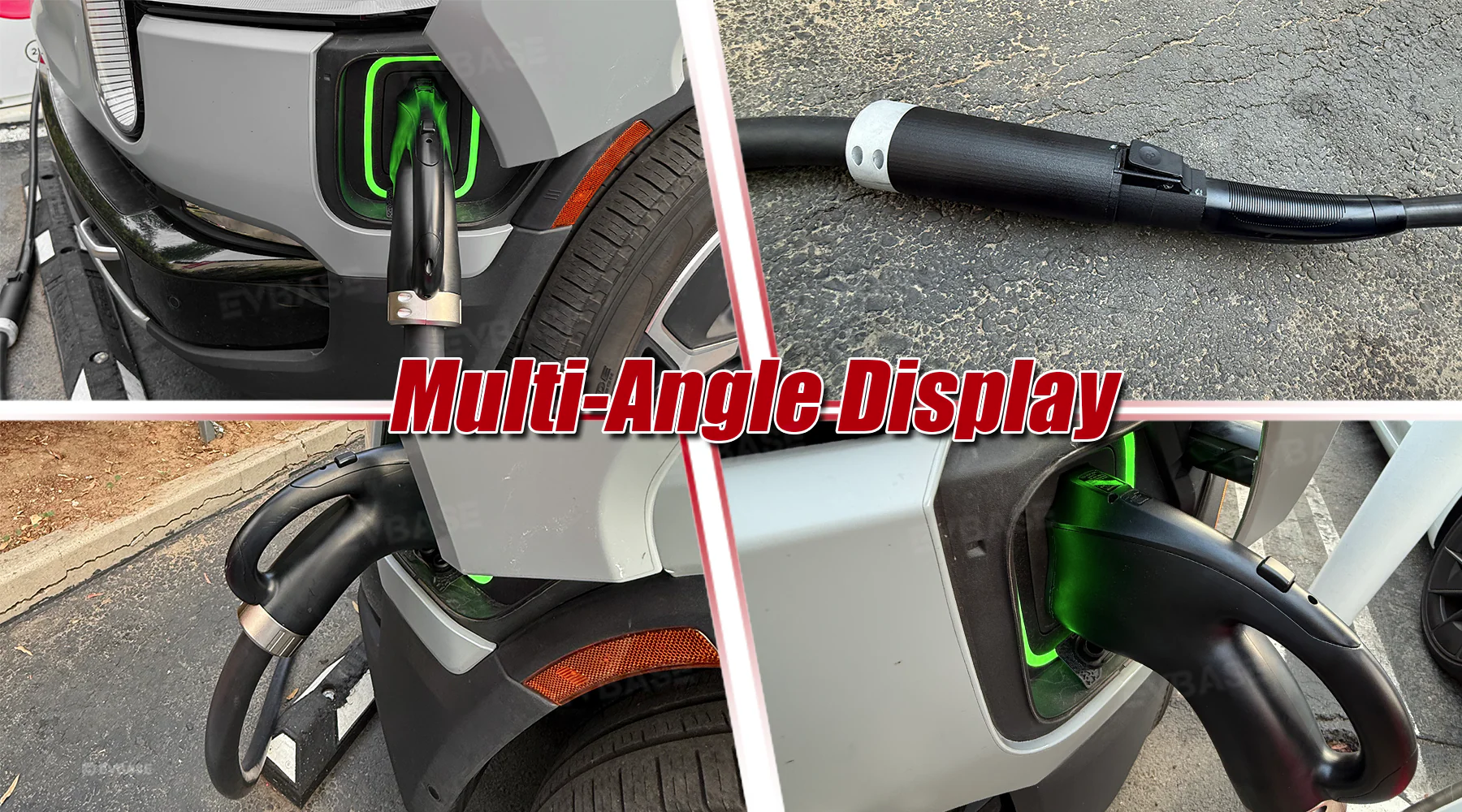
The photos above show the adapter in use — the flexible cable body routing naturally to the vehicle port without forcing the connector joints into an awkward angle. This is the real-world improvement that the extension cable design provides over a stub adapter, and it's something you feel from the first session.
Vehicle Compatibility
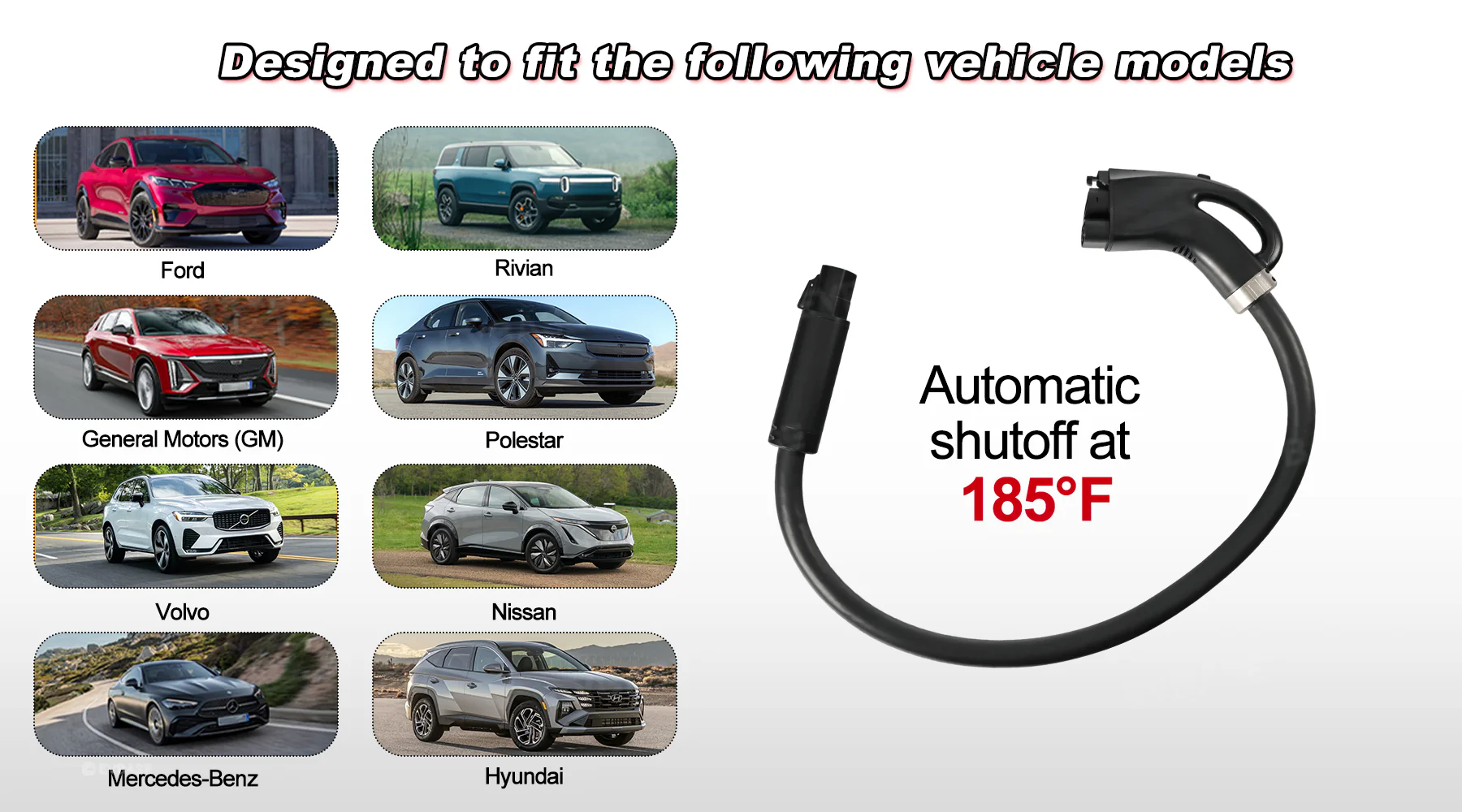
The EVBASE extension adapter is designed for CCS1-equipped vehicles in North America. CCS1 is the Combined Charging System Type 1 standard used by the majority of non-Tesla EVs sold in the US and Canada before the industry's 2024–2026 transition to native NACS ports.
| Brand | Compatible Models | Notes |
|---|---|---|
| Ford | Mustang Mach-E, F-150 Lightning (pre-2024 NACS) | 2024+ models ship with native NACS — adapter not needed |
| Rivian | R1T, R1S (Gen 1 and Gen 2 — both still CCS1) | R2 (2026+) ships native NACS and won't need the adapter |
| GM / Chevrolet / Cadillac | Bolt EV/EUV, Equinox EV, Silverado EV, Blazer EV, Lyriq (pre-NACS) | 2024+ GM NACS vehicles don't need this adapter |
| Polestar | Polestar 2 (North America CCS1 versions) | Polestar 3/4 may also apply — verify connector type |
| Volvo | EX40, EC40, EX90 (North America CCS1 versions) | Check model year — 2025+ may have native NACS |
| Nissan | Ariya (CCS1 North America) | LEAF uses CHAdeMO — this adapter does NOT work with CHAdeMO |
| Mercedes-Benz | EQS, EQE, EQB (North America CCS1 versions) | Verify your specific model's port type before ordering |
| Hyundai / Kia | IONIQ 5, IONIQ 6, EV6, EV9 (CCS1 North America) | IONIQ 5N and EV6 GT also compatible |
This adapter is for CCS1 vehicles only. It does not work with CHAdeMO ports (some older Nissan LEAF models), CCS2 ports (European and Australian market vehicles), or GB/T ports (Chinese market vehicles). Always verify your vehicle's charging port type before purchasing. The adapter also does not function on Level 2 AC chargers — DC fast charging only.
Safety: The 185°F Automatic Shutoff
The most distinctive safety feature on the EVBASE extension adapter is its built-in thermal protection: an automatic shutoff at 185°F (85°C). This is a hardware-level protection — not a firmware setting or a software switch — that cuts power if the connector assembly reaches that temperature.
To put that in perspective: most charging system components are designed for continuous operation up to around 140–158°F (60–70°C) under normal conditions. The 185°F threshold is high enough that it won't trigger nuisance trips during ordinary high-power sessions, but low enough to interrupt a charge before temperatures reach the range where insulation or contact integrity could be compromised. It's a practical design decision that gives you a meaningful safety margin without making the adapter overly conservative.
Normal high-power charging sessions — even at 150–250 kW — should not trigger the cutoff under ordinary ambient conditions. Scenarios that can push temperatures higher include: charging in direct sun in high ambient temperatures (above 95°F / 35°C), back-to-back sessions without cooldown, or a mechanical problem with pin seating that creates elevated contact resistance. If the shutoff activates, allow the adapter to cool for 10–15 minutes before resuming.
How to Use It at Tesla Superchargers
At Magic Dock Stations
Tesla began installing Magic Dock hardware at select US Supercharger locations starting in 2023. Magic Dock is a built-in CCS1 adapter mechanism housed inside the Supercharger pedestal — when you pull out the cable, you also pull out a built-in CCS1 connector that extends from the NACS plug. If you're at a Magic Dock station, you technically don't need a third-party adapter at all — the built-in adapter is provided by Tesla.
However, Magic Dock availability is uneven. Not every Supercharger has it, and even at stations that do, individual stalls within the same station may or may not have Magic Dock installed. Carrying the EVBASE extension adapter means you're never dependent on whether the specific stall you parked at happens to have built-in Magic Dock.
At Open NACS Stalls
At Superchargers that have deployed open NACS stalls — where any NACS vehicle or any vehicle with a NACS adapter can simply plug in — the EVBASE extension adapter is your bridge. The NACS plug connects to the Supercharger cable, and the CCS1 end connects to your vehicle. The session authorization works through the Tesla app or your registered non-Tesla account.
- 1Download the Tesla app and create a free Tesla account if you don't have one. Select your vehicle make and model as a non-Tesla vehicle during setup.
- 2Add a payment method in the Tesla app. Supercharger billing for non-Tesla vehicles is per kWh in most regions, or per minute where per-kWh billing isn't permitted by local regulation.
- 3Pull up to an open stall. Pull the NACS cable from the pedestal.
- 4Connect the NACS plug end of the EVBASE adapter to the Supercharger cable end. It seats with a click and a latch engagement.
- 5Connect the CCS1 connector end of the adapter to your vehicle's charging port, just like you would any CCS1 cable.
- 6In the Tesla app, tap Start Charging and select the stall number. The session initiates within 10–30 seconds in most cases.
- 7When the session is complete, press the button on the Supercharger cable or in the app to stop. Disconnect in reverse order: CCS1 from vehicle, then NACS from cable.
Your vehicle's maximum charge rate does not change because of the adapter. If your car accepts a maximum of 150 kW, that's what it'll draw — the adapter doesn't limit or expand the vehicle's hardware ceiling. The adapter's 350A / 1,000V rating simply ensures it can handle whatever your car requests without becoming a bottleneck.
International Context: Where Superchargers Are Open
This adapter is specifically designed for the North American CCS1 standard. CCS1 is the relevant DC fast charging connector for the US and Canada. Here's how the global picture fits together:
| Region | Charger Connector at Superchargers | This Adapter Applicable? |
|---|---|---|
| United States | NACS (SAE J3400) — open to all | Yes — for CCS1 vehicles |
| Canada | NACS at newer open stations; some Magic Dock | Yes — for CCS1 vehicles |
| Europe (EU/UK) | CCS2 (Type 2 Combo) natively at Superchargers | No — CCS2 vehicles plug directly, no adapter needed |
| Australia | Mixed NACS and CCS2 stalls at Superchargers | No — Australian vehicles use CCS2 |
| China | GB/T standard | No — different connector ecosystem entirely |
| Japan | CHAdeMO dominant; CCS1 growing | Only at CCS1-capable DC fast stations — not typical |
In Europe, Superchargers use the CCS2 (Type 2 Combo) standard natively, so European EVs with CCS2 ports plug directly into Tesla Superchargers without any adapter. The EVBASE extension adapter is a North America-specific product and is not compatible with the CCS2 connector used in Europe and Australia.
Extension Cable vs. Stub Adapter: Which Should You Buy?
Both product types — stub adapters and extension cable adapters — solve the same core problem: connecting a CCS1 vehicle to a NACS Supercharger cable. The choice between them comes down to a few practical considerations.
| Factor | Stub Adapter | Extension Cable Adapter (EVBASE) |
|---|---|---|
| Cable flexibility | None — rigid joint | Flexible body absorbs angle stress |
| Cable reach | Adds only connector thickness | Adds meaningful extra length |
| Size / portability | Very compact and pocketable | Larger, but still glovebox-friendly |
| Connector joint stress | All stress at connection faces | Distributed along cable body |
| Port angle tolerance | Requires good cable alignment | Handles awkward angles comfortably |
| Thermal safety | Varies by product | Built-in auto-shutoff at 185°F |
| Price range | ~$50–$175 depending on brand/cert | ~$629–$729 |
| Best for | Ideal stall conditions, easy port access | Tight angles, difficult cable reach, regular use |
For drivers who only occasionally use Superchargers and find their port is easily reached, a quality certified stub adapter may be sufficient. For drivers who charge at Superchargers regularly, have ports that are harder to reach at awkward angles, or want the additional protection of the thermal shutoff feature, the extension cable design offers a meaningfully better experience.
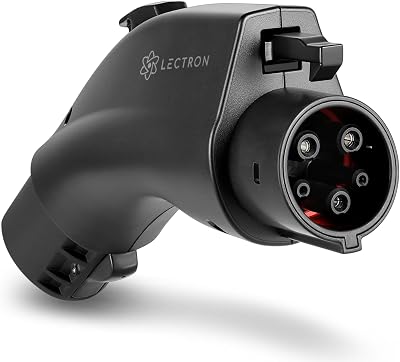
Lectron Vortex Plus NACS-to-CCS Adapter
The Gold Standard — UL 2252 Certified with Safety Interlock
* Amazon affiliate link — EV Charger Scout may earn a small commission at no extra cost to you.
Practical Tips and Important Warnings
- →Store it flat — unlike a stub adapter that fits in a jacket pocket, the extension cable does better coiled loosely in a dedicated pouch or the glovebox. Avoid tight coiling that could stress the cable sheath over time.
- →Inspect the connectors before each session — check both the NACS plug and CCS1 connector for bent pins, debris, or visible damage before plugging in. A damaged contact at 300+ amps is not something to discover mid-session.
- →Don't leave it outside in extreme weather — sustained UV exposure, ice, and extreme heat can degrade cable sheaths over time. Store it inside the vehicle between uses, especially in summer or winter months.
- →Check compatibility before your first session — confirm your exact vehicle make, model year, and port type against EVBASE's published compatibility list. If you're unsure, EVBASE customer support can confirm.
- →Allow cooldown between back-to-back sessions — if you're doing multiple consecutive fast-charge sessions (common on long road trips), give the adapter 10–15 minutes between sessions to let the connector ends return to ambient temperature.
This adapter is for DC fast charging only. It does not function on Tesla Wall Connectors (Level 2 AC), Destination Chargers, or any Level 2 J1772 station. The NACS-to-CCS1 direction is for CCS1 vehicles at Superchargers — it is not the same as a CCS1-to-NACS adapter for Tesla or NACS vehicles at CCS1 stations. These are different products for different use cases.
The Verdict
The EVBASE NACS-to-CCS1 Extension Adapter does something simple but valuable: it makes charging at Tesla Superchargers more comfortable and less mechanically stressful than a rigid stub adapter. The 350A / 1,000V rating gives plenty of headroom for any current production CCS1 vehicle. The built-in thermal shutoff at 185°F is a practical and meaningful safety feature. And the flexible extension cable between the two connector ends is the detail that matters most in day-to-day use — it turns a sometimes awkward connection into a natural one.
If you're regularly charging a Ford, Rivian, GM, Hyundai, Kia, Nissan, Polestar, Volvo, or Mercedes EV at Tesla Superchargers, the extension design is worth the modest price premium over a stub adapter. The mechanical stress reduction alone extends the useful life of both the adapter and your vehicle's port.
For drivers who are only occasionally hitting a Supercharger and find the cable reaches their port easily with a stub adapter, a UL 2252-certified stub like the Lectron Vortex Plus remains a solid alternative. The right tool depends on your specific situation — both approaches open the same Supercharger network.
EVBASE NACS to CCS1 Adapter with Extension Cable
Max 350A/1000V with Extension Cable — Charge CCS1 EVs at Tesla Superchargers
* EVBASE affiliate link (via AWIN) — EV Charger Scout may earn a small commission at no extra cost to you.
Frequently Asked Questions
How is the EVBASE extension adapter different from a stub adapter?
Instead of a rigid block that bridges your car's port directly to the NACS charger cable, the EVBASE unit includes a short length of flexible cable between the NACS plug and the CCS1 connector. That cable absorbs angle stress, distributes mechanical load along its body rather than concentrating it on the connector joints, and gives you several inches of extra reach at stations with stiff or short tethered cables.
What are the EVBASE adapter's power ratings?
It is rated for a maximum 350A and 1,000V DC, giving a theoretical ceiling of 350 kW — comfortably above what any current CCS1 consumer EV accepts and above what a Supercharger V3 stall delivers to a single vehicle (250 kW). The headroom matters because an adapter running well below its rated limit stays cooler and lasts longer.
Which vehicles is the EVBASE NACS-to-CCS1 adapter for?
It is designed for CCS1-equipped EVs in North America — including models from Ford, Rivian, GM, Hyundai, Kia, Nissan, Polestar, Volvo, and Mercedes-Benz that still use CCS1. It does not work with CHAdeMO ports, CCS2 (European and Australian) ports, or GB/T (Chinese) ports, and it is for DC fast charging only, not Level 2 AC.
How does the adapter's thermal shutoff work?
The adapter has a hardware-level automatic shutoff that cuts power if the connector assembly reaches 185°F (85°C). That threshold is high enough to avoid nuisance trips during ordinary high-power sessions but low enough to interrupt before temperatures could compromise insulation or contact integrity. If it activates, let the adapter cool for 10–15 minutes before resuming.
Does using the adapter slow down my charging speed?
No. Your vehicle's maximum charge rate is set by its own hardware — if your car accepts a peak of 150 kW, that's what it draws. The adapter's 350A / 1,000V rating simply ensures it can handle whatever the car requests without becoming a bottleneck.
More guides on Product Reviews
Explore the full Product Reviews topic hub — related guides that build on this one.