 EV Charger Scout
Tesla in 2026 looks more focused than it has in years. The Model Y "Juniper" refresh has shipped globally, the stalkless Model 3 "Highland" is now the default Model 3 everywhere except a handful of legacy markets, and the Cybertruck is finally in steady production from Giga Texas. The Model S and Model X were quietly removed from Tesla's configurators in late 2025 — Tesla is no longer taking new orders for either, and the lineup has narrowed to three current vehicles. What's actually changed under the skin matters more than the styling tweaks — especially for charging, range, and how each model fits a real-world driveway. This guide walks through every Tesla model on sale new in 2026, the specs that genuinely matter, and the buying tips that hold up internationally.
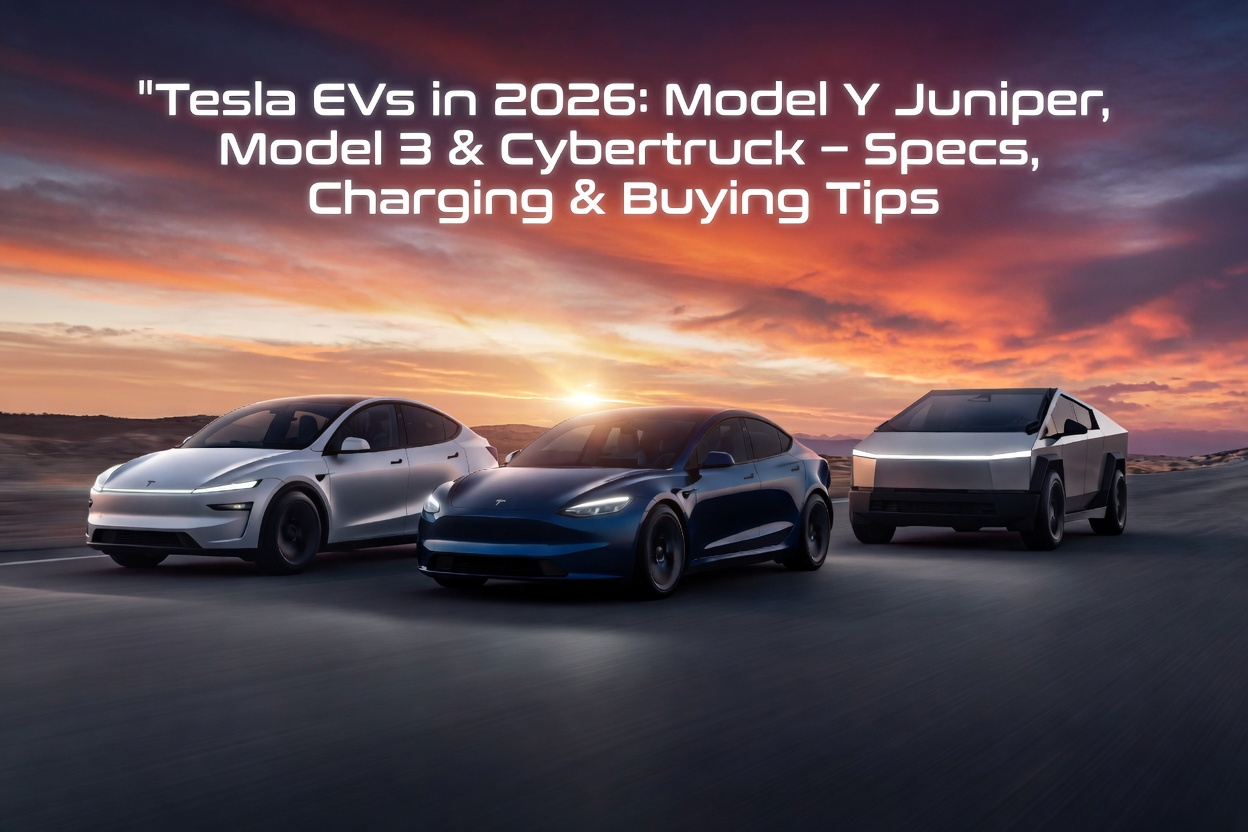
The 2026 Tesla lineup spans two architectures: the refreshed Model 3 and Model Y on 400V, and the Cybertruck on 800V — each with different real-world charging behaviour.
The 2026 Tesla Lineup at a Glance
Three vehicles are in active production globally as of 2026: Model 3, Model Y, and Cybertruck. The Model S and Model X were quietly removed from Tesla's order books in late 2025 — used examples are still everywhere, but you cannot configure a new one from Tesla. The next-generation Roadster has still not entered production despite repeated re-announcements. Here's how the current new-car lineup stacks up on the numbers buyers actually care about.
| Model | Top EPA range (US) | 0–60 mph (s) | Architecture | Max DC peak | Connector (NA / EU / China) |
|---|---|---|---|---|---|
| Model 3 Long Range RWD | ~363 mi | 4.9 | 400V | ~250 kW | NACS / CCS2 / GB/T |
| Model 3 Long Range AWD | ~341 mi | 4.2 | 400V | ~250 kW | NACS / CCS2 / GB/T |
| Model 3 Performance | ~298 mi | 2.9 | 400V | ~250 kW | NACS / CCS2 / GB/T |
| Model Y Juniper Long Range RWD | ~357 mi | 5.4 | 400V | ~250 kW | NACS / CCS2 / GB/T |
| Model Y Juniper Long Range AWD | ~327 mi | 4.6 | 400V | ~250 kW | NACS / CCS2 / GB/T |
| Model Y Juniper Performance | ~303 mi | 3.3 | 400V | ~250 kW | NACS / CCS2 / GB/T |
| Cybertruck Long Range RWD | ~350 mi | 6.2 | 800V | ~325 kW (V4) | NACS only |
| Cybertruck AWD | ~325 mi | 4.1 | 800V | ~325 kW (V4) | NACS only |
| Cybertruck Cyberbeast | ~301 mi | 2.6 | 800V | ~325 kW (V4) | NACS only |
Range figures above are EPA-rated US numbers. WLTP figures (Europe, UK, Australia) typically read 10–15% higher than the same vehicle's EPA rating, and CLTC numbers (China) often read 25–40% higher. None of those are "wrong" — they're just different test cycles.
Model Y "Juniper" — The Refreshed Bestseller
The Model Y is the world's best-selling EV by volume, and the "Juniper" refresh is the first significant exterior and interior overhaul since launch. It's been shipping in China since January 2025 (built at Giga Shanghai), in North America since spring 2025 (Fremont and Austin), and across Europe since spring 2025 (Berlin-Brandenburg). By 2026 it's the only Model Y you can buy new from Tesla.
What's actually new
- →Reshaped front and rear with a continuous LED light bar — clearly differentiates Juniper from the original from any angle.
- →Acoustic glass and additional sound-deadening — measurably quieter cabin at highway speeds.
- →Ventilated and heated front seats (heated rear seats too) on Long Range and Performance trims.
- →An 8-inch rear-passenger touchscreen — controls climate, media, and game streaming for back-seat occupants.
- →Revised front suspension and re-tuned dampers — noticeably better ride compliance over rough roads.
- →Ambient lighting strip wrapping the cabin, similar to Model 3 Highland.
What did not change: the platform, the battery, the motors, or the charging architecture. The Juniper is still a 400V car with the same nickel-based pack chemistry on Long Range and the same lithium iron phosphate (LFP) pack on RWD trims. Peak DC charging tops out around 250 kW on a Tesla V3 or V4 Supercharger — same as before.
The single biggest functional improvement on Juniper isn't visible on a spec sheet — it's the cabin acoustic treatment. If you've test-driven a pre-Juniper Model Y and found the road noise grating, drive a Juniper before writing the model off entirely.
Model 3 "Highland" — Sleeker, Cheaper, Stalkless
The Model 3 Highland refresh has been on sale globally since late 2023, so by 2026 it's the only Model 3 anyone is buying new. The exterior is more aerodynamic (Tesla quotes a drag coefficient of 0.219 — among the lowest of any production car), the cabin is genuinely upmarket compared to the original, and the EPA-rated range jumped to roughly 363 miles for the Long Range RWD trim — the highest range of any Model 3 ever.
The stalk question
Highland removed the turn-signal and gear-selector stalks. Turn signals live on capacitive buttons on the steering wheel; gear selection is on the centre touchscreen with a physical override on the headliner. Owner feedback after two-plus years on the road is mixed but settled — most drivers adapt within a week, but roundabouts and three-point turns remain awkward for some. If you frequently rent or borrow non-Tesla cars, the muscle-memory mismatch is real.
In the European Union, regulator UNECE has been reviewing whether touch-only turn signals comply with future safety rules under GSR (General Safety Regulation). No ban has been issued as of 2026, but a future regulatory shift could force a redesign. If you're buying in the EU, this isn't a reason to avoid the car, but it is a reason to be aware that the resale picture could shift.
Home Charging Upgrade · EV Shop

Tesla Universal Wall Connector
Best Universal — Two Cables, One Station: NACS + J1772
* Amazon affiliate link — EV Charger Scout may earn a small commission at no extra cost to you.
Model S and Model X — Discontinued for New Orders
Tesla quietly removed the Model S and Model X from its US and international configurators in late 2025. Existing reservations were honoured into early 2026, but you cannot place a new order for either today. Tesla has not formally announced a successor, and Fremont's S/X line has been wound down rather than retooled. The cars themselves remain on the road in big numbers — used 2021-onward refresh examples are widely available, and the parts and service network is still active — but for new-car buyers, the practical lineup is now Model 3, Model Y, and Cybertruck.
If you specifically want the larger sedan or SUV body, the Plaid-class acceleration, or the higher-end interior materials, you'll need to look at the used market or wait for whatever Tesla's flagship strategy turns into. Until then, the Model Y Long Range is the closest thing to a Model X replacement in today's catalogue, and the Model 3 Performance covers most of what Model S buyers used to want at less than half the price.
Cybertruck — The 800V Outlier
The Cybertruck is the only Tesla on sale in 2026 with an 800V architecture, and it's still only sold in North America. The stainless-steel exoskeleton, the angular styling, and the steer-by-wire setup all generate strong opinions; the engineering underneath is genuinely interesting regardless of how you feel about the look. Production has now stabilised at Giga Texas, and the Long Range RWD trim added in spring 2025 brought the entry price down to a more reasonable starting point.
What 800V actually means here
Higher pack voltage lets the same amount of power flow through smaller (and therefore lighter and cheaper) cables. In theory it also enables faster DC charging — production EVs from Hyundai, Kia, Genesis, Porsche, Lucid, and others on 800V architectures routinely peak above 250 kW. On a Tesla V3 Supercharger (which is itself a 400V cabinet), the Cybertruck has to step the voltage down and is limited to roughly the same ~250 kW peak as Tesla's 400V cars. On a Tesla V4 Supercharger built on the new 800V "V4 cabinet" hardware that began rolling out in 2024–2025, the Cybertruck can peak around ~325 kW — the highest sustained DC rate Tesla currently quotes for any of its own vehicles.
Translation: 800V is real and useful, but the practical benefit only shows up when you're plugged into the newer V4 800V cabinets. On older V3 stalls, Cybertruck charging behaviour is essentially Model-Y-equivalent, and in cold conditions it can actually be slightly slower because of the voltage step-down required.
The Cybertruck is the one Tesla you cannot simply throw a CCS-to-NACS adapter on. Tesla has confirmed that the Cybertruck does not support CCS1 DC fast charging, even with an adapter, due to the 800V architecture and the lack of CCS1 protocol implementation on the vehicle side. If you can't reach a Supercharger or a NACS-equipped non-Tesla DC station, your only DC option for a Cybertruck right now is to find a Magic-Dock Supercharger or wait for a stall.
Roadster — Still "Coming Soon"
The next-generation Roadster has been re-announced multiple times since 2017. As of 2026, no production vehicle exists, no firm reservation-to-delivery timeline has been honoured, and reservation deposits are still being held. Treat it as a future project rather than a 2026 buying option.
Charging Architecture: Why It Matters in 2026
Every North American Tesla — every model, every model year — uses the NACS (SAE J3400) connector. There has never been a CCS1 port on a North American Tesla. In Europe and the UK, every Tesla sold there uses the CCS2 (Type 2 Combo) connector natively — Tesla switched to CCS2 in Europe back in 2018–2019. In China, every Tesla sold uses the GB/T DC standard. The same vehicle assembled in Shanghai for the European market gets a CCS2 port; the same vehicle assembled in Berlin-Brandenburg for the European market also gets CCS2.
| Region | Tesla port | Public DC stations they plug into directly | Adapter usually needed? |
|---|---|---|---|
| United States / Canada | NACS (J3400) | Tesla Supercharger; new EVgo/Electrify America/ChargePoint NACS stalls | CCS1-to-NACS for older non-Tesla DC stations |
| Europe / UK / Norway | CCS2 (Type 2 Combo) | Tesla Supercharger (open to all CCS2 cars), Ionity, Fastned, Allego, BP Pulse, Shell Recharge | None for DC; Type 2 cable for AC |
| China | GB/T DC | Tesla Supercharger China network (GB/T cables), State Grid, Star Charge, NIO Power, BP Pulse China | None within China |
| Australia / NZ | CCS2 | Tesla Supercharger, Evie, Chargefox, BP Pulse | None for DC; Type 2 cable for AC |
Home Charging for Any 2026 Tesla
Every model in the current lineup — including Cybertruck — supports up to 11.5 kW (48A on a 240V single-phase circuit) on AC home charging in North America. In Europe and Australia, three-phase home charging delivers up to 11 kW (16A three-phase) on the European-market Model 3 and Model Y. In the US and Canada, 11.5 kW is the practical AC ceiling regardless of how big your home charger is.
For mixed households (a Tesla and a non-Tesla EV sharing the garage), Tesla's Universal Wall Connector is the cleanest solution: it has a NACS handle with a permanently attached J1772 adapter, so it natively serves both connector types without anyone hunting for a dongle. It's hardwire-only, rated up to 48A, and integrates with the Tesla app for power-sharing across multiple units on the same circuit.
Tesla Universal Wall Connector
Best Universal — Two Cables, One Station: NACS + J1772
* Amazon affiliate link — EV Charger Scout may earn a small commission at no extra cost to you.
If your household is Tesla-only, the standard Tesla Wall Connector (NACS-only) is cheaper and works identically. The Universal version's only point is the built-in J1772 adapter — pay for it only if you actually need to charge a J1772 car at the same outlet.
Road Trips: Supercharger Access in 2026
The Supercharger network is still the strongest single argument for buying a Tesla. As of 2026 it spans more than 50,000 stalls globally across roughly 6,500+ sites, with V4 hardware (taller posts, longer cables, up to 500 kW per stall on the post-rebuild generation) now standard at new builds. In Europe and China, the network has been open to non-Tesla CCS2 / GB/T vehicles for years; in North America, opening to non-Tesla NACS cars from Ford, Rivian, GM, Stellantis, and others has accelerated through 2024–2026.
For Tesla drivers themselves, the practical 2026 picture is that you can drive across North America, most of Europe, the UK, Norway, eastern Australia, and large swaths of China without ever leaving the Supercharger network. The trip planner in the car does the work — it routes you through stalls, pre-conditions the battery before arrival, and accounts for elevation and weather.
Charging at Non-Tesla DC Networks
Outside the Supercharger network, things vary by region. In Europe, the UK, and Australia, your Tesla's native CCS2 port plugs straight into Ionity, Fastned, BP Pulse, Allego, Shell Recharge, Evie, and Chargefox — no adapter, no fuss, just tap a card or use Plug & Charge.
In North America, the situation is in transition. Newer EVgo, Electrify America, and ChargePoint sites increasingly have NACS stalls that plug directly into your car. Older stalls are CCS1-only, and to use those you need a CCS1-to-NACS adapter that supports your specific Tesla. The catch: only 2021 and newer Model 3 and Model Y (and the now-discontinued 2021-onward Model S and Model X) have the CCS1 protocol enabled on the vehicle side. Pre-2021 Teslas and the Cybertruck cannot accept a CCS1 connection regardless of adapter.

LENZ CCS1-to-Tesla NACS Adapter
UL 2252 Certified — Charge Your Tesla at CCS1 DC Fast Stations
* Amazon affiliate link — EV Charger Scout may earn a small commission at no extra cost to you.
Only buy a CCS1-to-NACS adapter that carries UL 2252 certification (or the equivalent in your region — IEC 62196-3 in Europe, GB/T 20234.3 in China). Non-certified DC adapters can fail to handshake correctly with the station, drop the session mid-charge, or in rare cases cause hardware damage. Price is not a reliable indicator of safety here — pay for the certification, not the brand name.
EV Interior Essentials · EV Shop

BLACK+DECKER Lithium Handheld Vacuum
Trusted Brand Cordless Vacuum — Lithium, with Brush Attachment
* Amazon affiliate link — EV Charger Scout may earn a small commission at no extra cost to you.
The International Picture
Europe and the UK
Tesla's European and UK lineup is now just Model 3 and Model Y — the Cybertruck has not been homologated for European roads as of 2026, and the Model S and Model X were removed from European order books alongside the global discontinuation in late 2025. Every European Tesla uses CCS2 natively — no adapter is needed for any major DC network — and three-phase 11 kW AC home charging is the norm across both current models. Pricing is broadly higher than North America once VAT and country-specific taxes are applied. Norway remains Tesla's strongest single market by per-capita penetration.
China
Made-in-Shanghai Model 3 and Model Y are the entire current Tesla lineup in mainland China. They use GB/T DC connectors and a separate 380V three-phase AC standard. The Chinese Supercharger network uses GB/T cables and is interoperable with all major Chinese charging apps. The Model S and Model X — previously sold as imports through Tesla retail rather than built locally — were removed from the Chinese order book in late 2025 alongside the global discontinuation. The Cybertruck is not officially sold in mainland China.
Australia and New Zealand
CCS2 again, just like Europe. Public DC fast networks include Tesla Supercharger, Evie, Chargefox, and BP Pulse. Three-phase 11 kW or 22 kW home charging is common in newer homes; older homes often default to single-phase 7 kW.
India, Southeast Asia, Middle East
Tesla launched limited Indian sales in 2025 with showrooms in Mumbai and Delhi-NCR, importing from Berlin-Brandenburg with CCS2 ports — a deliberate match for the public DC network being built out under FAME-II and successor schemes. Across most of Southeast Asia and the Middle East, Tesla is sold through grey-import channels or limited official outlets, with charging compatibility varying by country.
Buying Tips: What to Actually Choose
- →Most people should buy the Model Y Juniper Long Range RWD or AWD. It's the most balanced car in the lineup — strong range, decent ride after the Juniper update, the largest cargo area, the second-row 8-inch screen if you have kids, and the lowest cost-per-mile to run.
- →If you don't need the SUV body, the Model 3 Highland Long Range RWD is the range champion of the lineup at roughly 363 miles EPA, and it's cheaper than any Model Y. Test the stalkless setup before committing.
- →Choose Performance trims only if you actually want the acceleration. The range hit is real (often 60+ EPA miles), the ride is firmer, and the wheels are easier to curb.
- →If you specifically wanted a Model S or Model X, look at the used market. Tesla closed new orders for both in late 2025. Plenty of 2021-onward refresh examples are out there, and they share the same 400V architecture and ~250 kW peak DC charging as the current Model 3 and Y.
- →The Cybertruck is a specialty vehicle. If you need a pickup that can tow up to roughly 11,000 lb, has genuinely useful all-electric features (the bed outlets, the air suspension, the wading capability), and you're comfortable with the styling and the limited DC network compatibility, it earns its place. If any of those don't apply, a Model Y will serve you better.
- →Don't pay for FSD upfront. The monthly subscription is now offered in a growing list of markets — the US and Canada at full capability, mainland China with a localised feature set, and trial rollouts underway across parts of Europe — and it lets you sample current capability on your specific roads before committing. Availability, pricing, and approved feature set all vary substantially by country, so check your local Tesla configurator before assuming anything.
Buying a new Model 3, Model Y, or Cybertruck? Get 3 months of Full Self-Driving free.
Order any new Model 3, Model Y, or Cybertruck through the EV Charger Scout Tesla referral link and Tesla will give you 3 months of Full Self-Driving (Supervised) free. Tesla is also currently advertising 0% APR on Model Y and 0.99% APR on Model 3 through the same link, plus $400 off Solar Panels & Powerwall. It costs you nothing extra and helps support the site. Specific offers are set by Tesla and change periodically — the live referral page always shows what's active right now.
Tesla referral link — EV Charger Scout may receive a referral credit at no cost to you. Tesla refer-and-earn terms apply.
Common Pitfalls to Avoid
Do not assume a Tesla in one country has the same connector as the same Tesla in another country. A Model Y bought in Germany has a CCS2 port; the same Model Y bought in Texas has NACS. Used-import buyers (Teslas brought into the UK from Japan, Norway from the US, Australia from China) frequently end up with the wrong connector for their target charging network. Always verify the port physically before you buy.
For road trips that take you well off the Supercharger corridor — rural Europe, the Australian outback, parts of the American West — keep a Level 2 portable charger and the appropriate outlet adapters in the trunk. A campground 32A outlet or a friend's NEMA 14-50 can save a trip when DC fast options are sparse.

SEGUMA Level 1/2 Tesla Portable Charger — NACS
Dual-Voltage NACS Charger — Works at 120V & 240V, 25 ft Cable
* Amazon affiliate link — EV Charger Scout may earn a small commission at no extra cost to you.
Don't trust forum claims about charging speeds without checking the date and the specific firmware. Tesla pushes charging-curve and pre-conditioning updates regularly, and a 2023-era complaint about a slow taper at 80% may simply not apply to a 2026-firmware car.
Bottom Line
The 2026 Tesla lineup is the most focused it has been in years — three vehicles, two architectures, and a charging story that finally makes sense. The Model Y Juniper is the right answer for most buyers in most countries. The Model 3 Highland is the long-range, lower-cost alternative with a more polarising interior layout. The Cybertruck is a focused product for North American pickup buyers who want the engineering and can live with its DC network limitations. The Model S and Model X are now used-only purchases after Tesla closed new orders in late 2025, and the Roadster remains a future project. Whatever you choose, the connector and charging picture is now genuinely simple — match the port to your region, keep one adapter for the older non-Tesla DC stalls if you're in North America, and let the trip planner do the rest.
Frequently Asked Questions
Which Tesla models can you buy new in 2026?
Three vehicles are in active production globally in 2026: the Model 3, the Model Y “Juniper,” and the Cybertruck. Tesla quietly removed the Model S and Model X from its configurators in late 2025 and is no longer taking new orders for either, and the next-generation Roadster still hasn't entered production. For new-car buyers the practical lineup is Model 3, Model Y, and Cybertruck.
What changed in the Model Y Juniper refresh?
The Juniper brings a reshaped front and rear with a continuous LED light bar, acoustic glass and extra sound deadening, ventilated and heated seats, an 8-inch rear-passenger touchscreen, and revised suspension for a better ride. What did not change is the platform, battery, motors, or charging architecture — it's still a 400V car peaking around 250 kW on a Supercharger.
Does the Cybertruck's 800V architecture make it charge faster?
Only on the newer hardware. On a Tesla V3 Supercharger (a 400V cabinet) the Cybertruck steps its voltage down and is limited to roughly the same ~250 kW peak as Tesla's 400V cars. On a true V4 800V cabinet that began rolling out in 2024–2025, it can peak around ~325 kW — the highest sustained DC rate Tesla quotes for any of its own vehicles.
Can you use a CCS-to-NACS adapter on a Tesla Cybertruck?
No. Tesla has confirmed the Cybertruck does not support CCS1 DC fast charging even with an adapter, due to its 800V architecture and the lack of CCS1 protocol on the vehicle side. If you can't reach a Supercharger or a NACS-equipped non-Tesla DC station, your only DC option is a Magic Dock Supercharger or waiting for a stall.
Do Teslas use the same connector in every country?
No. North American Teslas use the NACS (J3400) connector and have never had a CCS1 port. In Europe, the UK, and Australia, Teslas use CCS2 natively, and in China they use the GB/T DC standard. The same model can have a different port depending on where it was sold, so used-import buyers should always verify the physical connector before purchasing.
More guides on EV Models
Explore the full EV Models topic hub — related guides that build on this one.