 EV Charger Scout
Stellantis was late to the NACS party — later than Ford, later than GM, and later than most observers expected, and the physical connector transition is still rolling out more slowly than originally promised. But as of 2026, drivers of Jeep, Dodge, and Ram electric vehicles have access to Tesla's Supercharger network via Stellantis's free NACS adapter program and Magic Dock stalls. It's the single most consequential development in public charging for Stellantis EV owners since those vehicles launched. Here's the full picture of what works, what doesn't, how to set it up, and what to realistically expect at the charger.
This article focuses specifically on the Stellantis NACS transition — the Jeep, Dodge, and Ram EV lineup. If you want the broader brand-by-brand Supercharger access overview across all manufacturers, that's covered separately in our non-Tesla Supercharger access guide.
Which Stellantis EVs Have Supercharger Access
Stellantis originally announced in February 2024 that NACS (SAE J3400) would begin appearing on North American models in 2025. In practice, the transition has slipped: the first-wave Wagoneer S and Charger Daytona EVs launched with CCS1, and Stellantis now supplies a free CCS1-to-NACS adapter to give existing owners Supercharger access while native NACS ports phase in later in the 2026 cycle. Current status:
| Model | Market Year | Connector | Supercharger Access |
|---|---|---|---|
| Jeep Wagoneer S | 2025–2026 | CCS1 (native NACS delayed) | Yes — via NACS adapter or Magic Dock |
| Jeep Avenger EV (NA launch) | 2026 | CCS1 with NACS adapter at launch | Yes — via adapter |
| Dodge Charger Daytona R/T & Scat Pack | 2024–2026 | CCS1 | Yes — via NACS adapter or Magic Dock |
| Ram 1500 REV / ProMaster EV | 2025–2026 | CCS1 | Yes — via NACS adapter or Magic Dock |
| Jeep Recon EV | Late 2026 (on-sale H2 2026) | TBA — expected CCS1 at launch | Via adapter at launch |
If your Stellantis EV is a 2024 or early 2025 model with a CCS1 port, you can still access Superchargers — but only at stations equipped with Magic Dock (Tesla's CCS1 adapter built into the stall) or using a third-party CCS-to-NACS adapter. Magic Dock availability varies by location, so check the Tesla app or EV Charger Scout before navigating to a specific station.
The Jeep Wagoneer S: Stellantis's First BEV in the US
The Wagoneer S is Jeep's first US-market battery-electric vehicle and the first Stellantis EV to access the Tesla Supercharger network — though via a supplied NACS adapter rather than a native NACS port, despite earlier marketing suggestions. With a ~100 kWh gross (94 kWh usable) battery pack and an EPA range of 303 miles on standard tires, the Wagoneer S is positioned as a premium SUV with genuine road trip capability.
At Supercharger V3 and V4 stations, the Wagoneer S can accept up to 203 kW of DC fast charging, averaging around 141 kW across a 10–80% session. That's competitive — comparable to a Rivian R1T's 220 kW and above the Ford Mustang Mach-E's 150 kW. A 20–80% charge from the highway takes approximately 23 minutes, which aligns well with a real-world comfort stop.
DC Fast Charging Upgrade · EV Shop
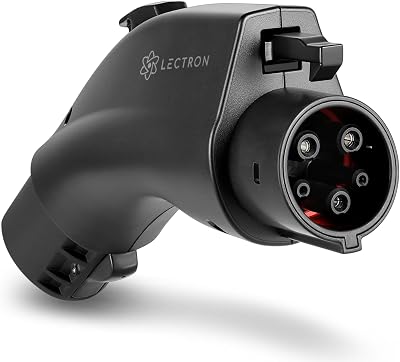
Lectron Vortex Plus NACS-to-CCS Adapter
The Gold Standard — UL 2252 Certified with Safety Interlock
* Amazon affiliate link — EV Charger Scout may earn a small commission at no extra cost to you.
Dodge Charger Daytona: NACS Transition Still In Progress
The Charger Daytona EV launched in late 2024 on Stellantis's STLA Large platform with a CCS1 port. Contrary to early marketing projections, Dodge has not yet switched the Daytona to native NACS as of early 2026 — both R/T and Scat Pack remain CCS1, with Supercharger access provided via Stellantis's free CCS1-to-NACS adapter program or at Magic Dock stalls.
Unlike some rumors, both the Daytona R/T and Scat Pack share the same 400V STLA Large architecture — there is no 800V Scat Pack. Current production Daytona EVs peak at approximately 183 kW DC, completing a 20–80% charge in roughly 28 minutes. An 800V variant has been announced under the "Banshee" nameplate but has not been released as of April 2026.
Charger Daytona CCS1 Owners: Magic Dock vs. Adapter
For Daytona owners, Supercharger options depend on station equipment. Magic Dock — Tesla's CCS1 adapter built into select stalls — gives CCS1 Dodges access without any hardware purchase. Use the Tesla app to filter for "Magic Dock" when planning a trip. Alternatively, the Stellantis-supplied CCS1-to-NACS adapter lets you use any standard Supercharger stall.
Ram ProMaster EV: Commercial Fleet Implications
The ProMaster EV is a commercial cargo van, not a consumer vehicle in the traditional sense, but a significant share of Stellantis EV volume runs through fleet channels — delivery companies, service businesses, municipalities. For fleet operators who have transitioned to ProMaster EVs and need public charging during extended routes, Supercharger access is meaningful.
The ProMaster EV is rated at up to ~125 kW DC — lower than the latest passenger vehicles, reflecting its commercial application, 110 kWh gross battery pack, and chemistry optimized for cycle life rather than peak charge speed. At a V3 or V4 Supercharger, expect roughly 55 minutes for a 10–80% charge. Fleet managers should still prioritize depot Level 2 charging whenever possible, using Superchargers as backup rather than primary infrastructure.
Setting Up Tesla Supercharger Access for Stellantis Vehicles
- 1Download the Tesla app on iOS or Android. You do not need to own a Tesla — the app supports third-party vehicles with NACS connectors.
- 2Create a Tesla account. Use your personal email — this becomes the billing account for Supercharger sessions.
- 3In the app, tap 'Add non-Tesla.' Select your vehicle make, model, and year.
- 4Add a payment method. Tesla bills per kWh at most locations in the US (pricing varies by state — some states require per-minute billing due to regulation).
- 5Navigate to a Supercharger location using the Tesla app. The app shows stall availability in real time, which is one of its main practical advantages over other networks.
- 6At the station, the app activates the stall after you connect. Some newer V4 stations allow plug-and-charge (the car handles authentication automatically) — check your vehicle's software release notes for this capability.
Supercharger non-Tesla pricing is typically 20–30% higher per kWh than the rate Tesla owners pay. If you plan to use Superchargers regularly, the cost difference is worth factoring into your total cost of ownership comparison.
Finding Compatible Stations: What to Look For
Not all Supercharger stations are equal for Stellantis vehicles, and the differences matter for trip planning:
- →V4 Superchargers — The newest generation. Most V4 sites today combine V4 posts with V3 cabinets (250 kW per stall, or up to 325 kW at boosted installations from January 2025 onward). Tesla's true V4 cabinet, rated up to 500 kW per stall, began rolling out in September 2025 at a growing number of flagship sites. Longer cables make V4 posts easier to reach from the Wagoneer S or Charger Daytona's passenger-side port.
- →V3 Superchargers — Dedicated 250 kW cabinets, one per stall (no power sharing). Still the most common Supercharger type nationwide and a strong fit for the Wagoneer S and Charger Daytona.
- →V2 Superchargers — Older stalls paired 2-to-a-cabinet with 150 kW peak that's shared across the pair — typically ~72 kW per stall when both are occupied. Fully accessible for Stellantis NACS/adapter users but considerably slower.
- →Urban Superchargers — Usually V3 or newer, often located in urban parking structures. No pull-through bays for trucks or large SUVs — the Wagoneer S and ProMaster EV may have tighter parking logistics at some urban locations.
Home Charging Upgrade · EV Shop

Emporia Universal Dual EV Charger
Best Value Universal — UL + ETL Certified, NACS & J1772 Dual Connector
* Amazon affiliate link — EV Charger Scout may earn a small commission at no extra cost to you.
International Perspective: Stellantis EVs Outside North America
Outside North America, the Stellantis EV picture is different and worth understanding clearly. The Jeep Avenger EV, which has been on sale in Europe since 2023, uses a CCS2 connector — the European standard. European Supercharger stations accept CCS2 natively, so Jeep Avenger EV drivers in Europe, the UK, and Australia already have access to Tesla Superchargers without any adapter. No setup beyond the Tesla app and a payment method is required.
The Dodge and Ram brands have minimal presence in European markets, so the Charger Daytona and ProMaster EV are effectively North American products. For Fiat-brand EVs (also under the Stellantis umbrella), European models use CCS2, and Supercharger access via the standard non-Tesla process applies there too.
| Region | Connector Standard | Supercharger Access Method |
|---|---|---|
| North America (2026 models) | NACS (J3400) | Plug directly, Tesla app session |
| North America (2024–2025 CCS1 models) | CCS1 | Magic Dock or third-party adapter |
| Europe / UK | CCS2 | Plug directly into CCS2-capable stall |
| Australia / New Zealand | CCS2 | Plug directly into CCS2-capable stall |
Practical Tips for Stellantis EV Owners at Superchargers
- →Pre-condition your battery before arriving at a Supercharger if your vehicle supports it. Navigate to a Supercharger in your car's nav system — some Stellantis vehicles will automatically warm the battery to its optimal charging temperature during transit.
- →Avoid parking at stalls labeled 'Tesla only' at older installations. Most stations have been updated to allow non-Tesla use, but signage at legacy locations can be misleading — the Tesla app will tell you definitively if non-Tesla access is enabled.
- →At busy stations, the Tesla app shows a queue estimate. If the wait is long, check EV Charger Scout for alternative DCFC options nearby — EVgo, Electrify America, and ChargePoint all have NACS or dual-connector stalls at many locations.
- →Check your vehicle's onboard charging settings. Some Stellantis models have a maximum DC charge rate cap in the vehicle settings — confirm it's set to the highest rate the vehicle supports.
- →Idle fees apply at Superchargers when the station is at capacity. The Tesla app notifies you when your session is complete — move your vehicle promptly to avoid the idle fee, which Tesla charges per minute after a short grace period.
EV Charger Scout aggregates station data from NREL and OpenChargeMap. Filter by your connector type — NACS or CCS1 — to find the nearest compatible Supercharger and non-Tesla DCFC options. The station detail panel shows per-stall connector types and rated power levels.
The Bottom Line
Stellantis's ongoing NACS rollout is a genuine improvement for Jeep, Dodge, and Ram EV owners. The Supercharger network's density, reliability, and ease of use are real advantages — particularly in regions where other DCFC networks have thinner coverage. Until native NACS ports arrive, the supplied CCS1-to-NACS adapter plus Magic Dock stalls handle the vast majority of situations, though checking station-level compatibility before a trip remains a good habit.
The ProMaster EV's slower charge rate is the one area where Supercharger access delivers less practical benefit — commercial operators should still prioritize depot charging infrastructure as their primary strategy. But for Wagoneer S and Charger Daytona drivers, access to 27,500+ Supercharger stalls across North America materially changes the road trip math in their favor.
Frequently Asked Questions
Can Jeep, Dodge, and Ram EVs use Tesla Superchargers in 2026?
Yes. As of 2026, drivers of Stellantis EVs — Jeep Wagoneer S, Dodge Charger Daytona, Ram 1500 REV and ProMaster EV — can access Tesla's Supercharger network. Because the transition to native NACS ports has slipped, most current models use a free CCS1-to-NACS adapter supplied by Stellantis or Magic Dock stalls rather than a built-in NACS connector.
Do current Stellantis EVs have native NACS ports or do they need an adapter?
Most current Stellantis EVs still ship with CCS1 ports. The first-wave Wagoneer S and Charger Daytona launched with CCS1, and Stellantis now provides a free CCS1-to-NACS adapter so existing owners get Supercharger access while native NACS ports phase in later in the 2026 cycle. CCS1 owners can also use Magic Dock stalls where available.
How do I set up Supercharger access for a Stellantis EV?
Download the Tesla app, create a Tesla account, and use the “Add non-Tesla” option to select your make, model, and year. Add a payment method, then navigate to a Supercharger using the app, which shows real-time stall availability. You do not need to own a Tesla to use the app with a third-party NACS-equipped or adapter-equipped vehicle.
How fast does the Jeep Wagoneer S charge at a Supercharger?
The Wagoneer S can accept up to 203 kW of DC fast charging at V3 and V4 Supercharger stations, averaging around 141 kW across a 10–80% session. A 20–80% charge from the highway takes roughly 23 minutes, which lines up well with a typical comfort stop.
Does Supercharger access cost more for non-Tesla Stellantis vehicles?
Yes. Non-Tesla Supercharger pricing is typically 20–30% higher per kWh than the rate Tesla owners pay. Tesla bills per kWh at most US locations, though some states require per-minute billing due to regulation. If you plan to use Superchargers regularly, factor this difference into your total cost of ownership.
More guides on Network Access
Explore the full Network Access topic hub — related guides that build on this one.
Non-Tesla EVs at Superchargers: Which Brands Have Access Now (March 2026)
10 min read
UK Ultra-Rapid Charging: The Best 350 kW+ Stations and Motorway Routes to Map Now
14 min read
BMW 2026 i3 & iX3: Native NACS Ports Explained – Which Public Chargers Work Best
11 min read
Charging Your Rivian or Ford at Tesla Superchargers: Complete 2026 Guide
11 min read