 EV Charger Scout
The next major shift in EV technology isn't a bigger battery or a faster motor — it's what's inside the battery itself. Solid-state batteries are moving from laboratory promise to limited production in 2026, and they change the rules on charging in ways that most coverage gets wrong. This isn't just about faster charging speeds (though that's part of it). Solid-state cells behave fundamentally differently from today's liquid-electrolyte batteries, and the charging infrastructure that works perfectly for a 2024 Ioniq 5 may be genuinely inadequate for what's coming from Toyota, Nissan, Samsung SDI, and QuantumScape in the next 24 months.
What Actually Makes a Battery "Solid-State"
Today's lithium-ion batteries use a liquid electrolyte — a chemical solution that allows lithium ions to move between the anode and cathode during charging and discharging. This liquid works well, but it has real limitations: it's flammable, it breaks down at high temperatures, it limits how fast ions can move (which limits charge speed), and it reacts poorly with some of the most energy-dense electrode materials available.
Solid-state batteries replace the liquid electrolyte with a solid material — typically a ceramic, glass, or polymer compound. The solid electrolyte is not flammable, is chemically stable across a wider temperature range, and — critically — is compatible with lithium metal anodes that can store roughly 10× more energy per gram than the graphite anodes used in current EVs.
| Property | Current Li-ion (liquid electrolyte) | Solid-State (solid electrolyte) |
|---|---|---|
| Electrolyte | Liquid (flammable) | Solid ceramic/glass/polymer (non-flammable) |
| Anode material | Graphite | Lithium metal (10× energy density) |
| Energy density (pack level) | ~250–300 Wh/kg | ~400–500 Wh/kg (projected) |
| Operating temperature range | −20°C to 60°C (degraded outside) | −40°C to 100°C+ (stable) |
| Thermal runaway risk | Present (requires cooling + flame retardant) | Significantly reduced |
| Charge speed potential | Limited by liquid ion mobility | Higher (solid enables faster ion movement at scale) |
| Cycle life | ~1,000–2,000 cycles to 80% | 5,000–10,000 cycles (projected) |
| Manufacturing maturity | Highly mature | Early production (2025–2027 window) |
Who Is Actually Close to Production in 2026?
Solid-state battery development has been "5 years away" for over a decade. But 2025–2026 marks the first time multiple credible manufacturers are delivering pre-production cells to automotive partners for real-world testing. Here's an honest assessment of where each major player stands:
Toyota
Toyota has been the most vocal and aggressive on solid-state timelines. Their target is a solid-state EV in limited production by 2027–2028, with cells produced by Panasonic's Prime Planet and Energy & Solutions (PPES) joint venture. Toyota's cells use a sulfide-based solid electrolyte and are designed for a 1,200+ km (745+ mi) range vehicle. The company claims charging from 10–80% in approximately 10 minutes, though this has only been demonstrated in laboratory conditions. Mass production targets are 2030.
Nissan
Nissan's All-Solid-State Battery (ASSB) program targets a 2028 vehicle introduction using cells manufactured at their Yokohama pilot plant, which opened in 2024. Their sulfide electrolyte cells are designed for a 50% cost reduction versus current NMC batteries by 2028. Nissan's internal targets show charge speeds of approximately 15 minutes for a significant range addition, with total pack energy density of ~400 Wh/kg at the cell level.
Samsung SDI
Samsung SDI is supplying solid-state cell samples to BMW, Stellantis, and General Motors for testing as of 2025. Their "S-Line" cells use an oxide-based electrolyte and are being integrated into concept vehicle testing by BMW iVentures-funded programs. Samsung SDI has not committed to a specific vehicle production date but has announced a pilot line in Ulsan, South Korea, targeting cell-level energy density of 430 Wh/kg.
Home Charging Upgrade · EV Shop

ChargePoint Home Flex
Best J1772 — Up to 50A, Energy Star Certified, Any Non-Tesla EV
* Amazon affiliate link — EV Charger Scout may earn a small commission at no extra cost to you.
QuantumScape
QuantumScape (backed by Volkswagen) uses a lithium metal anode with a proprietary ceramic separator as the solid electrolyte. They delivered "QSE-5" cells to automotive partners in 2024 for qualification testing. Their published data shows remarkable cycle life — over 1,000 cycles with minimal degradation at fast-charge rates — but scaling manufacturing to automotive volumes remains the primary challenge. VW group vehicles are the primary integration target.
CATL (China)
Contemporary Amperex Technology (CATL) — the world's largest battery manufacturer — announced their "Shenxing" solid-state battery program with a target vehicle integration by 2027. CATL's approach uses a semi-solid electrolyte (a transitional technology sometimes called "quasi-solid-state") as a bridge toward full solid-state. Their competitive advantage is manufacturing scale; they can ramp production faster than any other manufacturer once the technology matures.
"Semi-solid" or "quasi-solid-state" batteries — used by CATL and several Chinese manufacturers — are a transitional technology that improves on standard liquid-electrolyte cells but don't deliver the full benefits of true solid-state. When evaluating battery claims, look for clear specification of whether the electrolyte is fully solid or a gel/semi-liquid hybrid.
Why Solid-State Batteries Need Different Chargers
This is where most coverage misses the point. The assumption is that solid-state vehicles will plug into the same CCS, NACS, or GB/T connectors as today's EVs and just charge faster. The connector part is mostly correct — the physical plug standards are designed to be forward-compatible with higher power levels. But the charging protocol and infrastructure requirements are more complex:
Higher Voltage Architectures
Current EVs operate on 400V or 800V electrical architectures. 800V vehicles (Hyundai Ioniq 5/6, Kia EV6/EV9, Genesis GV60, Porsche Taycan, Audi e-tron GT, Lucid Air at 900V) already require high-power DC fast chargers to unlock their maximum charge rates. Mercedes EQS and EQE are still 400V platforms — their 800V successor arrives with the 2026 CLA on the MMA platform — a 400V charger connected to an 800V car delivers roughly half the rated power unless the vehicle has an onboard boost converter.
Solid-state battery packs, with their higher energy density, may be packaged at higher voltages than current 800V architecture — some research programs are evaluating 1,000V+ systems. The existing CCS standard (IEC 62196-3 / SAE J1772 DC) specifies a maximum of 1,000V DC for CCS2 and 1,000V DC for NACS per the latest revision. Chargers rated and tested at 1,000V DC already exist in testing environments but are not yet deployed publicly.
Higher Current Requirements
Achieving 10-minute charging (the benchmark most manufacturers cite for solid-state) at practical energy levels requires enormous power delivery. A 100 kWh battery charged from 10% to 80% (70 kWh added) in 10 minutes requires 420 kW of average power. At 800V, that's 525 amps. The current NACS/CCS2 standard supports up to 500A at 1,000V = 500 kW maximum. So the physical connector can theoretically handle these power levels — but only the newest, highest-rated charger hardware can deliver them.
| Charger Power Level | Representative Hardware (2026) | Adequate for Solid-State? |
|---|---|---|
| 50 kW DC | Most ChargePoint DCFC, older Blink, smaller networks | No — too slow for solid-state potential |
| 150 kW DC | Electrify America Gen 1, EVgo newer units | Marginal — limited to slower solid-state sessions |
| 250 kW DC | Tesla V3 Supercharger, Electrify America Gen 2 | Partially — adequate for 400V solid-state, limited for 800V+ |
| 350 kW DC | IONITY, Electrify America Gen 3, Ionna, newer Tesla V4 | Yes — full solid-state potential at 800V architecture |
| 500+ kW DC | MCS (Megawatt Charging System, emerging) | Future-ready — required for 1,000V solid-state and commercial EVs |
Thermal Management Is Simpler — But Not Gone
Solid-state cells generate less heat during fast charging than liquid-electrolyte cells at equivalent power levels, primarily because the solid electrolyte has lower ionic resistance. This is the good news: thermal throttling of the kind common in hot-weather liquid-electrolyte fast charging should be significantly reduced in solid-state vehicles. However, it won't disappear entirely — lithium metal anodes can develop dendrites (microscopic metal filaments that grow through the solid electrolyte) if charged too aggressively or at too-low temperatures. Cold-weather charging limitations will remain a concern for early solid-state vehicles.
Solid-state batteries charged below −10°C (14°F) without preconditioning may be more susceptible to lithium dendrite formation than current liquid-electrolyte cells in the same conditions. Early solid-state vehicles will almost certainly require active preconditioning before cold-weather fast charging — potentially even more rigorously than today's EVs.
DC Fast Charging Upgrade · EV Shop
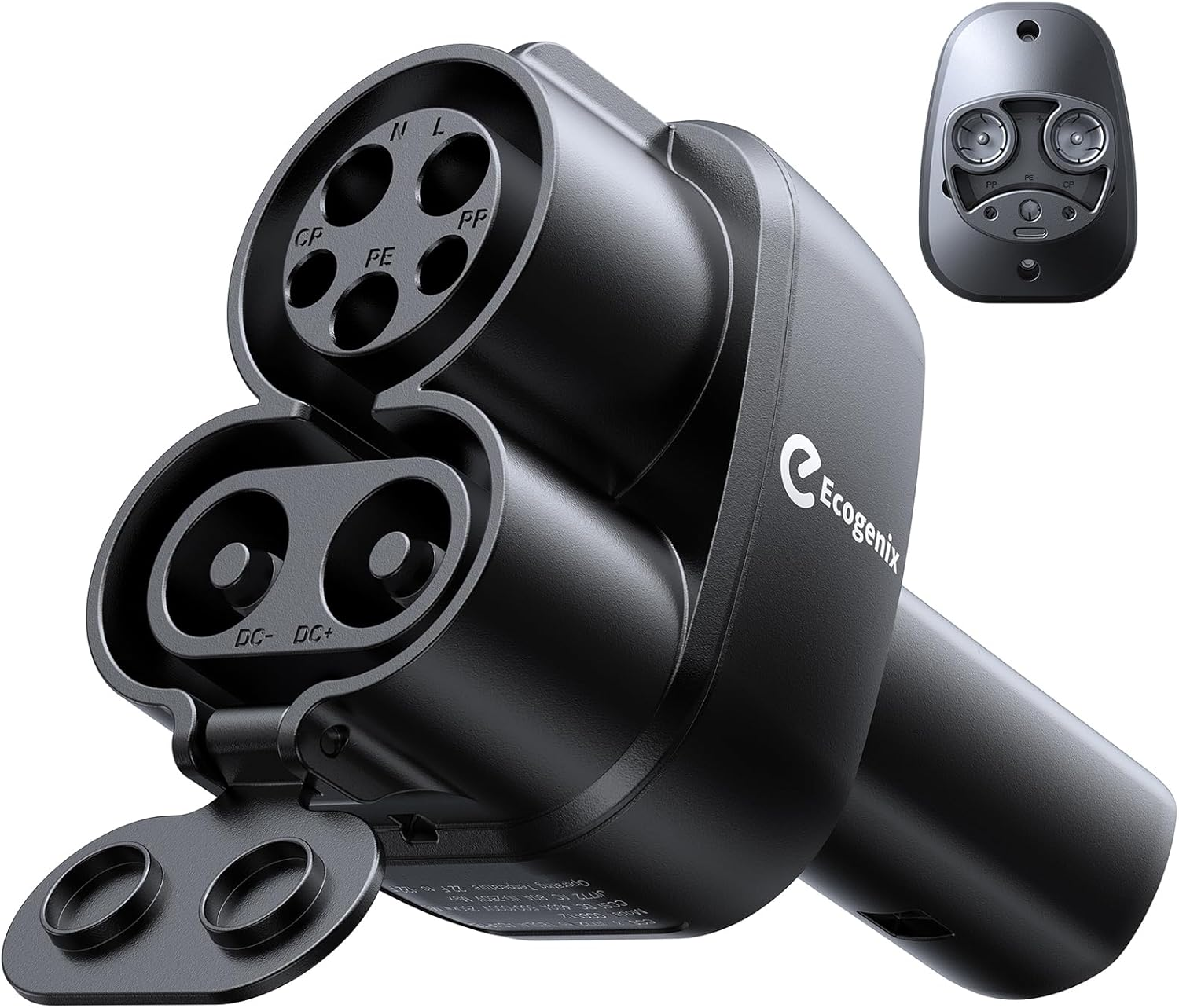
Ecogenix 2-in-1 CCS & J1772 to NACS Adapter
One Adapter, Two Standards — CCS DC Fast + J1772 Level 2
* Amazon affiliate link — EV Charger Scout may earn a small commission at no extra cost to you.
What Today's Charging Infrastructure Means for Tomorrow's EVs
If you buy a solid-state EV in 2027 or 2028, here's the realistic picture of what the public charging network will look like for you:
- →Most existing DCFC will still work — but at reduced speeds. A 150 kW charger connecting to a solid-state 800V car will deliver roughly 75 kW (limited by the charger). You'll be charging significantly slower than the car's capability.
- →350 kW chargers will be the sweet spot for 800V solid-state vehicles. The IONITY network in Europe, Ionna in North America, and Tesla V4 Superchargers are the stations that will unlock near-full solid-state charge speeds in 2028.
- →The connector you need won't change in North America (NACS) or Europe (CCS2). Physical compatibility is designed in. You don't need a new cable or adapter for solid-state — just a more powerful charger.
- →Public 350 kW+ coverage will still be limited in 2028. It will be concentrated on major highway corridors in the US, Europe, and East Asia. Rural and secondary route coverage will lag by several years.
- →Home charging remains relevant. A 11–22 kW AC home charger can fully restore a solid-state battery overnight in most use cases — overnight charging from a home charger is still the baseline for the majority of EV owners regardless of battery chemistry.
The Cost and Availability Question
First-generation solid-state EVs will be expensive. Toyota's initial solid-state vehicles are expected to be premium models — think Lexus rather than Corolla. Samsung SDI's cells going into BMW are not going into the entry iX1. The pattern will mirror every prior battery technology rollout: premium vehicles first, then mid-range, then entry-level over a 5–8 year window.
Cell cost projections from BloombergNEF suggest solid-state cells will reach cost parity with NMC cells between 2030 and 2033, assuming manufacturing scale-up proceeds as planned. Until then, solid-state vehicles will carry a premium of approximately $5,000–$12,000 over an equivalent liquid-electrolyte EV of similar range.
What This Means If You're Buying an EV Now
The honest answer: a 2024 or 2025 EV is not made obsolete by solid-state. The charging connector will remain compatible. The public charging network it uses will still be the same network. Its battery will degrade slower than earlier-generation EVs and should last 10–15 years with reasonable care. Waiting indefinitely for solid-state to become affordable and widely deployed is not a strategy — it extends the wait by another decade, through which you continue paying gasoline prices.
If you're buying in 2026, the most future-proofed purchase criteria are: an 800V architecture vehicle (for better compatibility with the high-power chargers that will serve solid-state vehicles too), a car from a manufacturer with an active solid-state program (more likely to receive software updates for next-generation infrastructure protocols), and a good active thermal management system that handles today's fast charging well.
800V architecture EVs available now that will be best positioned for solid-state-era charging infrastructure: Hyundai Ioniq 5/6 and Ioniq 9, Kia EV6 and EV9, Genesis GV60, Porsche Taycan, Audi e-tron GT, Lucid Air (900V), and the 800V GM Ultium derivatives (GMC Hummer EV, Cadillac Escalade IQ). BMW's first 800V vehicle is the Neue Klasse iX3 (late 2026); current i4/i5/i7/iX and Mercedes EQS/EQE are still 400V. These are the cars that will use the 350 kW+ chargers being deployed now and that solid-state vehicles will also require.
The Connector and Protocol Standards Being Updated
Standards bodies are actively updating specifications to accommodate higher-power charging:
- →NACS (J3400 / SAE J3400): Adopted as a US national standard in 2023. Rated for 1,000V DC and up to 900A = 900 kW theoretical maximum. Physical connector can handle solid-state charging power levels without modification.
- →CCS2 (IEC 62196-3): European standard. Rated for 1,000V DC, up to 500A. Being updated by CharIN consortium for 1,000V / 500A = 500 kW operation at existing connector geometry.
- →MCS (Megawatt Charging System): Designed primarily for commercial vehicles (trucks, buses) at 3.75 MW maximum. Not relevant for passenger solid-state EVs but indicative of the direction of infrastructure investment.
- →ChaoJi / GB/T 2015 DC: China's updated standard supports up to 900V / 600A. China's domestic network is being upgraded to this specification, with compatibility planned for future solid-state vehicles from CATL, BYD, and SAIC.
EV Charger Scout filters stations by power level — search for 350 kW DC fast chargers specifically to find the sites where next-generation EVs will charge at full speed. Available free on web, iOS, and Android.
Frequently Asked Questions
What makes a battery “solid-state”?
Solid-state batteries replace the flammable liquid electrolyte in today's lithium-ion cells with a solid material — typically a ceramic, glass, or polymer. The solid electrolyte is non-flammable, stable across a wider temperature range, and compatible with lithium metal anodes that store roughly 10× more energy per gram than the graphite anodes used in current EVs, enabling much higher energy density.
Will my current EV charger work with a solid-state EV?
Yes. The physical connector standards — NACS in North America and CCS2 in Europe — are designed to be forward-compatible, so you won't need a new cable or adapter for a solid-state vehicle. Most existing DC fast chargers will still work, just at reduced speeds; a 150 kW charger connected to an 800V solid-state car delivers only around 75 kW.
What charger do solid-state EVs actually need for fast charging?
350 kW DC chargers are the sweet spot for 800V solid-state vehicles, unlocking near-full charge speeds — networks like IONITY in Europe, Ionna in North America, and Tesla V4 Superchargers fall in this range. Lower-power 50–250 kW chargers will work but limit you to slower sessions, and 500+ kW hardware (such as MCS) is aimed at future 1,000V and commercial use.
Which manufacturers are closest to solid-state production?
As of 2026, multiple credible players are delivering pre-production cells. Toyota targets limited production by 2027–2028 with mass production around 2030, Nissan targets a 2028 vehicle, Samsung SDI is supplying samples to BMW, Stellantis, and GM, QuantumScape (backed by Volkswagen) delivered QSE-5 cells for qualification in 2024, and CATL is pursuing a semi-solid approach targeting 2027 integration.
Should I wait for a solid-state EV before buying?
No. First-generation solid-state EVs will be premium models carrying roughly a $5,000–$12,000 premium, with cost parity not expected until 2030–2033. A 2024 or 2025 EV isn't made obsolete — the connector and charging network stay the same. If buying in 2026, an 800V architecture vehicle with good thermal management is the most future-proofed choice, since it already uses the high-power chargers solid-state cars will need.
More guides on Industry News
Explore the full Industry News topic hub — related guides that build on this one.
NACS vs CCS in 2026: Which Connector Is Winning?
9 min read
Global EV Charging Hits 9 Million Points: What the Milestone Really Means for Drivers
15 min read
800V EVs in 2026: Which Networks Are Actually Ready for Fastest Charging?
16 min read
Bidirectional Charging Rewards: Earn Money at These New V2G-Enabled Spots
13 min read
Multi-Fuel Hubs: EV + Hydrogen Stations Arriving Together — Where to Find Them
14 min read
600 kW Ultra-Fast Chargers on US Highways: What They Are and Who Can Use Them
12 min read
Fleet EV Charging Hubs: How Rivian, Ford, and GM Are Solving Commercial Charging in 2026
14 min read
Megawatt Charging for Electric Trucks: New US Stations Opening in California and Texas
13 min read
China's 2026 Megawatt Truck Charging Hubs: What North American Drivers Can Learn
12 min read
V2G Is Live in 2026 – Which Stations Let Your EV Sell Power Back to the Grid
11 min read
Wireless EV Charging Pilots 2026: First Public Spots in the US and Europe
11 min read