 EV Charger Scout
Reliability has become the single most-debated topic in the public EV charging world. Drivers have learned to check apps before committing to a route, plan backup stations, and treat charging stops as something that occasionally goes sideways. The question is whether that experience is getting better — and which networks are actually earning trust versus just claiming it. Q1 2026 produced enough independent data to start drawing real conclusions.
How Network Uptime Is Measured
"Uptime" sounds simple but the definition varies across data sources. The three main methodologies you'll encounter:
| Method | What It Tracks | Limitation |
|---|---|---|
| Self-reported (by network) | Network's own backend status flags | Incentive to report favorably; may not reflect user experience |
| Third-party monitoring (PlugShare, Uptime Institute) | User check-ins, session success rates, timestamped failure reports | Dependent on user engagement; varies by region density |
| API availability sampling | Automated pings to station APIs at regular intervals | Measures data availability, not necessarily physical charger function |
The most credible Q1 2026 reliability data comes from a combination of federal NEVI compliance reporting (for NEVI-funded stations), J.D. Power's EV Experience Study, and independent analysis by organizations including the Rocky Mountain Institute, ChargeX Consortium, and state-level agency reports from California, Texas, and New York. No single source captures the full picture, but their convergence points clearly.
Q1 2026 Network Reliability Rankings
The rankings below combine reported uptime percentages, user satisfaction data, and session success rates (a session was "successful" if it started without a major fault and delivered charge). Data covers January through March 2026 for the contiguous United States.
| Network | Reported Uptime | Session Success Rate | Notable Strength |
|---|---|---|---|
| Tesla Supercharger | 99.2% | 98.7% | Highest density, integrated app experience |
| Ionna | 98.1% | 97.4% | Newest infrastructure, modern hardware |
| EVgo | 97.6% | 96.8% | Strong urban reliability, retrofitted to NACS |
| Electrify America | 94.2% | 91.3% | High power ceiling, rural highway coverage |
| ChargePoint (Level 2) | 96.8% | 95.1% | Massive network, consistent Level 2 |
| ChargePoint (DCFC) | 93.1% | 90.7% | Wide coverage, variable hardware age |
| Blink Network | 91.4% | 88.3% | Growing, older equipment in legacy sites |
| EV Connect | 90.8% | 87.9% | Fleet-focused, property-managed variance |
These figures represent averages across the entire network. Individual stations — particularly highway corridor locations or older urban sites — can deviate significantly from network-wide numbers. Always check recent user reviews for your specific planned station before relying on it for a critical charge.
Tesla Supercharger: Still the Benchmark
No other network comes close to Tesla's reported 99.2% uptime, and the reasons are structural rather than incidental. Tesla owns and directly operates its Supercharger hardware and software stack end-to-end. When a stall has a problem, Tesla's backend knows immediately — the station flags itself in the app before most drivers arrive. Maintenance response times in high-traffic areas average under 24 hours based on user reports.
The network's Q1 2026 reliability is particularly impressive given that it absorbed a significant increase in non-Tesla vehicles. The open network rollout — which has seen hundreds of thousands of CCS and NACS non-Tesla vehicles register — added session volume without a corresponding reliability drop. That's an engineering achievement worth acknowledging.
If you're driving a non-Tesla CCS vehicle, you need a NACS-to-CCS adapter to use Superchargers. Plan this before a trip — don't show up and assume the station has Magic Dock capability. Not all Supercharger locations have been retrofitted.
DC Fast Charging Upgrade · EV Shop
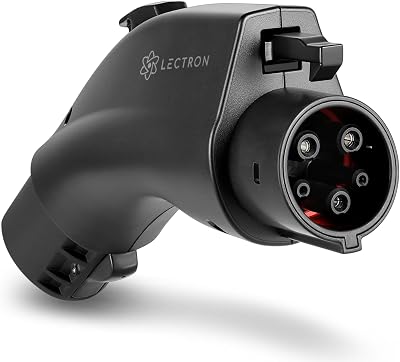
Lectron Vortex Plus NACS-to-CCS Adapter
The Gold Standard — UL 2252 Certified with Safety Interlock
* Amazon affiliate link — EV Charger Scout may earn a small commission at no extra cost to you.
Ionna: The Highest-Uptime New Entrant
Ionna — backed by a consortium of eight automakers (BMW, GM, Honda, Hyundai, Kia, Mercedes-Benz, Stellantis, and Toyota) — deployed its first stations in late 2024 and spent Q1 2026 aggressively expanding. Its 98.1% uptime figure benefits from having entirely new hardware (no legacy equipment to fail), a rigorous site certification process, and network redundancy built into its architecture from the ground up.
Ionna stations are designed for 400 kW peak delivery with NACS connectors as standard, plus CCS1 at most locations. The network's smaller station count (compared to Electrify America or EVgo) means its uptime average isn't yet tested by the sheer scale challenges larger networks face — but its per-station reliability is genuinely excellent.
Electrify America: High Power, Mixed Reliability
Electrify America's 94.2% average uptime number is the most contentious in the industry. The network operates at some of the highest power levels in the US (up to 350 kW), has the best highway corridor coverage outside Tesla, and has made genuine reliability improvements since its troubled 2020–2022 period. But its session success rate of 91.3% trails its reported uptime significantly — a gap that reflects hardware fault rates that don't always register as "offline" in backend systems.
State-level analysis is revealing. California and the Northeast show EA uptime above 95%. The Southeast and Mountain West tell a different story, with some corridors averaging below 90% session success. EA acknowledged reliability challenges in a Q1 2026 investor presentation and cited a hardware replacement program targeting approximately 30% of its oldest stalls by end of 2026.
The Electrify America Reliability Improvement Plan
- →Replacement of Gen 1 liquid-cooled cable assemblies — the most common failure point in older stations
- →Remote diagnostics upgrade: all stations now stream real-time health data to EA operations center
- →Increased on-site maintenance frequency for high-traffic highway stations (weekly vs. monthly previously)
- →Improved payment terminal redundancy — card reader failures were a significant cause of session-start failures
ChargePoint: Two Very Different Stories
ChargePoint is the world's largest charging network by station count, but that scale conceals a stark split: its Level 2 network performs well (96.8% uptime) while its DC fast charging fleet trails at 93.1%. The gap exists because ChargePoint's DCFC portfolio includes equipment of widely varying ages and manufacturing generations — the oldest units date to 2015 and are showing hardware fatigue.
ChargePoint's business model — selling hardware and software to site hosts rather than owning and operating stations directly — means reliability also depends on the site host. A shopping mall that doesn't prioritize maintenance contracts will have worse ChargePoint reliability than a dedicated charging hub with on-site staff.
What Blink and EV Connect Need to Fix
Blink's 91.4% uptime and EV Connect's 90.8% represent the bottom of the major-network rankings, and both face similar root causes: older equipment, property-managed maintenance, and historically lower investment in remote monitoring infrastructure.
- →Both networks are mid-upgrade cycle — newer stations in 2024–2026 deployments perform significantly better than 2019–2022 hardware
- →Blink's acquisition of SemaConnect hardware and its own Gen 3 units are showing better Q1 2026 numbers than the legacy fleet
- →EV Connect's fleet-focused deployment (workplace and destination charging) means lower session volume per station, which can delay fault detection
For any network outside the top tier, always check PlugShare check-ins for your specific station within the last 72 hours. A recently reported working station is more reliable than any network average.
Roadside Safety Pick · EV Shop

AUTOWN Tire Repair Kit — Plug & Patch
Fix a Flat Without a Tow — 60-Piece Plug Repair Kit
* Amazon affiliate link — EV Charger Scout may earn a small commission at no extra cost to you.
International Comparison: How US Uptime Compares Globally
For context, US network reliability — while improving — still lags several other markets. European networks under AFIR compliance obligations (which require 97% uptime for publicly funded DCFC) have driven investment in reliability that the US market hasn't yet replicated at scale.
| Region | Leading Network | Avg Uptime (Q1 2026) | Key Driver |
|---|---|---|---|
| United States | Tesla Supercharger | 99.2% | Vertical integration, direct operations |
| Europe | IONITY | 98.6% | AFIR compliance obligations, premium positioning |
| United Kingdom | Pod Point (EDF) | 97.8% | Utility-backed investment, dense urban |
| Netherlands | Allego | 97.4% | High EV penetration, strong grid infrastructure |
| Australia | Chargefox | 96.9% | Telstra-backed infrastructure, remote monitoring |
| South Korea | E-pit (Hyundai) | 98.1% | Manufacturer-operated, integrated quality control |
Factors That Predict Station Reliability
Beyond the network rankings, specific factors predict whether any individual station is likely to be working when you need it:
| Factor | Effect on Reliability |
|---|---|
| Manufacturer-operated vs. host-managed | Manufacturer-operated stations average 4–6% higher uptime |
| Hardware age (under 3 years) | Newer hardware has significantly lower component failure rates |
| Remote telemetry capability | Stations with real-time health monitoring detect faults 3× faster |
| Urban vs. rural location | Rural highway stations have slower maintenance response, lower availability |
| High-traffic vs. low-traffic | High-traffic stations get more frequent monitoring visits |
| Recent user check-in (PlugShare) | Positive check-in within 72 hours is the best single predictor of working station |
How to Protect Yourself from Reliability Failures
Even with the best networks, planning for reliability failures makes road trips significantly less stressful. A practical approach:
- 1Always plan a backup station within 10–15 miles of your primary fast charging stop
- 2Check PlugShare check-ins for your specific planned station within 24–48 hours of departure
- 3On long routes, favor high-volume stations over isolated single-stall installations
- 4If using a network with sub-95% reliability, prefer their newer locations over older legacy sites
- 5Download the network app and complete payment setup before your trip — failed payment terminal sessions are a major source of non-uptime failures
- 6Carry a Level 1 or portable Level 2 charger as a true emergency backup for routes through areas with limited DC fast charging density
The US EV charging reliability picture improved meaningfully in Q1 2026 compared to two years prior. NEVI compliance requirements for newly funded stations (which mandate 97% uptime and real-time monitoring) are beginning to push baseline standards higher across the industry — not just for federally funded stations, but as a competitive benchmark all networks are being measured against.
Bottom Line
Tesla Supercharger and Ionna are in a class of their own for reliability. EVgo has made meaningful improvements and earns strong marks for urban reliability. Electrify America is improving but still has regional inconsistency that needs addressing. ChargePoint's Level 2 network is solid; its DCFC side is a mixed bag depending on hardware vintage. Blink and EV Connect are works in progress.
The encouraging trend is directional: Q1 2026 network-wide session success rates are up across every major network compared to the same period in 2024. The industry is measurably getting more reliable — it just isn't there uniformly yet.
Frequently Asked Questions
Which EV charging network is the most reliable in 2026?
Tesla Supercharger leads with a reported 99.2% uptime and a 98.7% session success rate in Q1 2026, thanks to vertical integration and direct operation of its hardware and software. Ionna, the newest major entrant, ranks second at 98.1% uptime because its entirely new hardware has no legacy equipment to fail.
What does “uptime” actually mean for a charging network?
Uptime is measured differently depending on the source — self-reported network status flags, third-party monitoring like PlugShare check-ins, or automated API availability sampling. Each method has limitations, so the most credible picture comes from combining federal NEVI compliance data, J.D. Power studies, and independent analysis. Reported uptime can also differ from session success rate, the share of sessions that actually start and deliver charge.
Why does Electrify America's reliability vary so much?
Electrify America reports 94.2% average uptime but a lower 91.3% session success rate, reflecting hardware faults that don't always register as offline. Reliability is strong in California and the Northeast (above 95%) but weaker in the Southeast and Mountain West. The network has announced a hardware replacement program targeting roughly 30% of its oldest stalls by the end of 2026.
How can I avoid a dead charger on a road trip?
Plan a backup station within 10–15 miles of your primary stop and check PlugShare check-ins for your specific station within 24–48 hours of departure. Favor high-volume stations over isolated single-stall sites, complete payment setup in the network app before you go, and carry a portable Level 2 or Level 1 charger as a true emergency backup.
Does US charging reliability lag other countries?
Yes, though it is improving. European networks under AFIR rules must hit 97% uptime for publicly funded DC fast chargers, which has driven reliability investment the US hasn't yet matched at scale. Leading networks abroad — IONITY in Europe, Pod Point in the UK, and E-pit in South Korea — all reported uptime above 97% in Q1 2026.
More guides on Network News
Explore the full Network News topic hub — related guides that build on this one.
India's EV Charging Boom 2026: Top Networks, Connector Standards, and Visitor Tips
13 min read
Ultra-Fast 400 kW Charging in Europe: Ionity Corridors Every EV Driver Needs to Know
12 min read
EVgo's NACS Expansion in 2026: What It Means for Your EV
8 min read
Ionna Network Hits Top 10: Fastest Growing DC Chargers in the US Right Now
10 min read