 EV Charger Scout
"Future-proofing" is often overused marketing language, but in EV charging it describes something specific and real: the charging infrastructure landscape is actively changing, and decisions you make today — which adapter you buy, which network accounts you set up, how you plan your routes — determine whether that change makes your life easier or harder over the next five years.
This guide is structured around practical decisions, not speculation. Here's what to do right now, why it matters, and where the industry is heading globally.
Step One: Know Your Vehicle's Exact Connector
This seems obvious, but a significant number of EV owners don't know which connector type their car actually has. This matters because your adapter needs (if any) flow entirely from this single piece of information.
- →North American NACS vehicle (2025+ from most brands) — You already have the dominant connector. You need a NACS-to-CCS1 adapter only if you encounter older CCS-only stations, which is increasingly rare as networks upgrade. No other adapters needed for normal charging.
- →North American CCS1 vehicle (pre-2025 most brands) — You need a CCS1-to-NACS adapter to use Tesla Superchargers. This unlocks the largest single fast charging network in North America. This is your highest-value adapter purchase.
- →European/Australian CCS2 vehicle — You already plug natively into every European DCFC and every European Supercharger. No adapters needed for normal charging in your market. CHAdeMO adapter optional if you travel to Japan.
- →CHAdeMO vehicle (Japan/legacy) — Your infrastructure options are narrowing. CHAdeMO stalls in Japan remain available, but new installations have stopped in most markets. A CCS2 adapter for CHAdeMO does not exist in a practical form. This is the connector situation with the most constrained long-term outlook.
- →Chinese GB/T vehicle — In mainland China, you're on the dominant standard with the world's largest charging network. If your vehicle is exported with CCS2 or CCS1 for overseas markets, treat it accordingly.
Check your vehicle's spec sheet or the manufacturer app to confirm your connector type definitively. The physical port is the most reliable check — NACS is a compact oval; CCS1 is a large combined socket; CCS2 has a Type 2 upper section; CHAdeMO is a large separate round connector.
Step Two: The Adapter Decisions
If You Have a North American CCS1 Vehicle
Buy a CCS1-to-NACS adapter. This is the single most impactful accessory you can add to your EV kit. Here's the priority order for sourcing one:
- 1Check your manufacturer's owner portal first. Rivian and Ford ran free adapter programs for qualifying vehicles. GM had a similar program. You may be entitled to one at no cost.
- 2If no manufacturer program applies, buy Tesla's official NACS adapter ($50–$60 USD). It has the best Supercharger compatibility, proper billing communication, and UL certification.
- 3If you want more thermal protection for regular high-power charging, consider the Lectron Vortex Plus or INFGO adapter — both UL-listed with better thermal management at a modest price premium.
- 4Keep a NACS-to-CCS1 adapter handy if you switch to a NACS vehicle in the future — it covers the reverse scenario at older CCS-only stations.
DC Fast Charging Upgrade · EV Shop
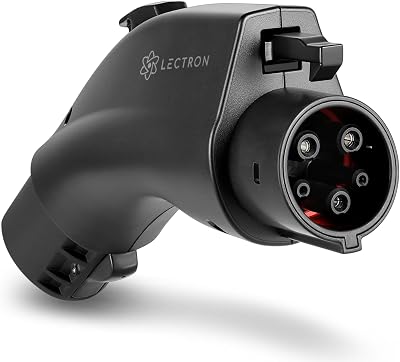
Lectron Vortex Plus NACS-to-CCS Adapter
The Gold Standard — UL 2252 Certified with Safety Interlock
* Amazon affiliate link — EV Charger Scout may earn a small commission at no extra cost to you.
If You Have a 2025+ North American NACS Vehicle
Your core adapter need is minimal. However, a NACS-to-J1772 adapter (often included with the vehicle) lets you use the vast installed base of J1772 Level 2 stations. Confirm yours came in the box. For DCFC, nearly all modern stations have NACS cables, and the remaining CCS1-only stations are a shrinking percentage of the network.
If You Drive in Multiple Markets
International driving with your own EV is logistically complex, but if you do it regularly, adapter strategy matters:
- →North American NACS vehicle to Europe — Your vehicle's NACS connector has no native European infrastructure support. CCS2 adapters for NACS vehicles exist but are not standardized. Practically, renting a local CCS2 vehicle is simpler for extended European stays.
- →European CCS2 vehicle to Japan — CCS2 infrastructure is growing in Japan but is not yet comprehensive. Identify specific CCS2 station locations before travel, or consider a CHAdeMO adapter if your vehicle supports it (some manufacturers offer this).
- →Any vehicle to China — GB/T adapters for incoming connector types are available through Chinese charging operators and some EV accessory retailers in China. Confirm availability and compatibility with your specific vehicle before relying on this for a Chinese trip.
Step Three: Network Accounts — Set Them Up Now
The second-highest value action after having the right adapter is having your charging network accounts fully configured before you need them. Creating a Tesla account while standing at a Supercharger with 5% battery remaining is a specific kind of stress you don't need.
North American Network Accounts to Have
- →Tesla — Free to create, required for Supercharger access for non-Tesla vehicles. Add a payment method, then go to Charging → Add Non-Tesla to enable non-Tesla billing.
- →Electrify America — The largest non-Tesla DCFC network in the US. A monthly membership significantly reduces per-session costs. The Guest mode is available but expensive per kWh.
- →EVgo — Strong urban coverage, particularly in coastal markets. Account required for the best rates.
- →ChargePoint — Broad Level 2 coverage and solid DCFC network. ChargePoint accounts work across multiple partner networks.
- →Blink — Patchy but present. Worth having the app installed.
- →NRCAN (Canada) — Natural Resources Canada's network directory is useful for Canadian charging route planning.
European Network Accounts to Have
- →Tesla — For Supercharger access as a non-Tesla driver.
- →IONITY — The primary European highway DCFC network. Membership significantly reduces per-session cost versus the wallet rate.
- →Fastned — Strong Netherlands/Germany/UK presence; expanding across Europe.
- →Plugsurfing or Smoov — Roaming aggregators that give you one account for multiple networks. Plugsurfing covers 400+ networks across Europe with a single RFID card — excellent value for multi-country drivers.
- →Network-specific apps — For your home country's dominant network (Allego, bp pulse, Pod Point UK, EnBW, Mer, Recharge, etc.).
Roadside Safety Pick · EV Shop

Airmoto Cordless Tire Inflator
Compact Cordless Air Compressor — Digital Pressure, Auto Shutoff
* Amazon affiliate link — EV Charger Scout may earn a small commission at no extra cost to you.
Step Four: Route Planning Before You Leave
Reactive charging — figuring out where to charge while already driving — is the primary source of range anxiety on road trips. Proactive planning eliminates it almost entirely.
- 1Use a route planner (ABRP, Google Maps EV routing, or your car's built-in routing if available) to identify charging stops for any trip over your car's highway range.
- 2Confirm each planned stop with EV Charger Scout or PlugShare to verify current operational status and whether your connector type is supported.
- 3Identify backup stations at each leg — the second-nearest station to each planned stop. If your primary station is down or full, you want to know immediately where to go.
- 4For NACS-vehicle owners, enable your car's navigation-integrated charging routing if available. It automatically preconditions your battery before arrival, which dramatically improves actual DC charging rates at the station.
- 5Plan to arrive at each charging stop with at least 10–15% remaining. The final few percent of battery range is always less efficient than the estimates, especially at highway speeds in cold weather.
Step Five: Staying Current as the Network Evolves
The charging landscape in 2026 is still changing faster than most other infrastructure sectors. What's useful to track:
- →NACS migration at existing CCS stations — Electrify America, EVgo, and ChargePoint are all adding NACS connectors to existing stations. Over the next 12–24 months, the number of CCS1-only stations will decline significantly. If you're a CCS1 driver who's been avoiding certain networks because they only had CCS1, check back periodically — your options are expanding.
- →V4 Supercharger rollout — Tesla's V4 stations offer higher peak power (up to 325kW vs. 250kW for V3) and do not share power between stalls. More V4s mean faster sessions with less wait-time variability.
- →European fast charging expansion — IONITY, Fastned, Allego, and national operators are all expanding capacity, particularly at highway locations. Coverage gaps in Southern and Eastern Europe are closing.
- →Australia's CCS2 rollout — Australia is deploying CCS2 infrastructure rapidly under the National Electric Vehicle Strategy, with highway charging corridors being funded nationally. Coverage outside major cities is improving quarter-by-quarter.
The 2026 Adapter Situation in Numbers
| Driver Type | Adapters to Own | Priority |
|---|---|---|
| NA CCS1 vehicle owner | CCS1-to-NACS (for Superchargers) | High — biggest range expansion |
| NA NACS vehicle owner | NACS-to-J1772 (usually included), NACS-to-CCS1 (for old stations) | Medium and declining |
| EU/AU CCS2 vehicle owner | None needed for home market; CHAdeMO adapter for Japan travel | Low unless traveling |
| JP CHAdeMO vehicle owner | Research CCS2 availability in non-Japan markets before travel | Travel-dependent |
EV Charger Scout lets you search stations by connector type and location before any trip. Use it to understand the charging landscape along your regular routes — and revisit quarterly as new stations come online.
Frequently Asked Questions
Which adapter should a North American CCS1 vehicle owner buy first?
A CCS1-to-NACS adapter is the single most impactful accessory, because it unlocks Tesla's Supercharger network — the largest single fast charging network in North America. Check your manufacturer's owner portal first, since Rivian, Ford, and GM ran free adapter programs for qualifying vehicles. If no program applies, Tesla's official NACS adapter at $50–$60 offers the best Supercharger compatibility and proper billing communication.
Do 2025+ NACS vehicles need any adapters?
Their core adapter need is minimal. A NACS-to-J1772 adapter, often included with the vehicle, lets you use the large installed base of J1772 Level 2 stations, so confirm yours came in the box. For DC fast charging, nearly all modern stations have NACS cables and the remaining CCS1-only stations are a shrinking percentage of the network.
Do European or Australian CCS2 drivers need adapters?
Generally no — a CCS2 vehicle plugs natively into every European DC fast charger and every European Supercharger, so no adapters are needed for normal charging in those markets. A CHAdeMO adapter is optional only if you travel to Japan. Adapter priority for these drivers is low unless they're traveling internationally.
Which network accounts should I set up in advance?
In North America, having Tesla, Electrify America, EVgo, ChargePoint, and Blink accounts configured ahead of time covers most situations, with a Tesla account required for Supercharger access on non-Tesla vehicles. In Europe, set up Tesla, IONITY, Fastned, and a roaming aggregator like Plugsurfing that covers 400+ networks with one card. Creating accounts before you need them avoids stress at a low battery.
How is the charging network expected to change over the next few years?
Electrify America, EVgo, and ChargePoint are all adding NACS connectors to existing stations, so the number of CCS1-only stations will decline significantly over 12–24 months. Tesla's V4 Supercharger rollout offers higher peak power (up to 325kW versus 250kW for V3) without sharing power between stalls. European operators are expanding capacity and Australia is deploying CCS2 rapidly under its national strategy.
More guides on Strategy & Planning
Explore the full Strategy & Planning topic hub — related guides that build on this one.
Managed Charging & Off-Peak EV Rates: How to Save $100+ Per Month in 2026
13 min read
Plug and Charge 2026: Which EVs Auto-Start at Electrify America, EVgo & Ionna
12 min read
Home vs. Public EV Charging Costs in 2026: Real Rates, the Math, and How to Save
14 min read
AI-Powered Smart Charging Apps: How They Predict Availability at Your Nearest Station
11 min read
Winter EV Battery Care & Charging 2026: Everything You Need to Know to Maximize Range and Speed in the Cold
13 min read