 EV Charger Scout
The single most misunderstood aspect of EV ownership economics is charging cost. Most EV owners pay wildly different amounts per mile of electric driving depending on when they charge, where they charge, and whether they bothered to check what the rate actually was before starting the session. The difference between the cheapest and most expensive options for the same amount of energy — measured in dollars per equivalent gallon — can be as large as the difference between buying gas at a Costco and a highway rest stop. This guide breaks down the real numbers, explains how to calculate your actual cost, and covers how to use EV Charger Scout's built-in calculator to estimate session cost before you arrive.
The Three Tiers of EV Charging Cost
Before comparing specific numbers, it's useful to understand that EV charging costs exist in three broad tiers based on where and how you charge:
- →Tier 1 — Home charging (off-peak): The lowest cost per kWh you'll encounter. Typical rates range from $0.06 to $0.14 per kWh in most US states if you charge at night during off-peak hours. In parts of Europe, night-rate residential electricity is similarly cheap. This is where 80–90% of EV owner charging happens for drivers with home access.
- →Tier 2 — Workplace and destination charging (Level 2): Often free or subsidized at employer-provided stations. Paid Level 2 charging at public garages, hotels, and parking structures typically runs $0.15–$0.30 per kWh or $1–$2 per hour.
- →Tier 3 — DC fast charging (public networks): The most expensive option. Ranges from $0.28 to $0.70+ per kWh in the US, depending on network, subscription status, and whether you pay ad-hoc. In Europe, highway DC fast charging runs €0.49–€0.89/kWh depending on the network and pricing tier.
Home Charging: The Baseline
United States
The average US residential electricity rate in 2026 is approximately $0.16–$0.17 per kWh. However, averages obscure significant regional variation: Hawaii averages above $0.35/kWh while several Mountain West and Great Plains states sit below $0.12/kWh. Most utilities offer Time of Use (TOU) rates that provide substantial discounts for overnight charging — typically between 11 PM and 7 AM.
| State / Region | Avg. Residential Rate | Off-Peak TOU (typical) |
|---|---|---|
| California (PG&E) | $0.28–$0.34/kWh | $0.17–$0.21/kWh (super off-peak) |
| Texas (ERCOT variable) | $0.12–$0.16/kWh | $0.06–$0.09/kWh (night) |
| New York (Con Ed) | $0.20–$0.27/kWh | $0.12–$0.16/kWh |
| Florida (FPL) | $0.13–$0.15/kWh | $0.09–$0.11/kWh |
| Pacific Northwest (hydro) | $0.10–$0.12/kWh | $0.07–$0.09/kWh |
| Midwest (ComEd, Ameren) | $0.12–$0.15/kWh | $0.07–$0.10/kWh |
At $0.10/kWh (a reasonable overnight TOU rate in many markets), charging a 75 kWh battery from 20% to 80% costs about $4.50. At the national average of $0.17/kWh, the same session costs $7.65. Compare that to filling a 15-gallon gas tank at $3.50/gallon: $52.50. The economics are stark — even at full residential rate, home EV charging is substantially cheaper per mile than gasoline.
Europe
Residential electricity rates in Europe vary enormously by country and have been particularly volatile following the 2022 energy crisis. As of 2026, most major markets have stabilized but remain higher than pre-2022 levels. Representative residential rates: Germany €0.32–$0.38/kWh, France €0.21–$0.25/kWh (regulated tariff), UK £0.24–£0.28/kWh, Netherlands €0.29–$0.34/kWh, Spain €0.20–$0.27/kWh. Night-rate tariffs are available in most markets and typically reduce the effective rate by 25–40%.
Australia and Other Markets
Australian residential electricity rates average A$0.28–$0.35/kWh depending on state, with significant TOU discounts available through retailers in Queensland, NSW, and Victoria. Japan's residential rates are approximately ¥30–38/kWh. South Korea's are among the lowest in Asia at approximately ₩120–140/kWh. In all these markets, overnight TOU charging is available and cost-effective compared to public network rates.
Setting up a Time of Use rate plan with your electricity provider is the single most impactful step you can take to reduce your EV charging cost. For most drivers, it reduces the cost of home charging by 30–50% compared to the standard flat rate.
Home Charging Upgrade · EV Shop

ChargePoint Home Flex
Best J1772 — Up to 50A, Energy Star Certified, Any Non-Tesla EV
* Amazon affiliate link — EV Charger Scout may earn a small commission at no extra cost to you.
Public DC Fast Charging: The Real Costs
United States: Network-by-Network Breakdown
US public DC fast charging rates vary significantly between networks and even between subscription and ad-hoc pricing at the same charger. Here's a realistic picture of 2026 pricing:
| Network | Ad-Hoc Rate | Subscription Rate | Subscription Cost |
|---|---|---|---|
| Electrify America | $0.48–$0.58/kWh | $0.31–$0.36/kWh | $7/mo (Pass+) |
| EVgo | $0.42–$0.55/kWh | $0.28–$0.34/kWh | $6.99/mo (EVgo Plus) or $12.99 PlusMax |
| ChargePoint (DC) | $0.35–$0.55/kWh | Varies by station | Free account (higher rates) |
| Tesla Supercharger | $0.24–$0.36/kWh (members) | $0.24–$0.36/kWh | Tesla membership |
| Blink (DCFC) | $0.40–$0.69/kWh | $0.33–$0.49/kWh | $4.99/mo |
| Ionna | $0.35–$0.44/kWh | $0.26–$0.32/kWh | $9.99/mo or OEM plan |
The most expensive public DC charging scenario — $0.65–$0.70/kWh at ad-hoc Electrify America or Blink on a hot day when charging is slower — can approach or exceed the per-mile cost of driving a fuel-efficient gasoline car. The cheapest public fast charging scenario (Tesla Supercharger at off-peak hours for Tesla members at $0.24/kWh) is still 3–4x more expensive than the best home charging rates.
The practical takeaway: if you rely primarily on public DC fast charging for your daily driving (for example, you live in an apartment without home charging access), the economics of EV ownership look significantly less favorable than for a driver with access to home charging.
Europe: Subscription vs. Ad-Hoc at Highway Chargers
European DC fast charging costs are broadly comparable to the US but with different network structures. IONITY charges €0.79/kWh ad-hoc and €0.35–$0.45/kWh on subscription plans (IONITY Passport or through OEM partner plans). Fastned charges €0.79/kWh ad-hoc and €0.49/kWh for Fastned subscription members. Allego and other networks are broadly similar.
Roaming platforms — Plugsurfing, Chargemap, and Mer Connect — aggregate multiple networks under a single subscription, often providing rates between the ad-hoc and the network's own subscription rate. For drivers crossing multiple countries, a roaming platform subscription is often the most cost-effective approach.
How to Calculate Your Actual Cost Per Session
The charging calculator built into EV Charger Scout lets you estimate the cost of any specific charging session before you start. Here's how the math works, so you understand what the calculator is computing:
The key inputs are: your vehicle's usable battery capacity (in kWh), your current state of charge (%), your target state of charge (%), the charger's energy rate ($/kWh or €/kWh), and — if the network prices by time rather than energy — the per-minute rate.
Energy to add (kWh) = Battery capacity × (target SoC% − current SoC%)
For example: a 77 kWh Hyundai Ioniq 5 charging from 15% to 80% needs 77 × (0.80 − 0.15) = 50.05 kWh added.
Session cost = Energy to add × rate per kWh
At $0.36/kWh (Electrify America subscription): 50.05 kWh × $0.36 = $18.02At $0.52/kWh (ad-hoc): 50.05 kWh × $0.52 = $26.03
Session time is estimated using the vehicle's max charge rate, the charger's rated output, and the charging curve. Most EVs accept maximum rated power from a low state of charge but taper significantly above 70–80% SoC — which is why charging to 80% is nearly always faster per kWh added than charging to 100%.
Open any station in EV Charger Scout and tap the Charging Calculator tab to run this calculation with your vehicle's actual battery size and your current SoC pre-filled. You can also adjust the rate to match the network's subscription or ad-hoc pricing to see the cost difference in real terms before you plug in.
DC Fast Charging Upgrade · EV Shop
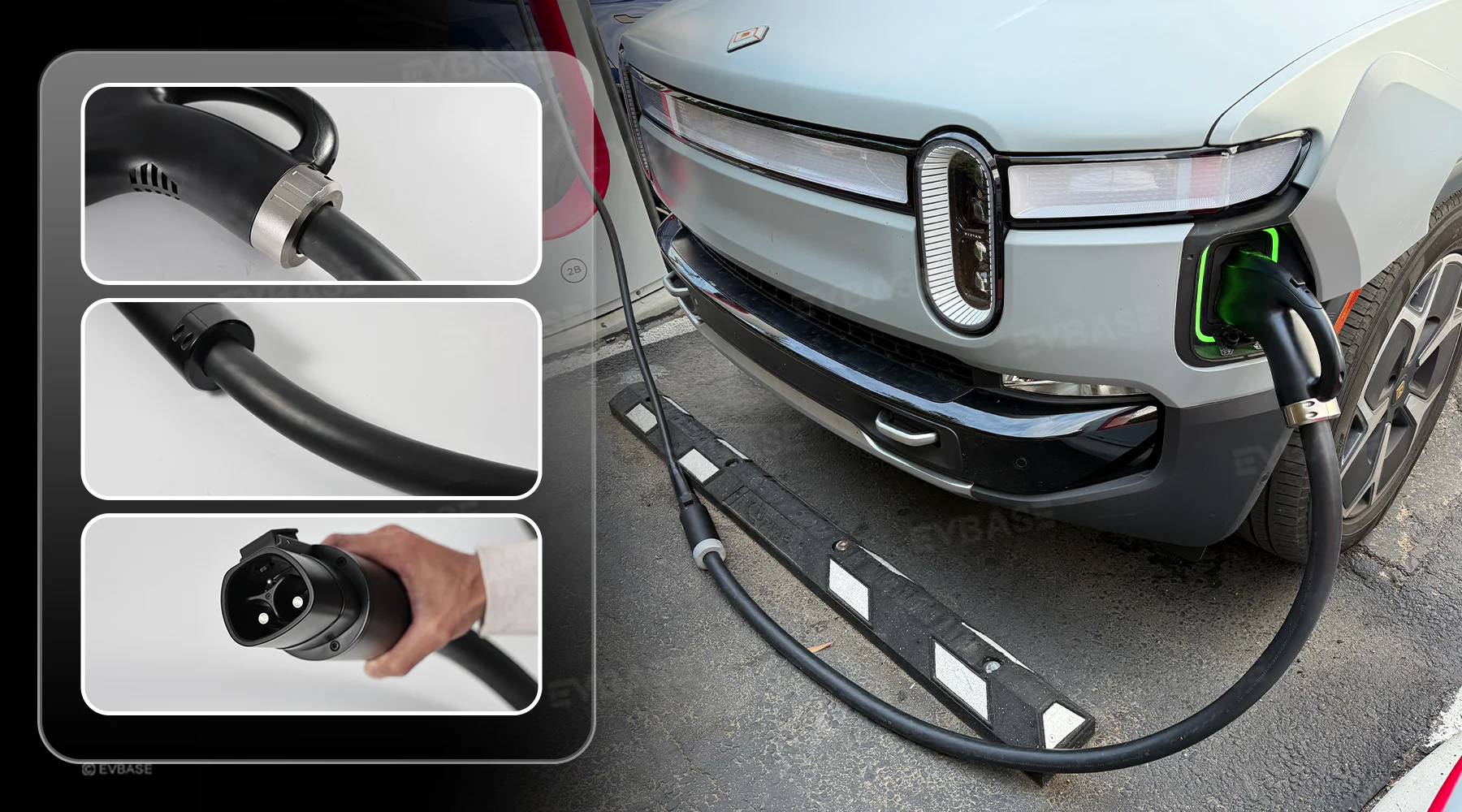
EVBASE NACS to CCS1 Adapter with Extension Cable
Max 350A/1000V with Extension Cable — Charge CCS1 EVs at Tesla Superchargers
* EVBASE affiliate link (via AWIN) — EV Charger Scout may earn a small commission at no extra cost to you.
Cost Savings Strategies That Actually Work
For Apartment and Condo Dwellers
- →Negotiate with your building. Many landlords and condo associations aren't opposed to Level 2 charging installation — they just haven't been asked. A ChargePoint CT4000 or similar unit can be installed at a parking space with cost-sharing arrangements that make it viable for building owners.
- →Use workplace charging as your primary "home" charge. If your employer provides free or subsidized Level 2 charging, this is effectively free fuel. Optimize your daily schedule to arrive at work with a low state of charge and leave with a full one.
- →Use a roaming subscription. If most of your charging will be public Level 2 and DC fast charging, compare network subscription costs against your expected monthly energy spend. At $20/month, a subscription that saves $0.15/kWh pays for itself after roughly 133 kWh per month — less than most EV drivers add in a week of regular use.
For Home Charging Optimizers
- →Set your charge schedule. Every major EV and home charger supports a scheduled charging feature. Set it to start at the beginning of your utility's off-peak window (often 11 PM or midnight) and complete before morning peak rates start.
- →Consider solar with a smart charger. In markets with suitable solar irradiance, pairing a rooftop solar system with a smart charger can reduce your effective charging cost to near zero for midday charging. Brands like Ohme, Easee, and Tesla Wall Connector include solar-integration software.
- →Don't pay for DCFC you don't need. For daily commuters whose cars never need fast charging during the week, avoid DC fast charger subscriptions — the monthly fee outweighs the savings unless you're doing multiple fast charges per month.
For Road Trippers
- →Stack your subscriptions strategically. Electrify America subscription + EVgo Plus together cost about $21/month and cover a significant portion of US fast charging. If you road trip monthly, the savings on two or three stops will pay for both subscriptions.
- →Know your OEM plan. Many automakers include free or subsidized fast charging for the first 1–3 years of ownership. Hyundai includes complimentary Electrify America sessions; Volkswagen ID.4 buyers get EA credits; Ionna founding-OEM vehicles (GM, BMW, etc.) have preferential rates. Use these before they expire.
- →Charge at Tesla Superchargers if you can. For vehicles with NACS ports or Magic Dock compatibility, Tesla Supercharger rates are among the most competitive in North America. The network's density along US highways makes it the most practical fast charging option on most road trip routes.
Per-minute pricing is the most deceptive charging format. If your vehicle charges slowly (say, 50 kW max) at a per-minute rate designed for 150–250 kW vehicles, you pay the same time cost for much less energy. Always check whether a station's pricing is per kWh or per minute before starting a session, and compare the implied cost per kWh if it's per-minute pricing.
The Bottom Line
Home charging — particularly with a TOU rate plan — remains by far the cheapest way to power your EV. The break-even between EV operating cost and gasoline depends on whether you have that home charging access. A Tesla Model 3 owner who charges at home at $0.10/kWh pays roughly $1.00 per 100 miles in electricity. The same driver relying on Electrify America at ad-hoc rates pays roughly $2.80–$3.40 per 100 miles — still competitive with a gasoline car but without the strong cost advantage of home charging.
The best advice is simple: charge at home when you can, subscribe to one or two networks for road trips, and use EV Charger Scout's calculator to know your cost before you commit to a session. A few minutes of planning per charging stop can save meaningful money over the life of your vehicle.
Frequently Asked Questions
Is it cheaper to charge an EV at home or at public stations?
Home charging is by far the cheapest, especially on an off-peak time-of-use rate. Typical home off-peak rates run $0.06–$0.14/kWh in most US states, while public DC fast charging ranges from $0.28 to over $0.70/kWh. Even the cheapest public fast charging is still several times more expensive than the best home rates.
How much does a typical fast charging session actually cost?
It depends on energy added and the rate. For a 77 kWh Hyundai Ioniq 5 charging from 15% to 80%, you add about 50 kWh — which costs roughly $18 at a $0.36/kWh subscription rate or about $26 at a $0.52/kWh ad-hoc rate. You can estimate this in EV Charger Scout's built-in charging calculator before you arrive.
How much can a time-of-use rate plan save me?
Setting up a Time of Use rate plan with your electricity provider is the single most impactful step for cutting charging cost. For most drivers it reduces the cost of home charging by 30–50% compared to a standard flat rate, since overnight off-peak windows (often 11 PM to 7 AM) are dramatically cheaper.
Why is per-minute charging pricing risky?
Per-minute pricing is the most deceptive format. If your vehicle charges slowly — say 50 kW — at a per-minute rate designed for 150–250 kW vehicles, you pay the same time cost for much less energy. Always check whether a station prices per kWh or per minute, and compare the implied cost per kWh before starting.
Are EV charging subscriptions worth it for road trips?
For frequent road trippers, yes. Stacking subscriptions like Electrify America plus EVgo Plus costs around $21/month and covers a large portion of US fast charging — the savings on two or three stops often pay for both. A subscription saving $0.15/kWh at $20/month pays for itself after roughly 133 kWh, less than many drivers add in a week.
More guides on Strategy & Planning
Explore the full Strategy & Planning topic hub — related guides that build on this one.
Managed Charging & Off-Peak EV Rates: How to Save $100+ Per Month in 2026
13 min read
Plug and Charge 2026: Which EVs Auto-Start at Electrify America, EVgo & Ionna
12 min read
AI-Powered Smart Charging Apps: How They Predict Availability at Your Nearest Station
11 min read
Winter EV Battery Care & Charging 2026: Everything You Need to Know to Maximize Range and Speed in the Cold
13 min read
How to Future-Proof Your EV Charging in the NACS Transition Era
9 min read