 EV Charger Scout
The used-EV market in 2026 is a different place from a year ago. The federal credits are gone — the $7,500 new-EV credit and the $4,000 used-EV credit both ended for vehicles acquired after September 30, 2025 — so nobody is subsidising your purchase, and the price you negotiate is the price you pay. At the same time, a wave of 2023-model-year lease returns is landing on dealer lots, and demand has followed: Recurrent's Q3 2026 market report found used-EV prices up 5.1% between January and June, led by a 9.4% rise in the under-$20,000 segment, with the most popular models selling in about two weeks. Supply is deep, prices are firming, and the best cars go fast. This guide is about picking the right one: what each recommended model really costs, how healthy its battery should be at 40,000 and 80,000 miles, how fast it charges, and whether it can genuinely do a road trip.
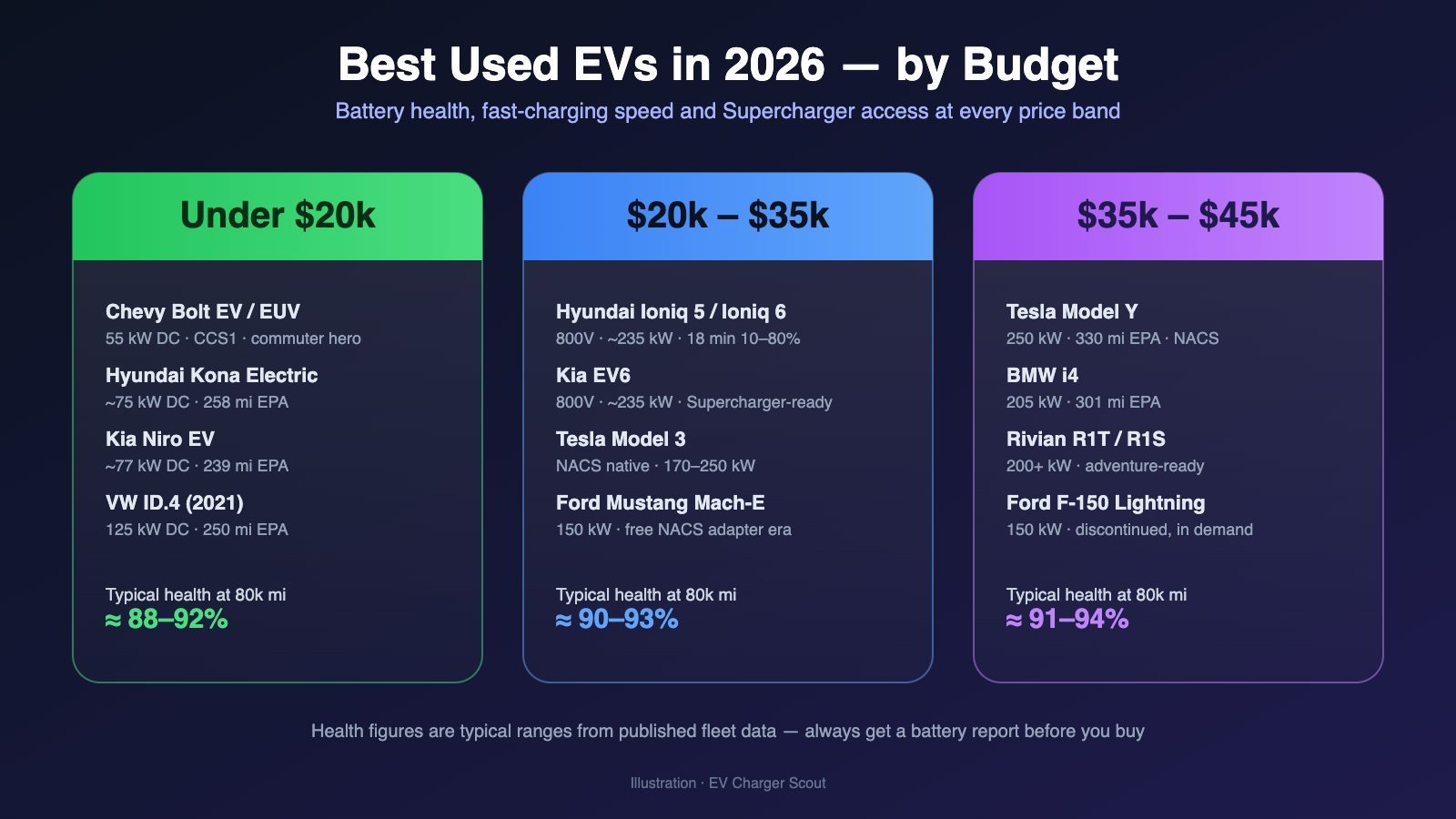
The shortlist by budget. Health figures are typical ranges from published fleet data, not guarantees — get a report on the specific car. Illustration: EV Charger Scout. Tap the image to enlarge.
How to read the numbers in this guide
- →Prices are June 2026 US dealer-listing averages for 2023 model-year cars from Recurrent's Q3 2026 market report unless a different year is noted; older years and private sales run lower. Treat every figure as a starting point that varies by trim, mileage and region.
- →Expected state of health (SoH) is the usable capacity remaining as a share of new. The 40k/80k-mile figures are modelled from published fleet data — Recurrent's community data (Model 3/Y around 90% at 100,000 miles, Ioniq 5 around 94% at 60,000, Bolt around 89% at 100,000) and Geotab's fleet average of roughly 1.8% loss per year — and are shown as ranges. A specific car can sit outside them.
- →DC peak kW is the manufacturer's maximum. Real sessions average well below peak; the road-trip verdict weighs the whole 10–80% curve, not the headline.
- →Supercharger access describes how the car reaches Tesla's network in North America today: natively, via the automaker's NACS adapter, or not at all. For the connector background, see the 2026 EV connector guide.
Under $20,000: the commuter sweet spot
This band is where prices rose fastest in 2026 and where the value is still best. Expect 2019–2022 model years for most entries; 2023 examples of the Bolt and Kona now average just over $20,000.
| Model (years to target) | Typical 2026 price | EPA range (new) | Expected SoH 40k / 80k mi | DC peak | Connector → Supercharger path |
|---|---|---|---|---|---|
| Chevrolet Bolt EV / EUV (2020–2023) | $15k–$22k (2023 EV avg $21,204; EUV $22,061) | 259 mi / 247 mi | 95–97% / 89–93% (higher on recall-replacement packs) | 55 kW | CCS1 → GM NACS adapter |
| Hyundai Kona Electric (2019–2023) | $14k–$21k (2023 avg $20,200) | 258 mi | 94–96% / 89–92% | ~75 kW | CCS1 → Hyundai NACS adapter (check model-year eligibility) |
| Kia Niro EV (2019–2022) | $15k–$23k (2023 avg $23,300) | 239 mi | 94–96% / 89–92% | ~77 kW | CCS1 → Kia NACS adapter (check model-year eligibility) |
| Tesla Model 3 Standard Range Plus (2018–2020) | $17k–$23k | 240 mi (2019–20) | 93–95% / 88–92% | 170 kW | NACS native — built in |
| Nissan Leaf 40 kWh / 62 kWh Plus (2018–2022) | $10k–$18k | 149 mi / 215–226 mi | 90–93% / 80–86% (air-cooled; hot climates lower) | 50 kW / ~100 kW | CHAdeMO → none |
The Bolt is the story of this band. It is cheap, roomy for its footprint, and every 2017–2022 car went through GM's battery recall — most 2017–2019 cars received an entirely new pack, which carries its own 8-year/100,000-mile warranty from the replacement date. Ask for the recall completion record and the pack replacement date; a 2019 Bolt with a 2022 pack is a better battery than its odometer suggests. Its limitation is charging: 55 kW means a 10–80% fast charge takes roughly an hour, which is fine for the occasional trip and miserable as a habit.
The Kona Electric and Niro EV are the range-per-dollar champions — Recurrent's real-world data shows both delivering more than their EPA rating at three years, around 300 miles for the Kona. Their 75-ish kW fast charging makes them marginal road-trippers rather than non-starters. The 2019–2021 Kona also had a battery-fire recall with pack replacements, so the same "when was the pack replaced?" question applies.
The Nissan Leaf is in this band on price, not on merit. Its battery has no liquid cooling, so it degrades faster in warm climates and throttles hard on back-to-back fast charges, and its CHAdeMO port is a dead-end standard in North America: no Supercharger path, and networks are removing CHAdeMO plugs. A cheap Leaf is a fine second car for short local trips and nothing else. Pre-2016 Leafs with original packs should be priced as if the battery is a consumable.
Home Charging Upgrade · EV Shop

Emporia Level 2 EV Charger (J1772, 48A)
Best Value — UL Listed + Energy Star, 48A WiFi Smart Charger for Any J1772 EV
* Amazon affiliate link — EV Charger Scout may earn a small commission at no extra cost to you.
$20,000–$35,000: the best cars for most buyers
This is where three-year-old lease returns concentrate, and where the 800V Hyundai and Kia cars change the calculation.
| Model (years to target) | Typical 2026 price | EPA range (new) | Expected SoH 40k / 80k mi | DC peak | Connector → Supercharger path |
|---|---|---|---|---|---|
| Hyundai Ioniq 5 (2022–2023) | $24k–$30k (2023 avg $26,000) | 256–303 mi | 95–97% / 91–94% | ~235 kW | CCS1 → Hyundai NACS adapter; Supercharger access since early 2025 |
| Hyundai Ioniq 6 (2023) | $22k–$28k (avg $24,400) | 240–361 mi | 95–97% / 91–94% | ~235 kW | CCS1 → Hyundai NACS adapter |
| Kia EV6 (2022–2023) | $25k–$31k (2023 avg $27,900) | 232–310 mi | 95–97% / 91–94% | ~235 kW | CCS1 → Kia NACS adapter |
| Tesla Model 3 (2021–2023) | $23k–$31k (2022 avg $26,884; 2023 avg $27,501) | 263–358 mi | 94–96% / 90–93% | 170 kW (RWD) / 250 kW (LR, Perf.) | NACS native |
| Ford Mustang Mach-E (2021–2023) | $26k–$36k (2023 avg $34,733) | 224–312 mi | 94–96% / 90–93% | 115 kW (SR) / 150 kW (ER) | CCS1 → Ford NACS adapter; access since Feb 2024 |
| Volkswagen ID.4 (2021–2023) | $19k–$28k (2021 avg $21,128) | 250–275 mi | 94–96% / 90–93% | 125 kW (2021) → 170 kW (2023) | CCS1 → VW NACS adapter (rolling out 2025) |
| Polestar 2 (2022–2023) | $24k–$30k (2023 avg $27,900) | 260–270 mi | 94–96% / 90–93% | 150 kW | CCS1 → Polestar NACS adapter |
| Tesla Model Y Long Range (2021–2022) | $27k–$34k | 326–330 mi | 94–96% / 90–93% | 250 kW | NACS native |
If you road-trip, the Ioniq 5, Ioniq 6 and EV6 are the standouts in this band and arguably in the whole used market. Their 800V architecture charges from 10% to 80% in about 18 minutes on a 350 kW charger — Recurrent measures the 2023 Ioniq 5 adding 100 miles in about six minutes, versus roughly 13 for a 2023 Model 3 — and since early 2025 they use Tesla Superchargers with Hyundai's and Kia's adapters. Two cautions: they need a genuinely high-power charger to show that speed (a 150 kW stall gives you 150 kW), and the 2022–2024 cars had a recall for the ICCU, the unit that charges the 12V battery; make sure it was done and that the car has the updated software, because failures leave the car in reduced-power mode.
The Model 3 remains the safe choice — native Supercharging, stable resale, the best software — but it is no longer the obvious one. Recurrent's data has three-year-old Teslas delivering about 90% of their EPA range in real driving, while the Hyundai and Kia cars beat theirs. The Mach-E is a lovely car to drive with a good real-world range, but a 2021–2022 example should have its high-voltage battery junction box recall completed (the contactors could overheat and cut power). The ID.4 straddles the $20,000 line and is well priced for its range; prefer a 2023 car if you fast-charge often, because charging power rose from 125 kW to 170 kW across those model years.

Lectron Vortex Plus NACS-to-CCS Adapter
The Gold Standard — UL 2252 Certified with Safety Interlock
* Amazon affiliate link — EV Charger Scout may earn a small commission at no extra cost to you.
$35,000–$45,000: more space, more speed
| Model (years to target) | Typical 2026 price | EPA range (new) | Expected SoH 40k / 80k mi | DC peak | Connector → Supercharger path |
|---|---|---|---|---|---|
| Tesla Model Y Long Range (2023–2024) | $31k–$38k (2023 avg $33,000) | 330 mi | 95–97% / 91–94% | 250 kW | NACS native |
| BMW i4 eDrive40 (2022–2023) | $33k–$40k (2023 avg $35,900) | 301 mi | 95–97% / 91–94% | 205 kW | CCS1 → BMW NACS adapter (2025) |
| Rivian R1T / R1S (2022–2023, Large pack) | $38k–$48k | 314–328 mi | 94–96% / 90–93% | ~220 kW | CCS1 → Rivian NACS adapter; access since March 2024 |
| Ford F-150 Lightning (2022–2023) | $38k–$48k (2023 avg $44,200) | 230–320 mi | 94–96% / 90–93% | 150 kW (ER) | CCS1 → Ford NACS adapter |
| Cadillac Lyriq (2023) | $33k–$40k | 312 mi (RWD) | 95–97% / 91–94% | 190 kW | CCS1 → GM NACS adapter |
The 2023–2024 Model Y is the default family EV for a reason: 330 miles rated, 250 kW charging, and a network the car navigates to without an adapter. The i4 is the enthusiast's pick — genuinely quick charging for a 400V car and a beautifully finished cabin — and BMW's own data on the i4 and iX packs has been reassuring. The Lightning is a special case: Ford has discontinued it, and Recurrent finds 2023 examples selling in about 12 days at around $44,000 as buyers grab the last of them. Its 150 kW peak and truck-sized battery make road trips slow going; buy it as a work-and-home truck, not a cross-country cruiser. The R1T/R1S with the Large pack is the adventure choice and charges far faster than the Ford, but check the tyre and suspension history on a lifted example that has clearly been used as intended.
Do not buy these for road trips
Every car below can be a good local car at the right price. None of them should be bought by someone who plans regular long drives, either because the fast-charging speed is too low or because the connector standard is dying in North America.
| Vehicle | Why it fails the road-trip test | OK for |
|---|---|---|
| Nissan Leaf (all years through 2025) | CHAdeMO port with no NACS path; 50 kW on 40 kWh cars; no liquid cooling so the second fast charge of the day is throttled | Local driving, second car |
| Chevrolet Bolt EV / EUV | 55 kW peak — roughly an hour for 10–80% | Commuting, errands, the occasional 300-mile trip if you're patient |
| Mini Cooper SE (2020–2024) | 110 mi rated, 50 kW | City car |
| Mazda MX-30 | 100 mi rated, ~50 kW | City car |
| Fiat 500e (2024+) and older Fiat 500e | ~150 mi (new) / ~85 mi (old), 85 kW at best | City car |
| BMW i3 (2014–2021) | 50 kW, 153 mi at best; early cars far less | City car, enthusiast curiosity |
| Kia Soul EV / Hyundai Ioniq Electric (pre-2020) | Sub-200 mi, 50–100 kW, aging packs | Local driving |
| Any early (2011–2015) EV with its original pack | Real range often under 70 miles; replacement packs cost more than the car | Short hops only |
A practical road-trip threshold in 2026: at least 125 kW peak, liquid-cooled battery, and a clear Supercharger path (native NACS or an automaker-supported adapter). Cars that meet all three — everything in the two upper bands above — will spend about 20–35 minutes at a stop. Cars that miss any of them will spend an hour.
DC Fast Charging Upgrade · EV Shop

Lectron CCS-to-NACS Adapter for Tesla
UL 2252 Certified — Charge Your Tesla at Any CCS DC Fast Charger
* Amazon affiliate link — EV Charger Scout may earn a small commission at no extra cost to you.
How to get an independent battery health report
Never rely on the dashboard's range estimate to judge a used battery; on many cars it is a guess, and on LFP-equipped cars it drifts unless the pack has been charged to 100% recently. Use at least one of these, in roughly this order of effort.
- 1Ask for a Recurrent report. Many US dealer listings now include one, and any owner with a connected EV can generate a free monthly report. It gives an estimated range, a comparison with similar cars, and a battery-health rating.
- 2Read the pack directly with an OBD app. LeafSpy for the Leaf, Scan My Tesla for Teslas, and Car Scanner (with the model's extended PIDs) for Hyundai, Kia and many others read state of health from the battery management system through a $20–$40 OBD adapter. Bring the adapter to the test drive.
- 3Have a dealer print it. Every brand's service tool reports battery state of health, and most will do it for a modest fee or as part of a pre-purchase inspection. In Europe, Aviloo offers a certified one-hour FLASH test and a longer premium test; the UK has ClearWatt.
- 4Do the full-charge test yourself. Charge to 100%, note the displayed range, and compare it with the original EPA rating for that exact trim. For an NMC/NCA car, 90% or better at 50,000–80,000 miles is normal; for the Leaf, expect noticeably less.
- 5Pull the warranty picture. Most packs are covered for 8 years/100,000 miles against dropping below 70% (Tesla covers Long Range and Performance cars to 120,000 miles). Confirm the remaining term and whether it transfers.
For what the numbers mean — how quickly packs age, what accelerates it and what the warranties actually cover — read our EV battery life guide, then run the specific car through the free Battery Health estimator.
Charging-port and adapter budget for a CCS car in a NACS world
Buying a CCS1 car in 2026 is not a mistake — nearly every non-Tesla EV on the used market is one — but it needs a small accessory budget, because the public charging landscape is converging on Tesla's NACS connector.
| Need | What to buy | Typical cost |
|---|---|---|
| Tesla Superchargers (DC fast) | NACS-to-CCS1 DC adapter — the automaker's own or a UL 2252-certified aftermarket unit | $125–$225 (OEM adapters: Ford and GM around $200–$225) |
| Tesla Wall Connectors, destination chargers, NACS home units (AC Level 2) | NACS-to-J1772 AC adapter | $50–$60 |
| Everything else today (Electrify America, EVgo, ChargePoint, IONNA…) | Nothing — CCS1 plugs remain on these networks through the transition | $0 |
| Home charging | Any J1772 Level 2 charger, or a NACS unit plus the AC adapter above | See our Level 2 charger guide |
Budget roughly $150–$300 all in. Confirm the automaker has enabled Supercharger access for your exact model year before buying the DC adapter — the car needs a software update to talk to the Supercharger, and a third-party adapter on an unapproved car will not work. The Supercharger adapter guide tracks the current list, and our adapter round-up covers the safety certifications that matter.

FOCSPROD Tesla/NACS-to-J1772 Adapter
Charge Your CCS EV at Tesla Destination & Wall Connectors
* Amazon affiliate link — EV Charger Scout may earn a small commission at no extra cost to you.
Recall and battery-replacement checks before you sign
- →Chevrolet Bolt EV/EUV (2017–2022): battery-fire recall covering every car. 2017–2019 models mostly received full pack replacements; 2020–2022 cars received new modules or advanced-diagnostics software with a charge-limit restriction until cleared. Ask for the completion record and, if the pack was replaced, its date — the replacement carries a new 8-year/100,000-mile warranty.
- →Hyundai Kona Electric (2019–2021) and early Ioniq Electric: battery recall with pack replacements after fire reports. Same question: replaced when?
- →Hyundai Ioniq 5/6, Kia EV6/EV9, Genesis GV60 (2022–2024): ICCU recall — the unit that charges the 12V battery can fail and put the car in reduced-power mode. Verify completion and current software.
- →Ford Mustang Mach-E (2021–2022): high-voltage battery junction box recall — contactors could overheat and cut power. Verify the software update and, where applicable, the hardware replacement.
- →Nissan Leaf (2011–2015): no battery recall, but original packs are often below 70% and Nissan replacement packs are expensive relative to the car's value. Treat an original-pack early Leaf as a battery purchase, not a car purchase.
- →Everything: run the VIN through NHTSA before you negotiate — the free VIN & Recalls tool pulls open recalls, safety investigations and the battery-warranty estimate in one place.
Pick the band, then buy the battery, not the badge. Get a state-of-health reading from the pack itself, confirm every recall is closed, make sure the car has a Supercharger path if you'll ever leave town, and add $150–$300 for adapters if it's a CCS car. With those four boxes ticked, a three-year-old lease return at today's prices is one of the best-value cars — electric or otherwise — you can buy.
Prices in this guide will move — the whole under-$40,000 market rose through the first half of 2026 — so use them to spot a bargain, not to set a ceiling.
Frequently Asked Questions
What is a good battery state of health for a used EV?
For a car with 40,000–80,000 miles, 90% or better is typical of a healthy pack on modern EVs with liquid cooling; 85–90% is acceptable if the price reflects it; below 85% at that mileage deserves a hard look at how the car was used. Air-cooled cars like the Nissan Leaf sit several points lower at the same mileage. Always compare against the model's normal, not a universal number.
Is a used Chevy Bolt a good buy in 2026?
For commuting and local driving, it's one of the best values on the market — 2023 Bolt EVs averaged about $21,000 in June 2026 and sell in under two weeks. Every 2017–2022 Bolt went through the battery recall, so many carry replacement packs with a fresh warranty. Its weakness is 55 kW fast charging, which makes it a poor road-trip car.
Is a used Tesla Model 3 still worth it now that other brands can use Superchargers?
Yes, but it's no longer the automatic choice. A 2023 Model 3 averaged about $27,500 in mid-2026 and gives you native NACS charging and the largest fast-charging network with no adapter. A 2023 Hyundai Ioniq 6 averaged about $3,000 less, delivers more real-world range and faster charging, and now uses Superchargers with an adapter.
How do I get an independent battery health report on a used EV?
Ask the seller for a Recurrent report (many dealer listings include one), or run one yourself: an OBD app such as LeafSpy (Leaf), Scan My Tesla or Car Scanner reads the pack's state of health directly, a dealer can print it from the service tool, and in Europe Aviloo offers a one-hour certified test. As a minimum, charge the car to 100% and compare the displayed range against the original EPA rating.
Can a used CCS electric car use Tesla Superchargers?
Most 2020-and-newer CCS models from Ford, GM (including the Bolt), Rivian, Hyundai, Kia, Genesis, Polestar, Volvo, BMW and others can, using a NACS-to-CCS adapter from the manufacturer or a UL 2252-certified aftermarket one, budget roughly $125–$225. Check the automaker's eligibility list for your exact model year; Nissan Leafs with CHAdeMO ports cannot.
More guides on Strategy & Planning
Explore the full Strategy & Planning topic hub — related guides that build on this one.
Managed Charging & Off-Peak EV Rates: How to Save $100+ Per Month in 2026
13 min read
Plug and Charge 2026: Which EVs Auto-Start at Electrify America, EVgo & Ionna
12 min read
Home vs. Public EV Charging Costs in 2026: Real Rates, the Math, and How to Save
14 min read
AI-Powered Smart Charging Apps: How They Predict Availability at Your Nearest Station
11 min read
Winter EV Battery Care & Charging 2026: Everything You Need to Know to Maximize Range and Speed in the Cold
13 min read
How to Future-Proof Your EV Charging in the NACS Transition Era
9 min read
Free EV tools
Put this guide to work — every tool is free and needs no account.
- EV Range LookupOfficial EPA, WLTP & CLTC range for 650+ models
- Real-World Range EstimatorRange adjusted for today's weather and your speed
- Home Charging Cost & PaybackMonthly bill and charger payback time
- EV vs Gas SavingsFuel savings over 1, 5 and 10 years
- EV Incentives by StateRebates and perks in all 50 states + DC
- Charging Network PricesCompare Supercharger, EA, EVgo and more
- Compare EV ModelsBattery, range and charging speed side by side
- Battery Health EstimatorProjected capacity at 100k and 200k miles
- VIN Decoder & RecallsNHTSA specs, recalls and investigations
- CO₂ Savings CalculatorEmissions avoided on your country's grid