 EV Charger Scout
"How long does it take to charge?" has three honest answers, because there are three kinds of charging — and within each one, the car, the battery's temperature and how full it already is matter more than the number on the charger. This guide gives you the real ranges for each charger type, a table of 16 popular 2026 models with the figures that actually determine your wait, the one formula that lets you estimate any session yourself, and the home-circuit decision most buyers get wrong. It does not re-explain connectors; if you need the NACS/CCS background, see the 2026 EV connector guide.
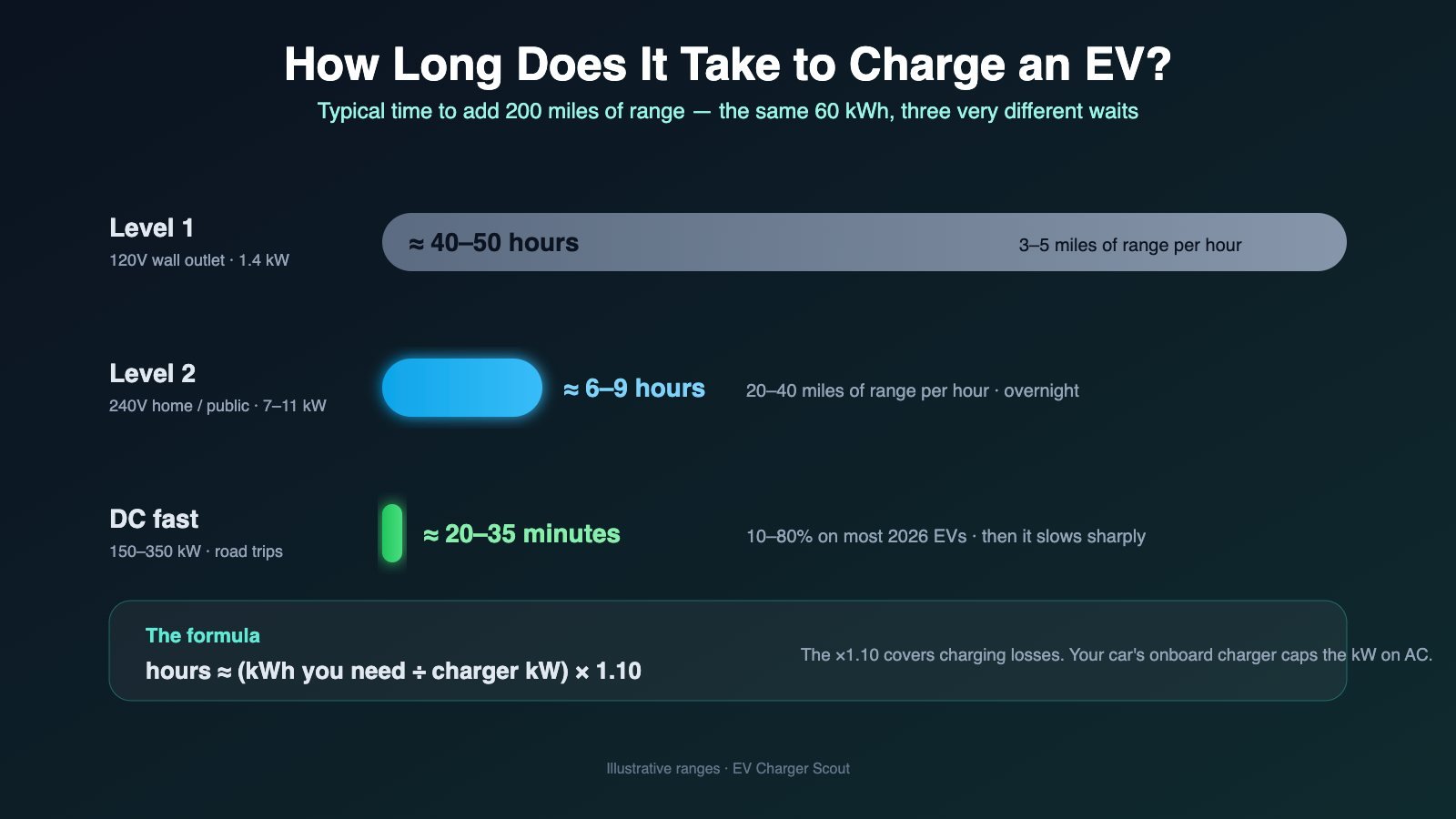
The same energy, three very different waits. Illustration: EV Charger Scout. Tap the image to enlarge.
Level 1 (120V outlet, ~1.4 kW): 3–5 miles of range per hour; 20–80% takes 25–40 hours; a full charge 40–60+ hours.
Level 2 (240V, 7–11.5 kW): 20–40 miles per hour; 20–80% in about 4–6 hours; empty to full overnight (7–12 hours).
DC fast (150–350 kW): 10–80% in 18–45 minutes depending on the car; 80–100% adds another 20–40 minutes and is rarely worth it on a road trip.
The formula that works for any car and any charger
Every charging estimate reduces to one line:
The kWh you need is the battery's usable capacity multiplied by the share you're adding (20% to 80% is 0.6). The charger kW is whichever is lower: what the station can supply, or what your car can accept. The 1.10 covers the roughly 10% lost as heat in the onboard charger, cables and battery during AC charging. For DC fast charging use the same formula with your car's average session power, not its peak — see below.
Worked example: a car with 75 kWh usable, charging 20% to 80% on a 48-amp home unit (11.5 kW) with an 11.5 kW onboard charger. Energy needed: 75 × 0.6 = 45 kWh. Time: 45 ÷ 11.5 × 1.10 ≈ 4.3 hours. Put the same car on a 32-amp unit (7.7 kW): 45 ÷ 7.7 × 1.10 ≈ 6.4 hours. On a 120V outlet (about 1.4 kW usable): about 35 hours.
Home Charging Upgrade · EV Shop
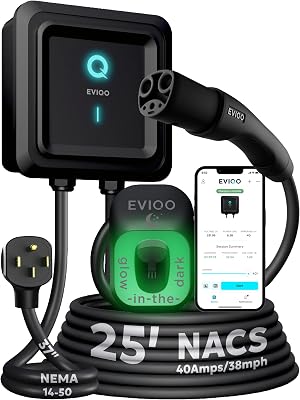
EVIQO NACS Level 2 EV Charger (40A Plug-In)
Plug-In NACS Level 2 — 40A, App Control, No Hardwiring Needed
* Amazon affiliate link — EV Charger Scout may earn a small commission at no extra cost to you.
16 popular 2026 EVs: the numbers that set your charging time
Usable capacity is approximate (manufacturers quote gross and usable inconsistently). Level 2 hours are calculated with the formula above at the car's maximum AC rate on a charger that can supply it. DC minutes are the manufacturer's published 10–80% claim where one exists, otherwise a typical warm-battery figure on a charger at least as powerful as the car's peak.
| Model | Usable kWh | Max AC (onboard) | Max DC | 20–80% on Level 2 | 10–80% DC fast |
|---|---|---|---|---|---|
| Tesla Model 3 RWD (LFP) | ~57 kWh | 7.7 kW | 170 kW | ~4.9 h | ~25 min |
| Tesla Model Y Long Range AWD | ~75 kWh | 11.5 kW | 250 kW | ~4.3 h | ~27 min |
| Hyundai Ioniq 5 (84 kWh) | ~80 kWh | 10.9 kW | 257 kW | ~4.8 h | 20 min (Hyundai) |
| Kia EV6 (84 kWh) | ~80 kWh | 10.9 kW | 258 kW | ~4.8 h | 18 min (Kia) |
| Kia EV9 Long Range | ~96 kWh | 10.9 kW | 210 kW | ~5.8 h | 24 min (Kia) |
| Ford Mustang Mach-E Extended Range | ~91 kWh | 10.5 kW | 150 kW | ~5.7 h | ~35 min |
| Ford F-150 Lightning Extended Range | ~131 kWh | 19.2 kW | 150 kW | ~4.5 h | 41 min, 15–80% (Ford) |
| Chevrolet Equinox EV | ~85 kWh | 11.5 kW | 150 kW | ~4.9 h | ~35 min |
| Rivian R1S Gen 2, Large pack | ~109 kWh | 11.5 kW | 220 kW | ~6.3 h | ~30 min (Rivian) |
| Volkswagen ID.4 Pro (82 kWh) | ~77 kWh | 11 kW | 175 kW | ~4.6 h | ~28 min |
| BMW i4 eDrive40 | ~81 kWh | 11 kW | 205 kW | ~4.9 h | 31 min (BMW) |
| Porsche Taycan (Performance Battery Plus) | ~97 kWh | 11 kW (19.2 optional) | 320 kW | ~5.8 h (3.3 h at 19.2 kW) | 18 min (Porsche) |
| Nissan Ariya (87 kWh) | ~87 kWh | 7.2 kW | 130 kW | ~8.0 h | ~40 min |
| Toyota bZ (2026) | ~75 kWh | 11 kW | 150 kW | ~4.5 h | ~30 min (Toyota) |
| Mercedes-Benz EQE sedan | ~90 kWh | 11 kW | 170 kW | ~5.4 h | 32 min (Mercedes) |
| Polestar 3 Long Range | ~107 kWh | 11 kW | 250 kW | ~6.4 h | 30 min (Polestar) |
Three patterns jump out. First, Level 2 times cluster between four and six hours for almost everything, because most 2026 EVs carry an 11 kW onboard charger and a 75–95 kWh pack — the outliers are the cars with small onboard chargers (Model 3 RWD, Ariya) and the very large packs (R1S, Polestar 3). Second, DC times split cleanly by voltage architecture: the 800V cars (Ioniq 5, EV6, EV9, Taycan) are done in 18–24 minutes, the 400V cars take 25–35, and anything capped at 150 kW with a big battery pushes 40. Third, peak DC power is a poor predictor on its own — the 150 kW Mach-E and the 130 kW Ariya land within minutes of each other because of how each holds its rate through the session.

ChargePoint Home Flex (NEMA 14-50 Plug)
Best J1772 — Plug-in up to 40A (50A hardwired), Energy Star, Any Non-Tesla EV
* Amazon affiliate link — EV Charger Scout may earn a small commission at no extra cost to you.
Why advertised peak kW is not what you get
A charger labelled 350 kW and a car rated 250 kW do not produce a 250 kW session. The car controls the rate, and it accepts its peak only briefly: from a low state of charge, with a warm battery, on a charger that can deliver it. From there the rate steps down as the cells fill — gently at first, then sharply above roughly 60–80%. Averaged over a 10–80% session, most cars pull 50–70% of their peak. That is why the table quotes minutes rather than kilowatts, and why two cars with the same peak can differ by ten minutes: the shape of the curve matters more than its highest point.
- →Peak is the number in the brochure. You see it for a few minutes below about 30%.
- →Session average is what determines your wait. A car with a lower peak that holds it longer (many 800V cars) beats a spiky curve.
- →The charger's own limit caps everything: a 150 kW stall gives an Ioniq 5 150 kW, not 257. Power-shared stalls can halve that again when the neighbouring bay is occupied.
The onboard charger: your home bottleneck
Level 2 charging is AC. The car's onboard charger converts it to DC for the battery, and its rating — not the wall unit's — sets the ceiling. Most 2026 EVs carry an 11–11.5 kW onboard charger (48 amps at 240V). A few carry 7.2–7.7 kW (32 amps): the Tesla Model 3 RWD and the Nissan Ariya are the notable current examples. A handful carry 19.2 kW (80 amps): the Ford F-150 Lightning Extended Range and, as an option, the Porsche Taycan, plus some GM trucks and the Cadillac Lyriq with the optional charge module.
The practical consequence is that a bigger home charger only helps if the car can use it. A 48-amp wall unit feeding a Model 3 RWD charges at exactly the same 7.7 kW as a 32-amp one. Conversely, a 32-amp unit feeding a Lightning throttles a truck that could take two and a half times more.
What home circuit size actually changes
Using the formula with a typical 75 kWh-usable car charging from 20% to 80% (45 kWh, plus 10% losses):
| Circuit / charger | Delivered power | 20–80% for a 75 kWh car | Who benefits |
|---|---|---|---|
| 40A circuit, 32A charger (typical NEMA 14-50 plug-in) | 7.7 kW | ~6.4 h | Everyone — full overnight charge for any car; the whole speed for 7.7 kW cars |
| 50A circuit, 40A charger (max on a 14-50 plug) | 9.6 kW | ~5.2 h | Any car with an 11 kW onboard charger — modest gain over 32A |
| 60A circuit, 48A charger (hardwired) | 11.5 kW | ~4.3 h | Cars with 11–11.5 kW onboard chargers: Model Y, Ioniq 5, EV6, Mach-E, ID.4, i4, Equinox EV and most others |
| 100A circuit, 80A charger (hardwired) | 19.2 kW | ~2.6 h | Only 19.2 kW cars: F-150 Lightning ER, Taycan (option), some GM trucks and Lyriq — no gain for anything else |
For the majority of households, a 48A hardwired unit is the sensible ceiling and a 32A plug-in unit is entirely adequate: even the slowest row refills a typical car in a single night. Go to 80A only if you own a 19.2 kW vehicle and regularly need a fast turnaround, and check panel capacity first — an 80A charger needs a 100A dedicated circuit. Our Level 2 charger guide and installation guide cover the hardware and wiring choices; the free Home Charging Cost tool shows what your nightly charge will cost.
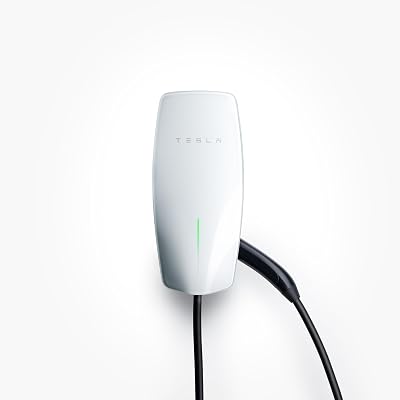
Tesla Universal Wall Connector
Best Universal — Built-In NACS + J1772 Connector for Any North American EV
* Amazon affiliate link — EV Charger Scout may earn a small commission at no extra cost to you.
Roadside Safety Pick · EV Shop

EVERLIT Emergency Roadside Assistance Kit
All-in-One Roadside Kit — Air Compressor, Flashlight & More
* Amazon affiliate link — EV Charger Scout may earn a small commission at no extra cost to you.
Winter and state of charge: the two multipliers
Temperature
On Level 2 the effect is small: a cold car diverts some power to warming the pack for the first stretch of a session, adding perhaps 10–20% to the time, and the car handles it invisibly overnight. On DC fast charging the effect is large. A battery that has cold-soaked at 20°F (−7°C) accepts a fraction of its rated power until it warms, and a 25-minute stop can become 50 or more. The fix is preconditioning — letting the car heat the battery on the way — which every current Tesla, Hyundai, Kia, Ford, GM, Rivian, BMW and Mercedes EV does when you navigate to a fast charger in the car's own system. Our preconditioning guide has the brand-by-brand steps.
State of charge
The 10–80% window is quoted everywhere because it is the fast part. Charging power falls as the battery fills, and on most cars the final 20% takes as long as the previous 50%. Two rules follow: on a road trip, arrive low (10–20%) and leave at 80% — two short stops beat one long one — and at home, don't fret about it, because Level 2 charging holds a near-constant rate to 100% and the car will be full by morning either way. The LFP vs NMC guide explains which cars should routinely charge to 100% and which shouldn't.
A session that stays slow on a warm day, at low state of charge, on a stall you know is powerful, is a car or station fault — not normal behaviour. Try a different stall, then a different site; if it persists across sites, have the car's charging system checked.
Rules of thumb you can actually remember
- →Level 1 adds about 4 miles an hour — fine for a 30-mile commute if you plug in every night; hopeless for anything more.
- →Level 2 adds about 30 miles an hour and fills any 2026 EV overnight, whatever the circuit size.
- →DC fast: 20 minutes for 800V cars, 30 for 400V cars, 40 for big trucks, from 10% to 80%, warm battery, big enough charger.
- →Cold battery: double the DC time unless you preconditioned.
- →Above 80%, walk away. The next 20% costs more time than it gives back in range on almost every car.
Want a number for your exact car and charger? The Compare EVs tool lists battery size, rated range and DC fast-charging speed for 650+ models side by side, and the EV Charger Scout map shows each station's power per port so you can pick a stall that will actually deliver it.
Frequently Asked Questions
How long does it take to charge an EV at home?
On a 240V Level 2 charger, most EVs go from 20% to 80% in about 4–6 hours and from empty to full overnight, adding 20–40 miles of range per hour. On a standard 120V outlet (Level 1) the same 20–80% charge takes 25–40 hours, adding only 3–5 miles per hour — enough for short commutes if you plug in every night.
How long does DC fast charging take from 10% to 80%?
Between 18 and 45 minutes on current EVs when the battery is warm and the charger is powerful enough. 800V cars such as the Hyundai Ioniq 5, Kia EV6 and Porsche Taycan take about 18–20 minutes; most 400V cars take 25–35 minutes; big-battery trucks and cars capped at 150 kW take 35–45 minutes. Charging past 80% is slow on every EV, which is why road-trip stops end there.
Why does my EV charge slower than the charger's advertised kW?
The advertised figure is the charger's maximum, but your car sets the actual rate — and it only accepts its own peak for a short window at low state of charge with a warm battery. The car tapers as the battery fills, cuts the rate when the pack is cold or hot, and on AC charging it can never exceed its onboard charger's limit no matter how powerful the wall unit is.
Is a 48-amp home charger worth it over 32 amps?
Only if your car can accept more than 7.7 kW on AC. Cars with an 11–11.5 kW onboard charger (most 2026 EVs) charge about a third faster on 48A; cars limited to 7.2–7.7 kW — including the Tesla Model 3 RWD and the Nissan Ariya — gain nothing. Either way, both will fully charge a typical EV overnight; the difference matters most if you drive 200+ miles a day or share the charger between two cars.
How much longer does charging take in winter?
Level 2 charging is barely affected once the car is plugged in, though some energy goes to warming the pack. DC fast charging is where winter hurts: a cold-soaked battery can take roughly twice as long for 10–80% unless the car preconditions on the way to the charger, which most 2026 EVs do automatically when you navigate to the station.
More guides on Charging 101
Explore the full Charging 101 topic hub — related guides that build on this one.
LFP vs NMC Batteries in 2026: How You Should Actually Charge Each Type
12 min read
How to Precondition Your EV Battery for Faster DC Charging (2026 Brand-by-Brand Guide)
13 min read
You Just Bought Your First EV – Now What? The Complete New Owner Guide & Checklist
13 min read
EV Charging Station Types Explained: Level 1, Level 2, and DC Fast Charging
8 min read
EV Battery Life in 2026: How Long It Really Lasts and 7 Proven Ways to Slow Degradation
14 min read
Tesla Charging in North America: The Owner's Guide to NACS, Adapters, and What's New in 2026
13 min read
2026 EV Connector Guide: Which Cars Use NACS, CCS, J1772, and More
10 min read
NACS vs. CCS Adapters: A Global Guide for EV Drivers
10 min read
Free EV tools
Put this guide to work — every tool is free and needs no account.
- EV Range LookupOfficial EPA, WLTP & CLTC range for 650+ models
- Real-World Range EstimatorRange adjusted for today's weather and your speed
- Home Charging Cost & PaybackMonthly bill and charger payback time
- EV vs Gas SavingsFuel savings over 1, 5 and 10 years
- EV Incentives by StateRebates and perks in all 50 states + DC
- Charging Network PricesCompare Supercharger, EA, EVgo and more
- Compare EV ModelsBattery, range and charging speed side by side
- Battery Health EstimatorProjected capacity at 100k and 200k miles
- VIN Decoder & RecallsNHTSA specs, recalls and investigations
- CO₂ Savings CalculatorEmissions avoided on your country's grid