 EV Charger Scout
"Charge to 80%" has been the standard EV advice for a decade — and for roughly half the electric cars sold in 2026 it is now wrong. The reason is chemistry. Lithium iron phosphate (LFP) batteries, once a budget option for Chinese-market cars, are now in Tesla's most popular trims, every BYD, the standard-range Mustang Mach-E and Rivian, and a growing list of European small EVs. LFP cells want to be charged differently from the nickel-based NMC and NCA cells that everybody's advice was written for. This guide explains what actually changes, what stays the same, and how to set your daily charge limit for the battery you own.
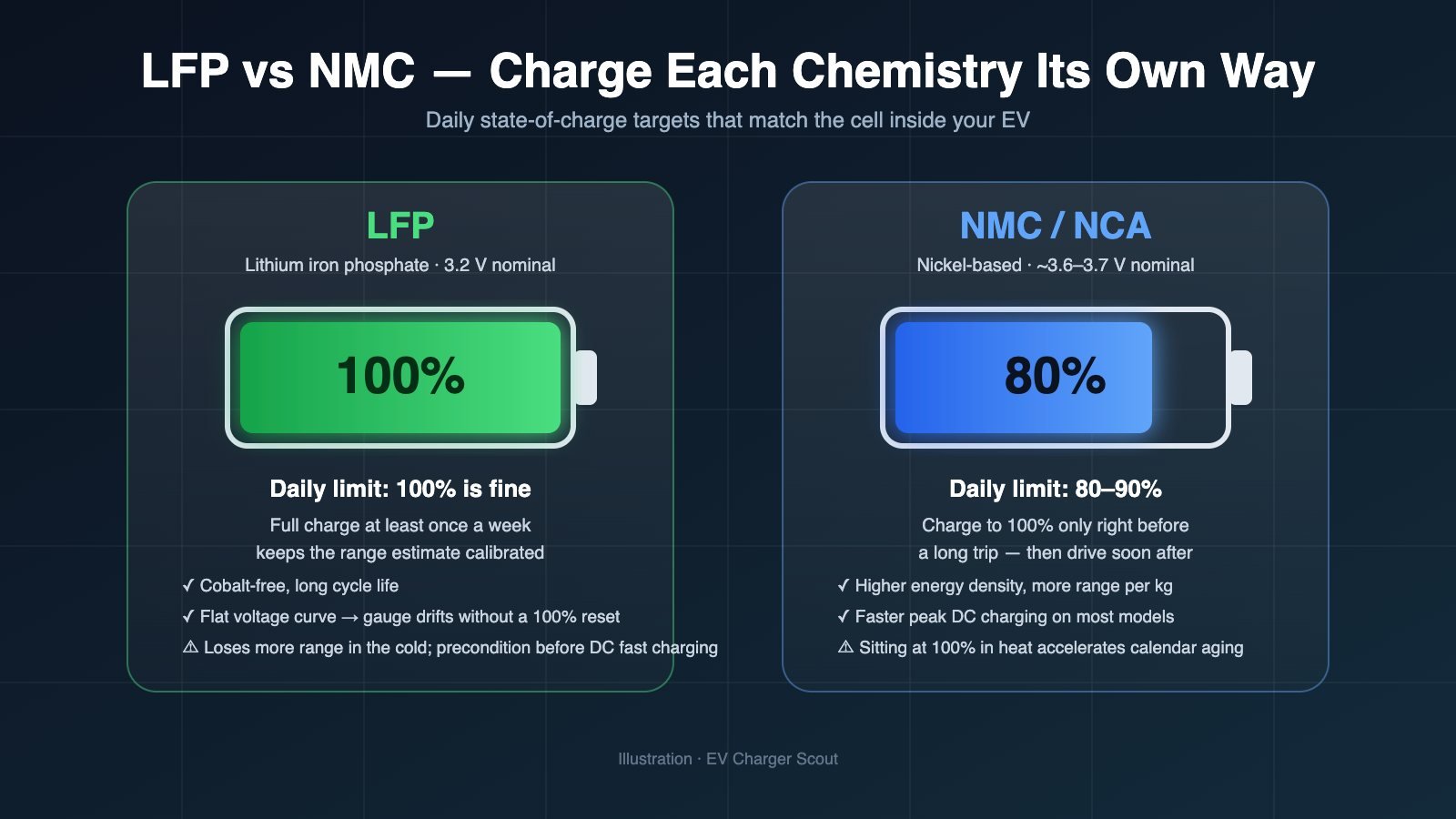
LFP packs are designed to live at 100%; nickel-based packs are happiest topped up to 80–90% for daily use. Illustration: EV Charger Scout. Tap the image to enlarge.
LFP vs NMC: the 60-second version
Both are lithium-ion. The difference is the cathode — the material the lithium ions park in when the cell is discharged. NMC uses nickel, manganese and cobalt (NCA swaps manganese for aluminium and behaves similarly). LFP uses iron phosphate. That one change shifts almost every characteristic that matters to a driver.
| LFP (lithium iron phosphate) | NMC / NCA (nickel-based) | |
|---|---|---|
| Nominal cell voltage | ~3.2 V | ~3.6–3.7 V |
| Energy per kg (cell level, typical) | Lower — roughly 160–210 Wh/kg | Higher — roughly 250–300 Wh/kg |
| Cycle life to 80% capacity (typical) | Longer — commonly 3,000+ cycles | Shorter — commonly 1,000–2,000 cycles |
| Cobalt | None | Yes (less in newer high-nickel formulas) |
| Thermal runaway onset | Higher temperature — more tolerant | Lower temperature — needs tighter management |
| Cold-weather behavior | Loses more usable capacity and charge speed when cold | Better cold tolerance |
| Voltage curve | Very flat between ~20% and ~95% | Sloped — voltage tracks state of charge |
| Recommended daily charge limit | 100% (with a weekly full charge) | 80–90% |
| Typical cost per kWh | Lower | Higher |
Every row in that table feeds into one practical question: where should the battery sit most of the time? To answer it you need to understand the two ways a battery ages.
Calendar aging vs cycle aging — the part most advice skips
A battery loses capacity in two independent ways. Cycle aging is wear from use: every charge and discharge moves lithium in and out of the electrodes and slowly damages them. It scales with how deep each cycle is, how fast you push current through the cell, and temperature. Calendar aging is wear from simply existing: side reactions on the electrode surface grow a layer that permanently traps lithium, and they run faster the warmer the cell is and the higher its voltage — which means the higher its state of charge.
For most private cars, calendar aging dominates. A typical EV is parked around 95% of the time, so the state of charge it sits at while parked matters more than how it was driven. This is the whole basis of the 80% rule for nickel-based cells: at 100% an NMC cell sits at its maximum voltage, where the side reactions are fastest; at 80% it sits in a noticeably gentler zone. Weeks parked at 100% in a hot climate is about the worst thing you can do to an NMC pack short of abusing it.
LFP changes the arithmetic in two ways. First, a full LFP cell sits at a much lower voltage than a full NMC cell, so the high-state-of-charge penalty is smaller. Second, LFP's electrode structure is more stable, so both its cycle life and its calendar life are longer to begin with. That is why manufacturers can tell LFP owners to charge to 100% daily without wrecking the warranty economics. It does not mean state of charge stops mattering: laboratory calendar-aging studies still measure faster capacity loss for LFP cells stored full and warm than for cells stored half-full and cool. The honest summary is "100% is fine for daily use, and you shouldn't leave it parked full in the sun for a month."
Whatever the chemistry, the two universal wins are the same: keep the pack cool when you can (shade, garage, avoid fast-charging a hot battery) and don't let the car sit for weeks at either extreme of the gauge. For the longer-term degradation picture — real fleet data, warranties, and the seven habits that slow aging — see our EV battery life guide.
Home Charging Upgrade · EV Shop

ChargePoint Home Flex (NEMA 14-50 Plug)
Best J1772 — Plug-in up to 40A (50A hardwired), Energy Star, Any Non-Tesla EV
* Amazon affiliate link — EV Charger Scout may earn a small commission at no extra cost to you.
Why LFP cars need a 100% charge — the flat voltage problem
This is the part that surprises new LFP owners. The car doesn't just allow a full charge; the manufacturer asks for one regularly. The reason is measurement, not battery health.
A battery management system estimates state of charge in two ways: by reading cell voltage, and by counting the energy that flows in and out (coulomb counting). Nickel-based cells have a sloped voltage curve — 3.9 V means something different from 4.1 V — so the car can cross-check its count against voltage all the time. LFP's curve is nearly flat from around 20% to 95%: the voltage barely moves while the state of charge changes enormously. The car is effectively blind in the middle of the pack and has to trust its running count, and that count drifts with every cycle, every temperature swing and every small measurement error.
A charge to 100% is a known reference point — the pack hits its top voltage and the counter resets. Skip it for a few weeks and the displayed range starts to lie. Owners see the classic symptoms: range that drops in sudden steps, a car that reads 15% then abruptly 5%, or a full charge that shows fewer miles than it did last month. None of that is degradation; it is a gauge that has lost calibration.
Winter makes the estimation error worse
Cold compounds the problem from both directions. A cold LFP cell delivers less usable energy and its voltage sags more under load, so the two signals the BMS relies on both become noisier. At the same time, LFP's steeper cold-weather capacity drop means the "true" available energy really has shrunk. The result is that LFP owners in cold climates report the largest winter range surprises of any EV group — part real capacity loss, part a confused estimate. The fix is the same weekly 100% charge, ideally finishing shortly before you leave so the pack is warm and the estimate is fresh. For the mechanics of cold-weather range and preconditioning in general, our winter battery care guide covers both chemistries.
If an LFP car's range display becomes erratic, don't assume the battery is failing. Charge to 100%, let it sit plugged in for an hour or two after it reaches full so cell balancing can finish, then drive normally. If the estimate is still unstable after two or three full-charge cycles, have a dealer run a battery health check.
Daily state-of-charge targets by chemistry
Here is how the major manufacturers frame it, and a practical target for each situation.
| Situation | LFP | NMC / NCA |
|---|---|---|
| Everyday commuting | Set the limit to 100% | 80% (90% if you need the range) |
| Minimum full-charge cadence | At least once a week (Tesla's guidance) | Not required — only before trips |
| Night before a road trip | 100%, timed to finish near departure | 100%, timed to finish near departure |
| Parking for 2+ weeks | Leave around 50–70%, plugged in if possible | Leave around 50–60%, plugged in if possible |
| Hot climate, parked outdoors | 100% is still permitted; avoid weeks at full | Prefer 70–80%; avoid sitting at 100% |
| Lowest routine level | Avoid regularly running below ~10% | Avoid regularly running below ~10% |
Tesla is the clearest example of the split. For LFP-equipped cars its owner's manual says to keep the charge limit set to 100% and to charge fully at least once per week. For its nickel-based Long Range and Performance packs, the in-car charge slider marks a "Daily" range and a "Trip" range, and Tesla advises staying in the daily range for normal use. BYD, whose entire lineup uses its LFP Blade battery, likewise treats a full charge as routine and recommends a periodic 100% top-up to keep the estimate calibrated. Ford lifted its usual daily-limit advice for the LFP Mustang Mach-E Standard Range and permits regular 100% charging, and Rivian does the same for its LFP Standard pack.

Emporia Level 2 EV Charger (J1772, 48A)
Best Value — UL Listed + Energy Star, 48A WiFi Smart Charger for Any J1772 EV
* Amazon affiliate link — EV Charger Scout may earn a small commission at no extra cost to you.
Setting the limit in practice
- →Use the car's charge-limit slider, not the charger. Home chargers control when and how fast you charge; the vehicle controls how full. Set the limit once and the car will stop there at home and at public chargers alike.
- →Schedule charging to finish near departure. A pack that reaches 100% at 6 a.m. and leaves at 7 a.m. spends almost no time full. A pack that hits 100% at 9 p.m. sits at maximum voltage all night. Most cars and most smart Level 2 chargers can do this with a departure time or an off-peak window.
- →Nickel-based owners: use 100% as a tool, not a habit. Charging to full before a long drive costs essentially nothing in longevity. Charging to full every night does.
- →LFP owners: pick a day. "Sunday night is 100% night" is the simplest way to guarantee the weekly calibration charge actually happens.
Tesla LFP cars: which ones, and how to tell
Tesla has used LFP cells in its rear-wheel-drive (formerly "Standard Range") Model 3 since 2020 in China and since late 2021 in North America and Europe, and in rear-wheel-drive Model Y builds from several factories since 2022, sourcing cells from CATL and, for some Model Y production in Europe, BYD. Long Range and Performance versions of both cars, and every Model S, Model X and Cybertruck, use nickel-based packs. Because the split follows trim and factory rather than model name, the reliable way to check is in the car: open Controls → Software → Additional Vehicle Info. LFP cars list the high-voltage battery as Lithium Iron Phosphate.
Two Tesla-specific habits follow from the chemistry. First, the LFP Model 3 and Model Y show the biggest displayed-range swings in winter of any Tesla, for the calibration reasons above — the weekly 100% charge is not optional in a cold climate. Second, LFP Teslas have a lower DC fast-charging peak (about 170 kW on the Model 3 RWD versus 250 kW for the Long Range), and that peak is only reachable with a warm battery. Navigate to a Supercharger in the car's navigation so it preconditions on the way; in winter this can roughly halve the time an LFP car spends at the stall.
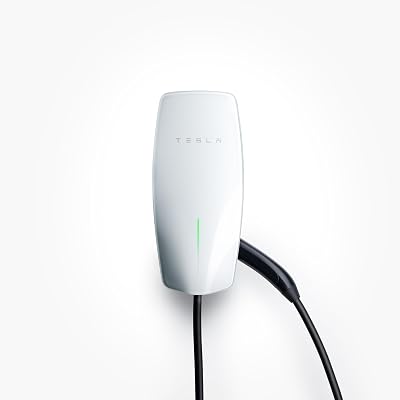
Tesla Universal Wall Connector
Best Universal — Built-In NACS + J1772 Connector for Any North American EV
* Amazon affiliate link — EV Charger Scout may earn a small commission at no extra cost to you.
BYD Blade: LFP done differently
BYD's Blade battery is the most widely deployed LFP design in the world, and it matters beyond BYD showrooms because the company also supplies cells to other automakers — including some Tesla Model Y production in Europe and Toyota's China-market bZ3. The Blade is a long, thin prismatic LFP cell arranged directly into the pack with no intermediate modules (cell-to-pack). That recovers much of the space that LFP's lower energy density would otherwise cost, which is how BYD gets competitive range from a chemistry that is heavier per kWh. BYD publicised the design with a nail-penetration test in which the cell neither caught fire nor exceeded a moderate surface temperature — a demonstration of the thermal tolerance that is LFP's other headline advantage.
For charging, a Blade-equipped car — a Dolphin, Atto 3, Seal, Sealion or Han — follows the LFP playbook exactly: routine 100% charging, a periodic full charge to keep the gauge honest, and extra attention to preconditioning before DC fast charging in cold weather. BYD's DC peak rates are modest by 2026 standards (roughly 150 kW on the Seal, less on smaller models), so on long trips it is the 10–80% window, not the peak number, that sets your stop time.
EV Interior Essentials · EV Shop

TrunkCratePro XL Collapsible Trunk Organizer
Best-Selling Trunk Organizer — Collapsible with Non-Slip Base
* Amazon affiliate link — EV Charger Scout may earn a small commission at no extra cost to you.
Which 2026 EVs use which chemistry
The list below is a guide to the common cases, not a complete catalogue — automakers change suppliers mid-cycle and often fit different chemistries to different trims of the same car. When it matters, confirm with the specification sheet for your exact build.
| Chemistry | Common 2026 examples |
|---|---|
| LFP | Tesla Model 3 RWD and many Model Y RWD builds; all BYD models (Blade); Ford Mustang Mach-E Standard Range; Rivian R1T/R1S Standard pack; MG4 standard-range; Citroën ë-C3 and other budget European EVs; the next-generation Chevrolet Bolt (announced with LFP) |
| NMC / NCA | Tesla Long Range and Performance trims, Model S, Model X, Cybertruck; Hyundai Ioniq 5/6/9 and Kia EV6/EV9; Porsche Taycan and Macan Electric; Lucid; Rivian Large and Max packs; Volkswagen ID.4/ID.7; Polestar and Volvo; BMW i4/i5/iX; Mercedes EQ models |
Does DC fast-charging advice change by chemistry?
Mostly no — and where it does, it is a matter of degree. The rules that protect a battery at a fast charger apply to every lithium-ion chemistry:
- →Precondition. Charging a cold cell at high current risks lithium plating, which is permanent. Every modern EV limits current on a cold pack to prevent it, which is why an unconditioned winter session can crawl.
- →Live in the 10–80% window on road trips. Charging power tapers hard above 80% on every chemistry; the last 20% typically takes as long as the previous 50%.
- →Don't make fast charging your default. Occasional fast charging is what the pack is designed for; a car that fast-charges almost exclusively, especially in heat, ages measurably faster than one charged mostly on Level 2.
The chemistry-specific nuances: LFP packs are more sensitive to cold, so preconditioning is more consequential for them and a winter session on an unwarmed LFP pack can be dramatically slower. LFP peak charging rates are generally lower than the best nickel-based packs — the fastest LFP cars in 2026 peak around 170 kW while leading NMC cars exceed 230 kW — so a 10–80% stop on an LFP car is usually a few minutes longer. And because an LFP car is permitted to charge to 100%, some owners assume they should do so at fast chargers; don't. The taper makes 80–100% painfully slow at a DC station regardless of chemistry, and the calibration charge is best done at home on Level 2 where the pack can also balance afterwards.
Not sure how your specific pack is holding up? The free Battery Health estimator adjusts its projection for LFP versus nickel-based chemistry, and the Real-World Range Estimator shows what today's temperature does to your usable range before you set off.
The short answer for each owner
Set the daily limit to 100%. Do a full charge at least once a week — every few days in winter — and let the car sit plugged in briefly after it reaches full. Precondition before every DC fast charge in cold weather. Don't store the car for weeks at 100% in the heat.
Set the daily limit to 80%, or 90% if you genuinely need it. Charge to 100% only when a long drive follows soon after, timed to finish near departure. Keep the pack cool and out of the 0–10% zone as a habit, and use Level 2 for most of your charging.
The one-line takeaway: the 80% rule was never about lithium-ion batteries in general — it was about nickel-based cells at high voltage. Know which cathode you have, and charge for that one.
Frequently Asked Questions
Can I charge an LFP battery to 100% every day?
Yes. Manufacturers that fit LFP packs — Tesla, BYD, Ford (Mustang Mach-E Standard Range) and others — permit routine 100% charging, and Tesla specifically asks LFP owners to keep the limit at 100% and fully charge at least once a week. The lower cell voltage of LFP makes a full charge gentler than it is for nickel-based cells, and the periodic full charge keeps the range estimate accurate.
What daily charge limit should I use for an NMC or NCA battery?
Around 80% for everyday driving, up to 90% if you need the extra range, and 100% only when a long trip starts soon after charging finishes. Nickel-based cells age faster the longer they sit at high state of charge, especially in warm weather.
How do I know whether my EV has an LFP or NMC battery?
Check the vehicle's specifications or the battery information screen. In a Tesla, open Controls, then Software, then Additional Vehicle Info — LFP cars show the battery type as Lithium Iron Phosphate. All BYD EVs use the LFP Blade battery. If the charging guidance in your owner's manual says to charge to 100% regularly, you almost certainly have LFP.
Why does my LFP car's range estimate jump around in winter?
LFP cells have an almost flat voltage curve across most of the charge range, so the car can't infer state of charge from voltage the way it can with NMC. It counts energy in and out instead, and that count drifts — more so in the cold, when the battery also delivers less usable energy. A full charge to 100% gives the system a known reference point and resets the drift, which is why the weekly full charge matters most in winter.
Does DC fast charging advice change between LFP and NMC?
The rules are the same — precondition the battery, charge in the 10–80% window on road trips, and don't rely on fast charging for every charge — but they matter more for LFP in the cold. LFP packs accept noticeably less charging power below freezing until they are warmed, so on a winter road trip preconditioning is the difference between a 25-minute stop and a 50-minute one.
More guides on Charging 101
Explore the full Charging 101 topic hub — related guides that build on this one.
How to Precondition Your EV Battery for Faster DC Charging (2026 Brand-by-Brand Guide)
13 min read
How Long Does It Take to Charge an EV in 2026? Real Times by Charger Type and Popular Models
12 min read
You Just Bought Your First EV – Now What? The Complete New Owner Guide & Checklist
13 min read
EV Charging Station Types Explained: Level 1, Level 2, and DC Fast Charging
8 min read
EV Battery Life in 2026: How Long It Really Lasts and 7 Proven Ways to Slow Degradation
14 min read
Tesla Charging in North America: The Owner's Guide to NACS, Adapters, and What's New in 2026
13 min read
2026 EV Connector Guide: Which Cars Use NACS, CCS, J1772, and More
10 min read
NACS vs. CCS Adapters: A Global Guide for EV Drivers
10 min read
Free EV tools
Put this guide to work — every tool is free and needs no account.
- EV Range LookupOfficial EPA, WLTP & CLTC range for 650+ models
- Real-World Range EstimatorRange adjusted for today's weather and your speed
- Home Charging Cost & PaybackMonthly bill and charger payback time
- EV vs Gas SavingsFuel savings over 1, 5 and 10 years
- EV Incentives by StateRebates and perks in all 50 states + DC
- Charging Network PricesCompare Supercharger, EA, EVgo and more
- Compare EV ModelsBattery, range and charging speed side by side
- Battery Health EstimatorProjected capacity at 100k and 200k miles
- VIN Decoder & RecallsNHTSA specs, recalls and investigations
- CO₂ Savings CalculatorEmissions avoided on your country's grid